UW professor: I-405 tolling data is misunderstood and misused
Feb 12, 2016, 11:16 PM | Updated: May 6, 2016, 11:17 pm
What keeps University of Washington Professor Mark Hallenbeck up late at night?
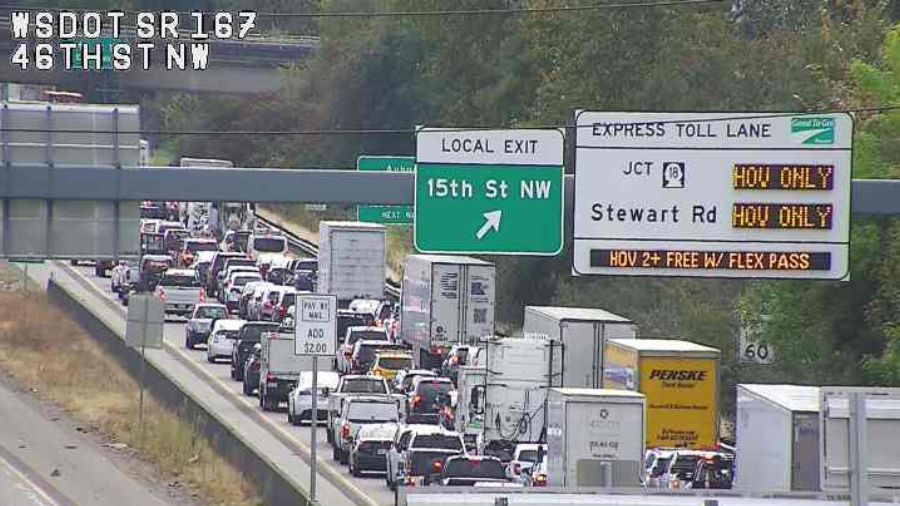
Data. Or more specifically, people misusing it. It’s an issue that has risen after express toll lanes were implemented on I-405. The Washington State Department of Transportation has reported traffic has gotten better, others have reported it has gotten worse. And drivers are reporting a range of experiences.
“The headlines and soundbites that come out of that (misused data) are harmful,” Hallenbeck said. “That’s what pisses me off and makes me stay up late at night and write rebuttals to reports.”
Related: WSDOT admits that drive times have gotten worse on parts of I-405
One report specifically was produced by Kirkland-based INRIX, which took data from I-405 before and after the express toll lanes were implemented. It concluded that traffic has gotten dramatically worse because of the new toll system. The report was picked up quickly around Puget Sound.
Hallenbeck, however, felt their data was limited – only looking at four days. He published a rebuttal to INRIX’s findings this week.
The INRIX analysis used data from a limited number of locations (four) and produced a biased review of the performance of the corridor. Given the data resources that INRIX has at its disposal, one must wonder why the paper does not present a full review of the performance of the corridor.
Hallenbeck is director of the Washington State Transportation Center at UW. Traffic and data is a big part of what they do. In fact, many of the data models that the Washington State Department of Transportation uses, as well as private data companies, were first created by his university department in the ’90s.
“So it’s personal for us when people misuse statistics,” Hallenbeck said.
Which is why Hallenbeck’s criticism doesn’t stop with INRIX. WSDOT also hasn’t presented a fair picture of what is happening on I-405, he said.
“The data itself is valid, but the statistics (WSDOT is) providing to the Legislature and the public, there’s nothing per say wrong with it, but it doesn’t do a good job of describing the variety of things that are happening out there,” he said, noting that WSDOT has largely reported averages. That’s a good number to know, but it doesn’t explain the big picture.
“If you take your left foot and stick it in a bucket of boiling water, and you take your right foot and stick it in a bucket of ice water, on average you feel pretty good. But in reality, the left foot burns like heck, and the right foot goes numb,” Hallenbeck said.
“The problem with INRIX is that they picked the boiling foot and said ‘everything is bad. Look at all this boiling water,'” he said.
What we talk about when we talk about I-405
Hallenbeck said, and he’s told the Legislature the same, that people shouldn’t look at partial pictures of I-405. The new express toll lanes have worked well for some, and they have not worked well for others. The problem with conversations around I-405 is that everyone is using data and experience and stretching that across the entire corridor – that’s not a rational approach.
“Both sides gave shorter versions of what’s happening than they probably should have,” he said. “The limited amount of information provided in both cases, certainly early, has not helped the situation. It has not given a full picture.”
Rather, drivers and WSDOT should be looking at the different groups of drivers and types of trips on I-405. Instead of starting over with the express toll lanes, find out where the problems are and fix them.
“The mean travel time got better in the peak periods southbound, it didn’t get any worse in the north bound, and the HOT lanes are better than the HOV lanes. Those statements are absolutely true,” Hallenbeck said. “What those numbers don’t say is that if you are coming from Lynnwood, it’s way worse until you get past 522, then it gets way better. So if you are getting off at Totem Lake, your life sucks.
“Maybe the right answer is not to turn the whole thing off, and go back to the lousy way it operated in 2014,” Hallenbeck said. “If you do that, the people whose lives got worse, yes, their lives will get better. But then you’re going to piss off all the other people whose lives did get better.”
Hallenbeck admits that such fixes take money, and that is a matter for WSDOT and legislators to figure out.
The I-405 corridor, however, did just take in far more money that ever expected – $3.7 million in three months. That money is legally only allowed to be used for I-405 projects.
One thing that Hallenbeck notes that many people are not talking about is that weekend travel times have “gone to heck in a hand basket.” That’s likely because people who used to be counted as a carpool aren’t counted as a carpool anymore. That’s one example of a fix that WSDOT could make, he said.