DOJ officially designates WA, Seattle as ‘sanctuary jurisdictions’
Aug 14, 2025, 11:35 AM
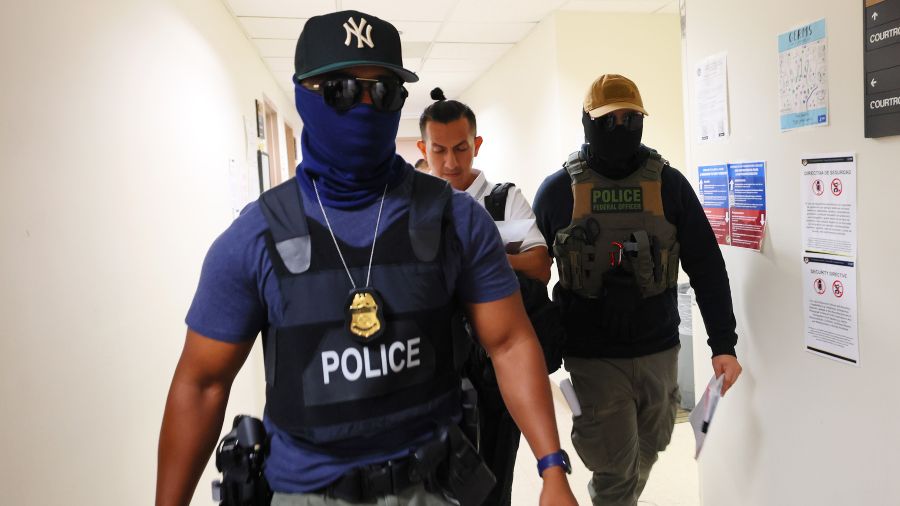
Federal agents detain a person exiting a court hearing at immigration court at the Jacob K. Javitz Federal Building on August 06, 2025 in New York City. (Photo: Michael M. Santiago, Getty Images)
(Photo: Michael M. Santiago, Getty Images)
The U.S. Department of Justice (DOJ) announced it has formally designated Washington as a “sanctuary jurisdiction,” claiming its state laws hinder federal immigration enforcement.
Washington is now among 13 states deemed a “sanctuary jurisdiction,” alongside California, Colorado, Connecticut, Delaware, the District of Columbia, Illinois, Minnesota, Nevada, New York, Oregon, Rhode Island, and Vermont.
The City of Seattle was also designated as a “sanctuary city.” Eighteen cities have received this designation.
“These designations were made after a thorough review of documented laws, ordinances, and executive directives by the listed jurisdictions,” the DOJ stated. “This initial list of designated Sanctuary Jurisdictions will be reviewed regularly, to include additional jurisdictions and remove jurisdictions that have remediated their policies, practices, and laws.”
If policies change, the DOJ revealed it can remove the designation, as the department will continuously review local and state laws, ordinances, and executive directives.
“Any sanctuary jurisdiction that continues to put illegal aliens ahead of American citizens can either come to the table or see us in court,” U.S. Attorney General Pam Bondi said in a statement.
The Justice Department said jurisdictions that remain on the list could face “additional consequences and further agency actions as permitted by law,” including potential funding impacts.
RELATED STORIES



What defines a ‘sanctuary jurisdiction’
The department outlined characteristics of sanctuary jurisdictions, which include:
- Declaring sanctuary status publicly.
- Restricting cooperation between local law enforcement and federal immigration authorities.
- Limiting the sharing of detainee immigration status information.
- Prohibiting the use of local funds to support federal immigration enforcement.
- Refusing to honor ICE detainer requests without a judge’s warrant.
- Limiting ICE access to jails without detainee consent.
- Operating immigrant affairs offices to advise undocumented residents.
- Providing access to benefit programs for undocumented immigrants, such as housing aid, legal services, or healthcare.
Contributing: KIRO 7
Follow @http://twitter.com/Mynorthwest