When a rip current sucks you out to sea, try not to panic
Jun 24, 2026, 4:02 AM
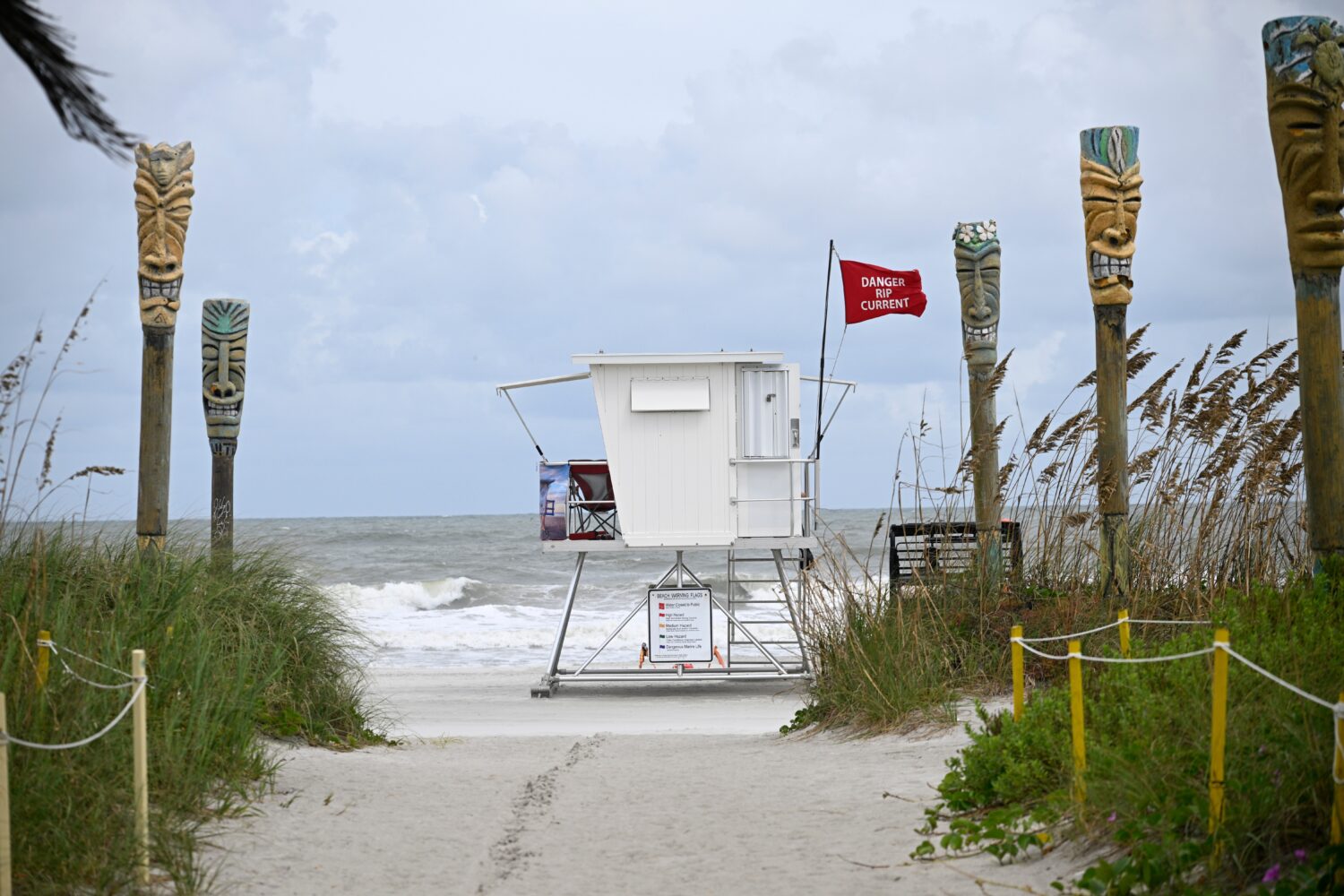
FILE - A "Danger Rip Current" flag flies as Tropical Storm Imelda passes offshore Sept. 29, 2025, in Cocoa Beach, Fla. (AP Photo/Phelan M. Ebenhack, File)
Credit: AP Photo/Phelan M. Ebenhack
(AP Photo/Phelan M. Ebenhack, File)

SAN DIEGO (AP) — To someone who is getting sucked out to sea by a rip current, “Don’t panic!” may be difficult to heed, even if that’s exactly what you should do. But lifeguards say to not only relax but flip over and float out of the danger.
Rip currents are one of the coast’s greatest dangers and account for the most beach rescues every year. About 100 people drown from rip currents along U.S. beaches each year, according to the United States Lifesaving Association. And more than 80% of beach rescues annually involve rip currents.
Already this year, there have been at least 21 people killed from rip currents in U.S. waters, according to the National Weather Service.
Here are some things to know about rip currents:
Rip currents are narrow columns of water flowing rapidly away from the beach. They don’t pull swimmers under water, but can carry them out a fair distance from shore.
“A rip current is like a river that pulls out to sea,” said San Diego Lifeguard Marine Safety Lt. Charlie Knight. “So when the waves come into the beach, it needs somewhere to go. And so it takes these little channels out that we call rip currents to put all that water back into the ocean.”
Low spots along the beach, or areas near jetties or piers, are often where rip currents form. They can be connected to stormy weather but also sometimes occur during sunny days. They can be hard to detect because the surface water often appears calm.
The current can flow as fast as 8 feet (3.2 meters) per second, faster than even a strong swimmer can overcome, according to the National Oceanic and Atmospheric Administration.
The most frequent advice from beach rescue teams and weather forecasters is to “’flip, float and follow.” Flipping over to float makes it easier to stay calm, conserves energy and keeps the airways open while the swimmer is in the rip current’s grip.
It’s nearly impossible to fight the current directly. Many swimmers who get in trouble tire themselves out trying to get back to the beach, lifeguards say.
“People tend to panic when they can’t get into the beach, and that’s when we have problems,” Knight said. “So if you are caught in a rip current, the biggest thing is don’t panic, stay calm, flip over onto your back, float and allow the rip current to take you out.”
Once the rip current dissipates, it might leave the swimmer out in deeper water. Lifeguards recommend raising an arm to signal for help.
Flags with different colors are used to warn beachgoers of various hazards.
Red means a high hazard, yellow means a moderate threat and green means low danger. There’s also purple for dangerous sea life, such as jellyfish, and double red when a beach is closed for any reason.
The National Weather Service posts rip current risks on its websites around the coasts and has developed a computer model that can predict when conditions exist that may lead to their formation up to six days in advance for the U.S. East and Gulf Coasts, Puerto Rico, Hawaii and Guam.
If possible, it’s best to swim near a lifeguard station.
It can be dangerous to try to rescue someone caught in a rip current, officials say. Often the people trying to perform the rescue can get into trouble themselves.
It’s best to find a lifeguard, if there is one, or call 911 if a struggling swimmer is spotted.
___
The Associated Press Health and Science Department receives support from the Howard Hughes Medical Institute’s Department of Science Education and the Robert Wood Johnson Foundation. The AP is solely responsible for all content.