Scientists work to identify cause of death for a whale at Commencement Bay
Aug 25, 2026, 7:15 AM
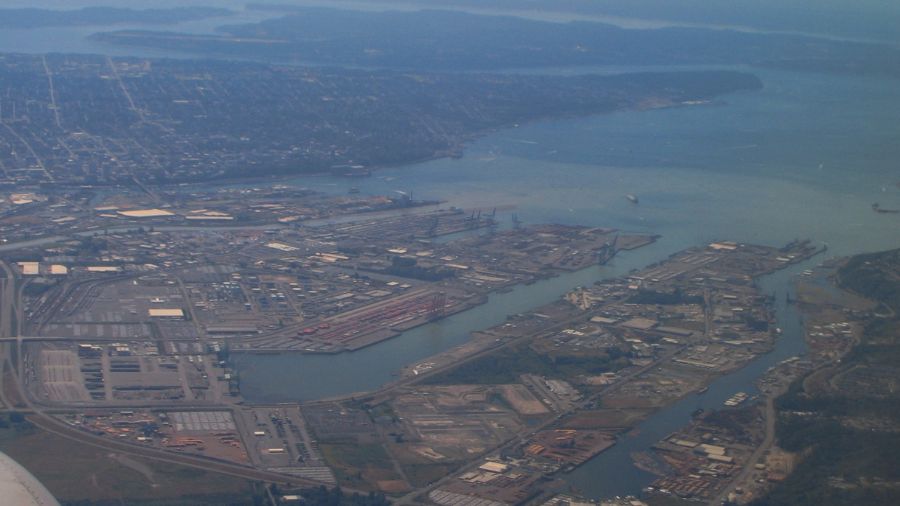
Aerial view of Commencement Bay. (Photo courtesy of KIRO 7)
(Photo courtesy of KIRO 7)
A dead whale was found decaying in Commencement Bay on Monday. Scientists are trying to figure out how it died.
So far, that’s unclear. But “The Northwest Seaport Alliance” said the whale was found on the bow of an Evergreen container ship.
It’s currently being kept in a secure location until the “State Department of Fish & Wildlife” can perform a necropsy.
They’ve been working with the “West Coast Marine Mammal Stranding Network” after learning of the whale around 5 a.m. Monday morning.
Along with how it died, one of the things experts will determine is how long it’s been dead. “The Northwest Seaport Alliance” said the ship that brought it in came all the way from China.
“Of 15 whale strandings in the Salish Sea, Washington part of the Salish Sea in the last five years, seven of those have shown signs of blunt force trauma consistent with vessel strikes,” John Calambokidis, founder of Cascadia Research, said.
NOAA said one ship reported the whale was already dead when they encountered it. The decay suggests it may have been decomposing for several days.
“Washington Fish & Wildlife” noted it’s about 60 to 70 feet long. Their team is analyzing it to determine if it was hemorrhaging, indicating whether it may have been alive if/when it was hit.
Meanwhile, scientists with “Cascadia Research” said early indications suggest it was a fin whale. Sightings of these animals are rare in the Sound.
“Either fin or sei whales, the two most likely species this could be, are generally distributed further offshore,” Calambokidis noted. “And, we don’t get either of those species commonly in inside waters.”
Calambokidis also said it’s unlikely Evergreen Shipping will face any repercussions.
“Generally, not. That decision is ultimately up to NOAA. That’s who’s responsible for enforcement of the Marine Mammal Protection Act,” the Cascadia Founder said. “But, generally in these cases of these large vessel strikes, these often occur without even the vessel’s knowledge.”
It’s still unclear if the whale was even killed by a ship. Scientists have scheduled a necropsy in the next day or two to try and get those questions answered.
“It’ll be important in the exam to confirm the suspected species … which was fin whale,” Calambokidis claimed. “Which I think can be done with a more accurate description and length that’ll be possible once the animal is examined.”
As for any advice for those enjoying the water?
“It’s just really important for people when they’re operating a higher-speed vessel, operating over 10 knots, let’s say … to be very aware,” Calambokidis answered. “Not just on the lookout for whales. But, if you see other boats, whale-watching boats in an area, that’s a strong hint there are whales in the area. And you should slow down.”