‘Not a problem that can be solved immediately’: Gov. Ferguson pledges to address ferry crew wage gaps
Oct 9, 2026, 5:30 PM | Updated: 6:41 pm
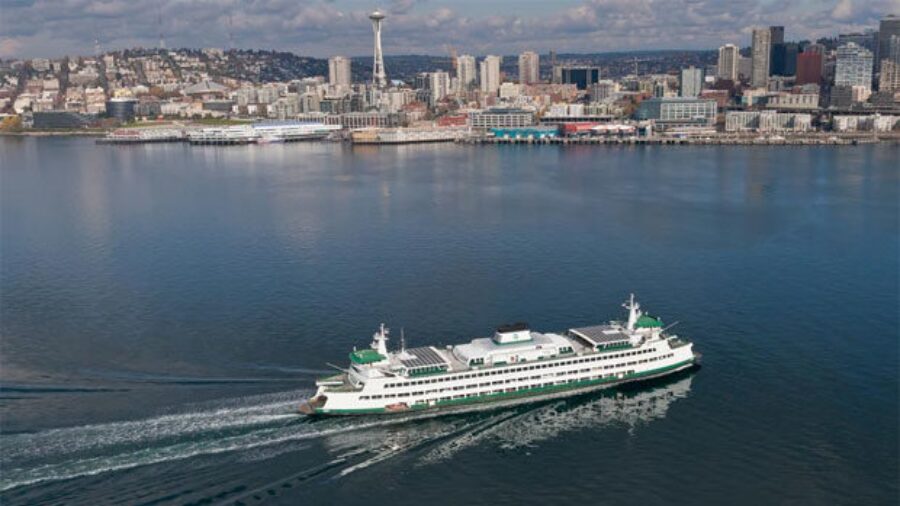
A ferry sails past Seattle. (Photo courtesy of WSDOT)
(Photo courtesy of WSDOT)
Washington Governor Bob Ferguson said he’s committed to working with the union representing Washington State Ferries engine-room crews on wage gap concerns, but warned in a letter, obtained by KIRO Newsradio, that budget challenges prevent an immediate solution.
Ferguson said he has directed a new salary survey to inform next summer’s negotiations. He also said maintaining a constructive partnership requires avoiding further service disruptions.
The Marine Engineers Beneficial Association (MEBA) represents 417 licensed and unlicensed engineers who operate, repair, and maintain the fleet of vessels at Washington State Ferries.
A growing workforce crisis boiled over Monday when crew call-outs resulted in major service disruptions.
Ferguson outlined his commitment in a letter to the union and thanked crew members for their professionalism and dedication to ferry-system safety, according to MEBA.
“I am committed to working with MEBA to address the structural wage gaps and pay disparities affecting engine room personnel to ensure that wages and fringe benefits are competitive consistent with legislative mandate,” Ferguson wrote. “Given the significant financial challenges we face in our near-term budget, this is not a problem that can be solved immediately. However, I am committed to the goal of correcting pay disparities between deck and engine.”
Union representative Eric Winge said there is renewed optimism.
“We are more hopeful that we can bargain together in good faith and have more fruitful negotiations,” he told KIRO Newsradio. “But more importantly, it’s the beginning of a good dialog, a good partnership.”
MEBA said competitive wages are key to keeping ferry service safe and reliable.
Winge said in the union’s news release that uncompetitive compensation and a widening pay gap between deck and engine-room workers are driving staffing problems. He said attracting and retaining experienced engineers will become even more important as Washington State Ferries transitions to hybrid-electric vessels.
Governor’s office says budget constraints limited wage negotiations
Ferguson’s office told KIRO Newsradio WSF and MEBA could not reach an agreement this year because of budget constraints. The negotiations went to a third-party arbitrator, who did not award raises. The office said none of the contracts it negotiated included across-the-board wage increases.
The governor’s office said Ferguson had been clear that salaries could not be addressed during the coming legislative session, though correcting wage disparities remains a priority.
The letter also set an expectation for continued ferry service.
“Going forward, in order to maintain a constructive partnership, it is imperative that there are no further service disruptions,” Ferguson wrote.
RELATED STORIES


Ferry worker describes long hours, pay gaps and staffing shortages
Nick Twietmeyer, an oiler aboard the M/V Spokane, said in the release that a shortage of relief workers puts additional pressure on crews when colleagues are sick or take time off.
“WSF engine crew already work 84 hours in a seven-day workweek, and because we don’t want to let down ferry-dependent communities, many engineers work an extra 500 to 1,500 hours of overtime a year,” Twietmeyer stated.
Twietmeyer said engine-room wages have fallen 20% below those of deck workers. He said he works a second job during his weeks off to make ends meet.
“I’m hopeful the state is serious about fixing this system,” he said. “That would be a win for WSF crew and, more importantly, the thousands of people and businesses in our communities who depend on ferries to get around.”
Ferguson’s office also pointed to improvements in ferry service. It said more than 7 million riders traveled on Washington State Ferries this summer, the highest summer ridership since 2019 and an increase of more than 600,000 riders compared with summer 2024.
According to the office, on-time performance improved from 71.6% in 2024 to 79.8% this summer. The system had 4,500 additional sailings compared with 2024 and completed 98% of sailings, up from 97.2%.
“While we have not solved every problem, our progress is undeniable,” the governor’s office stated.
Contributing: Julia Dallas, MyNorthwest
Follow James Lynch on X. Read more of his stories here. Submit news tips here.