Harger: Seattle tagger ‘Wesh’ got a sweetheart deal, mocked it, and told a judge graffiti isn’t a crime. He’s headed to jail today
Oct 14, 2026, 7:47 AM
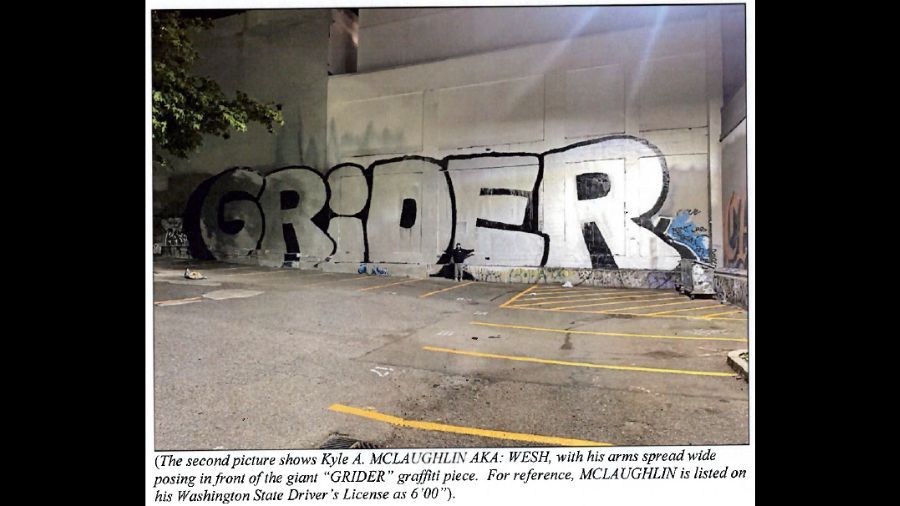
Evidence photo of Wesh and his graffiti tagging in Seattle. (Photo courtesy of King County Prosecutor's Office)
(Photo courtesy of King County Prosecutor's Office)
One of Seattle’s most prolific graffiti vandals was ordered to walk into the King County Jail by 5 p.m. Wednesday. He’s set to spend the next five months there.
He brought this on himself.
Let me introduce you to Kyle McLaughlin, aka “Wesh.”
If you’ve driven Interstate 5 through Seattle, you’ve seen his work. Two years ago, KIRO Newsradio’s Nate Connors and I counted 8,555 tags along I-5 inside city limits. Wesh was one of the names prosecutors later said drivers “might recognize from their daily commutes.” He did a bunch of those tags that paid tribute to a vandal known as “G-Ride.”
One evidence photo in his case shows him in Seattle at night, arms spread wide, posing in front of a giant graffiti piece. Investigators noted that, for scale, he’s 6 feet tall. Using him as a yardstick, the letters stand roughly 15 to 20 feet high, and the whole thing stretches about 80 feet, the length of two school buses parked end to end.
The judge in his case said the felony cases he settled involved tens of thousands of dollars in damage to public and private property. Easily. Likely a lot more.
McLaughlin is a longtime felon who was handed the kind of deal most people in his shoes never see. He spat on it. He mocked the prosecutors who gave it to him, the judge who signed off on it, and the city he spent years defacing. Then he sat in front of that judge, under oath, and insisted he’d done nothing wrong.
Wesh’s tags have victims, and they pay twice
Seattle’s graffiti ordinance gives property owners 10 days to remove graffiti from their buildings. Miss the deadline, and the owner faces fines and legal action. The vandal gets a can of paint. The victim gets a bill and a deadline.
So a small business owner pays to paint over the damage, and the tag comes back. And they pay again. “This is not victimless behavior,” Senior Deputy Prosecuting Attorney Gary Ernsdorff told me in a prior interview.
Seattle police and King County prosecutors gave Wesh a sweetheart deal
McLaughlin was one of 17 alleged taggers charged in King County’s largest graffiti crackdown in December 2024. Seattle Police Det. Robert Belshay spent more than a year investigating him. Prosecutors charged him in 10 felony cases.
His own words describe his record best. He told the judge he’s a “42-year-old 16-point felon” who had “spent most of my life in prison.” Washington’s felony scoring maxes out at nine. With a score like his, a felony conviction often leads to a trip back to prison.
In the plea deal, McLaughlin’s side told Ernsdorff he was done tagging and had changed. His sentencing memo promised he would keep his art to “art framed on walls, the murals in his own home, and permanent ink in the form of tattoos.”
Ernsdorff could have thrown the book at him. Instead, he gave him a chance at redemption. In February, McLaughlin pleaded guilty to one felony count of criminal sabotage and two misdemeanors. No prison. He got electronic home monitoring and served at his apartment in Honolulu. A year of jail time was suspended as long as he met the court’s conditions, including these three: pay restitution, put in 200 hours cleaning up graffiti, and commit no new crimes.
Ten felony cases. One felony conviction. Home monitoring in Hawaii.
Nobody wanted to lock him up and throw away the key. They wanted the damage paid for, some of it cleaned up, and the tagging to stop.
He kept tagging.
Wesh mocked his plea deal on Instagram
He was sentenced April 3. Det. Belshay kept an eye on him, and it didn’t take long to see Wesh was up to his old ways in his new state. Within weeks, his Instagram account posted a video. It opens on the view from his Honolulu apartment window, then pans to a close-up of the court-ordered ankle monitor. Then it follows him down the sidewalk, his dog following behind, as he sprays WESH on two walls. The hashtag: #housearrest.
Another post spelled out what he thought of the mercy he’d just been shown: “10 felonies including 2 burglaries. Knocked down to ‘criminal sabotage’ a felony that carries no time. Sentence 6 months house arrest in Hawaii … Go harder Seattle. Writing is NOT a crime.”
Taggers call themselves writers. From Honolulu, he was cheering on the people who deface our city.
So Belshay called around. A Honolulu police detective found both tags within walking distance of McLaughlin’s apartment. One building owner told Belshay the cleanup ran about $3,000. Parks workers scrubbed and pressure-washed the other wall, and the tag still showed through.
In King County Superior Court, Wesh said tagging isn’t a crime
A word of advice: If you ever find yourself in a courtroom and look over to see ol’ Gary Ernsdorff at the prosecutor’s table, you’re about to have a very bad day. He’s one of the most senior prosecutors in King County, and he doesn’t handle cases like this one unless somebody has seriously ticked him off. At a Sept. 30 hearing on the state’s request to jail McLaughlin, Ernsdorff argued the case himself.
McLaughlin testified from Honolulu over a Zoom connection so bad he called it “super crackly.” He couldn’t see the evidence Ernsdorff put up on the courtroom screen, and by the end, the judge gave up on Zoom and had his attorney call him on speakerphone. None of that slowed Ernsdorff down.
McLaughlin admitted he did the tags. He said he used water-based paint that would wash off in the rain. Then Ernsdorff asked whether it was a crime.
“No, I would not agree with that,” McLaughlin said.
Ernsdorff tried again: “I wasn’t asking if you thought it shouldn’t be a crime, but you know it is a crime, isn’t that correct?”
“No, not necessarily,” McLaughlin answered. “A lot of times I’ll do tags on people’s buildings and they’re super grateful, without permission.”
Super grateful. Ask the Honolulu building owner with the $3,000 bill. Ask the Seattle shop owner on a 10-day clock.
Ernsdorff wanted to settle whether McLaughlin was the tagger in a third video, so he asked the judge to order McLaughlin to show the tattoos on his right hand. She did. McLaughlin refused. “I’ve been advised by my attorney that we don’t have to do that,” he said, “but that’s not my hand.” The judge said she’d assume whatever was on that hand wouldn’t have helped him.
Then he played the victim.
“I’ve got the highest-paid detective and the head prosecutor coming and showing up to do this extensive investigation for misdemeanors,” he told the judge.
His attorney, Abigail Cromwell, made the strongest case she could. In nearly 20 years in that courthouse, she said, she’d never seen anyone get five months in jail on two misdemeanors. She argued he’d been overcharged and singled out for the sins of thousands of taggers. “In comparison,” she said, “this is paint.”
His sobriety deserves real credit. McLaughlin told the judge his past crimes grew out of drug addiction. He got clean in prison and stayed clean, and his attorney said he helps friends get sober too. “All of my friends are dying from fentanyl,” he told the court. He said the art world is “what’s keeping me off drugs.”
Staying clean while your friends are dying is hard, and he’s doing it. Nobody asked him to give up art to stay out of jail. The judge said she’d even suggested he do public art with the property owner’s consent. The deal left him every outlet he needed, except somebody else’s wall.
Those two misdemeanors were the gift. He was looking at 10 felony cases and a likely return to prison. The detective and the prosecutor were in that courtroom because McLaughlin filmed himself breaking the deal and posted it for them to find.
RELATED STORIES



Gary Ernsdorff and Judge Kristin Ballinger held the line
“I took in a lot of information from the defense, and I believed it, right?” Ernsdorff told the court.
Then he ran down the conditions. Restitution? Ernsdorff said he’d seen no evidence McLaughlin had paid any. His attorney said he’s making payments. The 200 hours of graffiti cleanup? No evidence of that either.
That one came with an explanation. McLaughlin, his attorney told the court, believed the 100 hours he’d spent on his own artwork counted as his community service. She said she had to set him straight. The court ordered him to clean up graffiti. Making more of his own art doesn’t count.
Ernsdorff closed the door.
“We gave him a chance, and he openly mocked us for that. It’s time for him to pay the piper.”
King County Superior Court Judge Kristin Ballinger could have gone light. The defense asked for two more months of home monitoring. She sided with the state.
“Water-based paint is paint,” she said. She called his conduct “behavior that is in defiance of the court’s order and makes a mockery of the sentence that the court imposed.”
Five months in the King County Jail. One more month stays suspended to make sure he finishes his 200 hours of cleanup. When McLaughlin asked for three weeks to report, so he could arrange care for his dog and sublet his apartment, she said no. She gave him two.
Ballinger deserves credit for seeing this one for what it was. So do Ernsdorff and Belshay. Accountability takes a fair offer, clear conditions, and real consequences when someone thumbs his nose at both. All three showed up in that courtroom.
Wesh’s five months, and the cleanup Seattle still needs
He hasn’t shown any remorse. Right to the end, he insisted it wasn’t a crime.
But hope springs eternal. The King County Jail has plenty of bare walls, and we trust he’ll leave them that way. He’ll have five months to think about it. When he gets out, those 200 hours of graffiti cleanup will still be waiting for him, and Seattle has saved him plenty of material.