King County graffiti defendant ordered to pay thousands in restitution
Nov 2, 2026, 4:00 PM
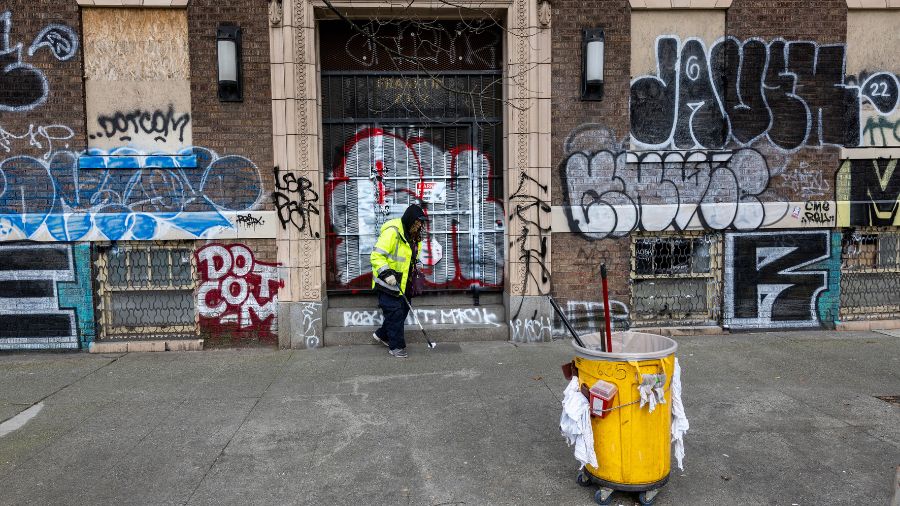
A city worker picks up trash next to graffiti on 4th Avenue. (Photo: John Moore, Getty Images)
(Photo: John Moore, Getty Images)

A defendant convicted of graffiti-related property damage and a firearms offense is in jail and has been ordered to pay $12,607 in restitution, according to Casey McNerthney of the King County Prosecutor’s Office.
Speaking on “Seattle’s Morning News,” McNerthney said the defendant was convicted of first- and second-degree malicious mischief, along with unlawful possession of a short-barreled firearm.
The restitution covers damage to a Capitol Hill property, a bus shelter in Pierce County, and Washington State Department of Transportation property. The transportation department’s property sustained more than $2,200 in damage, McNerthney said.
The defendant also must complete 100 hours of community service, with at least half devoted to graffiti abatement.
Court tracks restitution and sentencing conditions
Although the defendant’s jail term is only a few months, McNerthney said the financial obligation and other sentencing requirements remain important parts of the case. After leaving jail, the defendant will have time to work toward paying restitution, he said.
“The way that works is that’s court-ordered,” McNerthney said, explaining that defendants must check in with the court to demonstrate compliance with restitution and other conditions.
He pushed back on the idea that someone could avoid those obligations without consequences.
“The court keeps pretty good track of that,” he said, adding that a restitution lien can follow a defendant for a while.
The interview also revisited another graffiti defendant who returned to jail after failing to follow court-ordered conditions. McNerthney said both defendants are now incarcerated.
“Nobody really wins out of that,” he said. “But those are the repercussions of the behavior, and in particular, if you don’t follow court orders.”
McNerthney shared comments from Senior Deputy Prosecuting Attorney Gary Ernsdorff, who handled the cases, about how prosecutors monitor defendants after sentencing agreements.
“We are following through, Casey,” Ernsdorff said. “We’re keeping a close watch on these offenders that we have given these deals to, and that are out in the community.”
Ernsdorff said prosecutors would seek further court action if defendants resumed vandalism or violated their sentencing conditions.
“If they violate the terms of their sentence, we’re going to bring them back into court and ask the court to address them appropriately,” he said.
RELATED STORIES


More court appearances possible over alleged tagging
He also said he had identified two additional offenders whose police reports allege they continued tagging and vandalizing private property. Those allegations, he said, could lead to more court appearances.
“We intend to haul them back into court and see what a judge wants to do with them,” Ernsdorff said.
McNerthney recalled that the defendant who previously returned to jail complained he could not get away from a Seattle police detective and the prosecutor handling his case.
For McNerthney, that comment underscored the continued attention authorities are giving these cases, even after defendants receive sentencing agreements.
The discussion comes as graffiti remains visible along area roadways, including Interstate 5, an issue raised during the interview.
McNerthney’s message to defendants was straightforward: complying with court orders begins with ending the conduct that brought them into court.
“They’re pretty simple terms,” he said. “Just stop the behavior, and the problems will stop.”
Manda Factor is the host of “Seattle’s Morning News” on KIRO Newsradio. Follow Manda on X and email her here.