Chokepoints: WSDOT’s $5B fish passage problem and how we got here
Mar 11, 2025, 4:50 AM

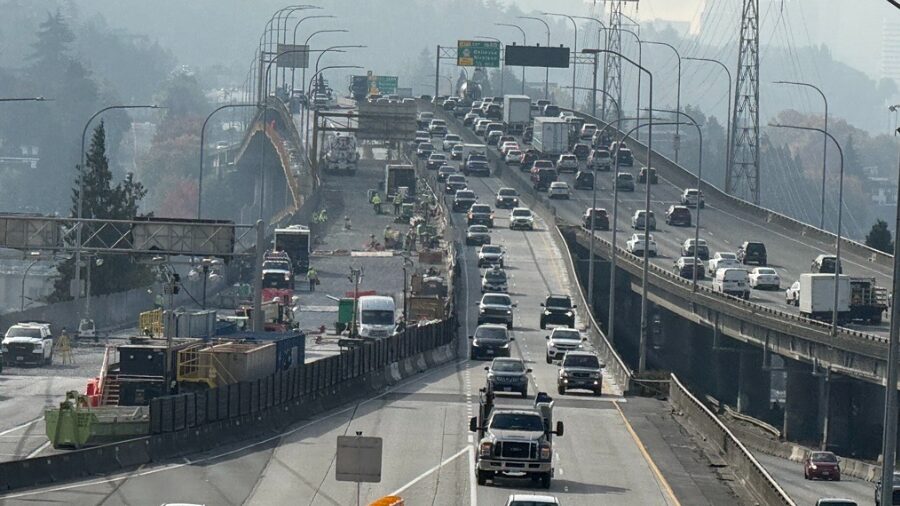
Inside the I-90 fish passage project. (Photo: Chris Sullivan, KIRO Newsradio)
(Photo: Chris Sullivan, KIRO Newsradio)
The state of Washington is spending billions of dollars and ripping up roads to restore fish habitat. Is it successful? How is success measured?
The state starting thinking about fish barriers in the 1990’s. No one really worried about fish habitat as the roads were being put down. In 2001, 21 local tribes sued the State of Washington to restore access. A federal court ruled in 2013 that the state must remove 90% of the barriers by 2030.
There are over 4,000 highway crossings on fish bearing waters in Washington. Over 2,000 are believed to be blocking historical fish habitat.
“The injunction is very specific to generally Western Washington, and there’s about 1000 barriers in that area that are subject to the injunction that we need to correct,” said Kim Rydholm, who is in charge of the fish passage program for the Washington Department of Transportation.
WSDOT really started ramping up its culvert replacement over the last ten years, and Rydholm said they’ve gotten a lot done. “As of June 2024, we’ve corrected 146 fish barriers that are subject to the injunction,” she said. We have about 350 remaining barriers to correct in order to get to that 90% of restorative access to habitat.”
Related from MyNorthwest: Chokepoints: Arlington fish passage to cause year-long I-5 delays
Fish passage opens up hundreds of miles of habitat
Removing those 146 barriers has opened up 571 miles of fish habitat.
I have reported on many of these fish passage projects. Many of the creeks or streams don’t seem like they would have many fish in them, so how does the state choose which ones to hit first?
Opening up the most potential fish habitat is the most important. “The injunction also requires that we correct barriers with the highest habitat gain earliest in the program, and it really is the right thing to do to get the most out of the investment, Rydholm said.
The second priority is fixing culverts that are damaged or in bad repair.
Is it working and how is success measured?
You would think that success would be the return of salmon and steelhead runs to every creek fixed. That isn’t how WSDOT measures the work.
“Really success to us is that the WSDOT fish barrier is corrected, and then it remains, fish passable,” Rydholm said. “We have anecdotal evidence of salmon returning to the site, but we’re really focused on the work that we’re doing to make the site fish passable.”
The price to fix less than half of the barriers under the federal injunction is already $4 billion. That was the original estimate for the entire process. Finishing the work is going to take a lot more. “We have identified that we need an additional about $5 billion in order to deliver our current delivery plan,” Rydholm said. “We still are very focused on our current plan. We are still doing as much of the work as we possibly can given the amount of funding that we have.”
More from MyNorthwest: Chokepoints: Answers to listener’s FAQs regarding I-5’s express lanes
Money could be found in this legislative process
How will the legislature find that money? Maybe we’ll get some answers this session, as the budgeting process is now underway.
The other issue is the state is getting less and less habitat as it moves down the barrier priority list. “As we get down the list, there is lower and lower habitat,” Rydholm said. “However, those streams are still valuable to salmon habitat and salmon migration. So while there is less and less habitat that we are getting as a result of removing our fish barriers, there’s still value in those streams.”
The state removed 32 barriers last year. The most in a single year so far. But it’s pretty clear that the state will not reach the 90% threshold by 2030, as the court injunction requires.
But there could be some wiggle room in that deadline. The tribes and the state recently went to federal court to request mediation in this case.
It’s too soon to speculate on what that might mean.
Check out more of Chris’ Chokepoints here. You can also follow Chris on X. Head here to follow KIRO Newsradio Traffic’s profile on X.
Follow @https://twitter.com/newsguysully