Feigenbaum, who is the lead author of the report, said the state’s biggest issue isn’t just road quality — it’s spending.
“Washington ranks dead last in three of the four spending categories,” Feigenbaum said. “When you have really high spending, and that’s not translating into a good system, that results in a poor ranking.”
Where Washington falls short
The report highlights several areas where Washington struggles, particularly in pavement quality and cost efficiency. The state ranks:
- 43rd in rural interstate pavement condition
- 44th in urban arterial pavement condition
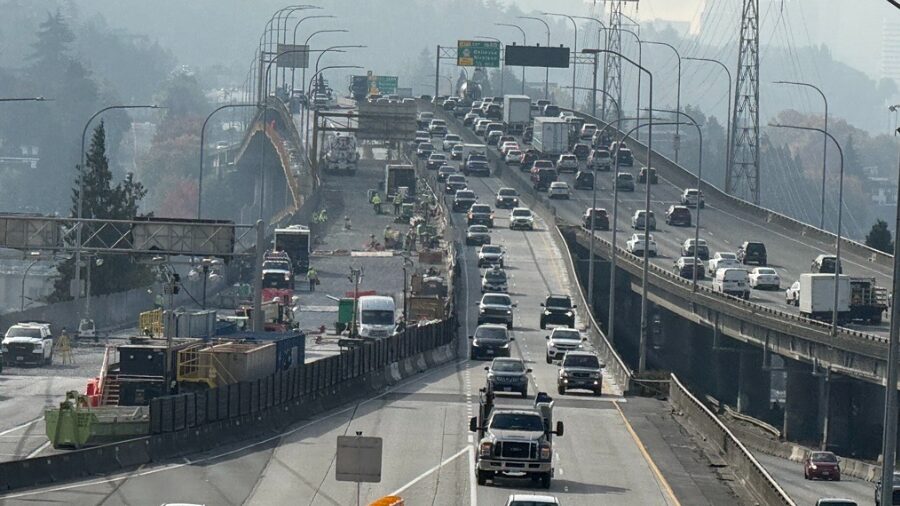
- 39th in traffic congestion, with drivers losing about 34 hours annually
- 34th in rural fatality rate and 31st in urban fatality rate
Spending metrics were even more concerning. Washington ranked:
- 50th in capital and bridge disbursements
- 50th in maintenance disbursements
- 39th in administrative spending
Despite the low overall ranking, Washington performs better in certain categories. The state ranks 23rd in structurally deficient bridges. There have also been modest improvements.
Compared to neighboring states, Washington’s performance is mixed. It ranks slightly better than California (49th) but trails behind Montana (22nd), Nevada (25th), Idaho (26th), and Oregon (33rd). Virginia was ranked first nationwide.
In a statement, Scott Thomsen, a spokesperson for the Washington State Department of Transportation, acknowledged the need for continued investment.
“We can’t comment on a study that we did not create. What we can say is that our state’s highways and bridges do need investment to preserve them for public use,” Thomsen said. “This is reflected in the state’s historic investment in its latest budget for Transportation, which Gov. Ferguson has described as an important down payment.”
Feigenbaum suggests that even incremental changes could make for meaningful improvements.
“Small improvements in spending efficiency or pavement condition can make a big difference in overall performance,” he said.
The report recommends that Washington adopt an analytic way to prioritize projects, with a focus on reducing costs while improving road conditions — steps that could deliver better value for taxpayers.