D-Day’s secret weapon was a weather forecast — and a new movie finally tells that story
May 30, 2026, 5:00 AM
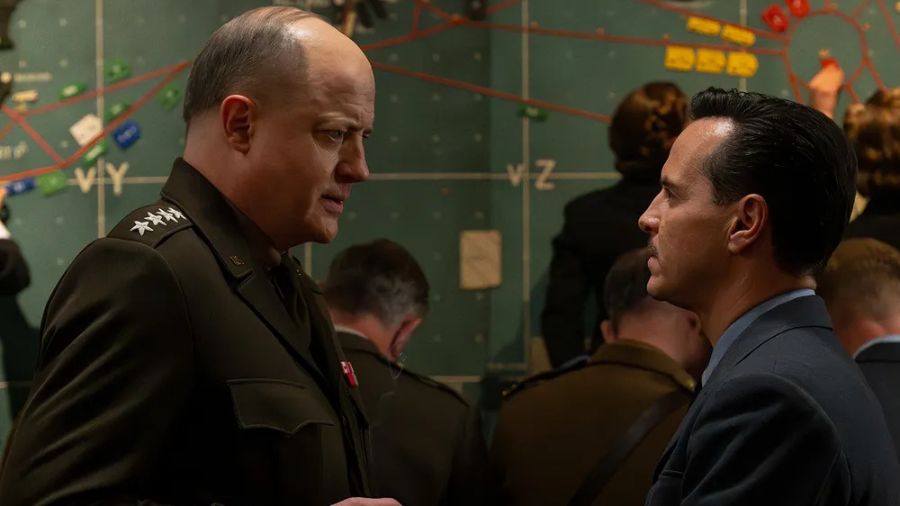
Promotional image from the film "Pressure," featuring Brendan Fraser and Andrew Scott. (Photo courtesy of Working Title Films)
(Photo courtesy of Working Title Films)
Many take today’s weather forecasts for granted. Forecast information is far better than it was decades ago, thanks to advanced technology such as high-speed computers, improved weather forecasting models, Doppler weather radar, next-generation weather satellites, and other tools to monitor and forecast weather to distribute to the public.
But would you trust your local weather forecaster with your life? That was the case with the decisions on when to commence the decisive invasion of Normandy on D-Day, June 6, 1944. The weather forecast had to be tied to low tides, light winds, and seas under a full moon. Only a few dates that month matched with the full moon and low tides. The surprise invasion could not afford a weather delay.
During World War II, the science of meteorology was emerging from its infancy. In that era, the resources available were limited to surface observations on land and weather balloon launches – both impossible in enemy territory. Weather observations from ships at sea were limited in number and scope.
Radar was invented just before the war began. Its early use included the day of the Pearl Harbor attack, when new operators were not sure what they were seeing from the newly deployed radar unit located on the west side of Oahu, when the first surge of Japanese attack planes approached the island.
Critical D-Day weather decision
To determine the exact date of when to launch the surprise D-Day invasion, imagine the pressure on meteorologist Royal Air Force Captain James Stagg. Captain Stagg was entrusted by Allied Supreme Commander General Dwight D. Eisenhower, who made the final decision to launch the invasion.
All the elements of low tides and ideal weather with clear skies and a full moon had to come together. A full moon and cloudless skies were needed for the planned air operations. At sea, low tide, calm seas, and light winds were required to more safely move invading troops onto the shorelines, and minimize the adverse impact of German beach obstacles.
Allied Advantage
Back then, meteorologists during the war had limited resources to use. But during the war, the Allies’ control of the North Atlantic gave meteorologists an edge in the region’s storm prediction.
Weather observations of what is currently happening and what has occurred in the recent past for weather trends were far more limited than they are today. Computers as we know them today had not been invented yet. In fact, the first computers used for weather forecast guidance were not developed until the 1950s.
Meteorologists in the war era used what is called the Norwegian cyclone model, originally developed during and after World War I. In layman’s terms, the cyclone model refers to what many learned in today’s middle school earth science classes about low-pressure systems and their associated cold, warm, and occluded fronts.
The use of weather balloons to collect data on winds aloft, temperature, moisture, and more began in the 1930s to better understand how the Jet Stream drives the storm track. Also used were weather charts showing similar past weather patterns.
Surface weather observations on land and at sea, plus weather-balloon upper-air observations, helped determine the current location, movement, and evolution of weather systems. This ability to track North Atlantic storms was a key element in helping predict the best date for the D-Day invasion.
Yet, Captain Stagg oversaw several teams of Allied multinational meteorologists with conflicting forecasting techniques and philosophies, adding to the already tense task of predicting the optimal time when weather and sea conditions would provide the mission’s best chance of success.
RELATED STORIES

Weather was decisive
General Eisenhower knew the weather would be critical in determining whether the invasion could be executed as planned. Any delays meant the massive troop buildup of over a quarter of a million in Great Britain could be detected by the enemy, significantly spoiling and endangering the invasion effort, leading to greater losses of allied troops and possibly losing the war.
‘Pressure’ – the movie
During the holiday weekend, I had the opportunity to pre-screen the movie “Pressure.” The film is based on the immense weight of choices made regarding the timing of the D-Day invasion, which were critically dependent on anticipated weather and sea conditions.
The film goes in-depth into the personal elements and tense drama of this historic seaborne invasion and was adapted from playwright David Haig’s 2014 play of the same name. The story takes place during the critical 72 hours leading up to D-Day and highlights an aspect of the invasion often overlooked by popular accounts. From General Eisenhower, “I need a forecast!!”
Oscar winner Brendan Fraser, Andrew Scott, Kerry Condon, Chris Messina, and Damian Lewis star. Andrew Scott’s performance is Oscar-nomination-worthy.
Over the more than 100-year history of movie-making, there have not been many films based primarily upon weather. Yet, there have been several significant weather-related movies such as “Twister” and its 2024 sequel, “Twisters,” “The Perfect Storm,” “Castaway,” and even “The Wizard of Oz.”
The movie “Pressure” joins this elite list of weather-related films. “Pressure” debuts this weekend in theaters nationwide.
Ted Buehner is the KIRO Newsradio meteorologist. Follow him on X and Bluesky. Read more of his stories here.