Why US health officials are ‘divided’ on need for COVID-19 booster shots
Sep 16, 2021, 12:13 PM
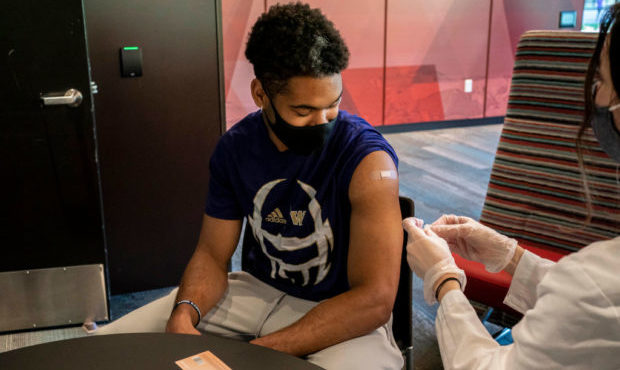
Julius Irvin, a student athlete on the football team, receives a COVID-19 vaccine at a vaccination clinic on the University of Washington campus in Seattle, Washington. (Photo by David Ryder/Getty Images)
(Photo by David Ryder/Getty Images)
The discussion on whether or not booster shots for the COVID-19 vaccine are needed in the United States is dividing even the experts.
The U.S. Food and Drug Administration’s vaccine advisory committee is supposed to meet Friday for a vote on if the FDA should approve a third dose. Two of the leaders in the FDA recently quit over this.
Seattle firefighter now supports vaccination after being hospitalized for COVID
KIRO Radio’s Gee & Ursula Show asked Dr. Angela Rasmussen, a virologist and weekly guest of the show, for her thoughts.
“This is a really complex topic, as you just pointed out,” Rasmussen replied. “And in fact, I’m as divided as all of my colleagues are, and I’m individually divided because I can see arguments for it and I can certainly see arguments against it, or at least arguments it’s not really needed right now for everybody.”
The arguments for it are that it’s possible that vaccine effectiveness has decreased a little bit, which has been indicated in data coming from other parts of the world and data regarding the delta variant. There’s two reasons, Dr. Rasmussen explains, why effectiveness may have decreased.
“One is that the delta variant is more transmissible and it can overcome some of the immune responses that the vaccine elicits, and we’ve certainly seen that,” she said. “And two is really that after a while, after you’ve been vaccinated, your immune system will go down to its sort of basal state. That doesn’t mean that you have no immune protection or that the vaccines don’t work anymore. But it can mean that there’s less robust immunity ready to go than closer to the time that you got the vaccine.”
“Now, we have a lot of other vaccines that often at this point will have a third and final dose — the Hepatitis B vaccine is a good example of this — that coming in about six months later with a third shot will really nail down those long-term protective immune responses,” she added. “That may explain why we have seen the vaccine effectiveness decrease a little bit.”
Dr. Rasmussen also noted that when she says “vaccine effectiveness,” she’s talking about the ability of the vaccine to protect against symptomatic COVID-19, not to protect against infection.
“That’s really what we’re seeing decrease,” she said. “The vaccines are still working very, very well in terms of being able to prevent severe disease and to prevent death from infection. But they do seem to be getting a little bit less effective at preventing symptomatic disease.”
That’s particularly a problem for older people or those who may already be at high-risk for COVID.
“We know that in older people in general, vaccines sometimes do not work as well as they do in younger people just because as the immune system ages, it doesn’t respond to stimuli the way that it did when you were younger,” Rasmussen said. “So if those older people are at higher risk for COVID and they get symptomatic disease that means that they are more likely to develop a severe outcome.”
For those people, Dr. Rasmussen does think it’s probably a good idea to have a third booster shot. She’s not convinced, however, that the booster shots are needed for everyone.
“As I said before, even though the rate of breakthrough infection has increased with delta, again, the vaccines are very much remaining protective against these severe outcomes,” she said. “So people who are not already high risk are going to remain at low risk even if they do get a breakthrough infection. And that’s the argument against it.”
King County nurse: Health care workers ‘feel left by the wayside’ with hospitals overwhelmed
Until there’s more data to support an increase in vaccine effectiveness, Dr. Rasmussen says it’s a bit of a waiting game.
“I can understand that uncertainty is really hard for people to grapple with,” she said. “And I’ve been seeing that people really misunderstand the way that science works because scientists are trained to deal with uncertainty. In many ways, science is all about trying to take things that are really uncertain and make them more certain, but that doesn’t just happen overnight.”
“Unfortunately we don’t have a magical machine of answers that we can just type stuff into and it pops out the correct answer,” she continued. “We have to collect data, we have to do experiments, and then we have to interpret that data. In the real world, that data is often conflicting. Often we’re not right in the guesses that we make, the hypotheses that we develop and then test. Those hypotheses fail and then we have to go back to square one and try to to reconstruct a new hypothesis that we can test in the hopes that it will work and will tell us something.”
That process, Rasmussen says, has to be transparent.
“I think that it’s really important for scientists to admit that they don’t know something and to explain to people what they are doing to try to find out the answer to that,” she said. “But [also] to be honest with people that sometimes there is no easy answer and it’s something that we’re uncertain about and here’s how you should respond to that uncertainty.”
A quick answer does not always exist, as much as we’d like it to.
“It really is a challenge trying to communicate these really, really complex topics in a quick sound bite, in a way that gives people confidence and that empowers them with that information to think about the problem for themselves,” she said.
Listen to the Gee and Ursula Show weekday mornings from 9 a.m. – 12 p.m. on KIRO Radio, 97.3 FM. Subscribe to the podcast here.