All Over The Map: The ‘monumental blunder’ of Camp Washington
Jan 10, 2020, 8:49 AM

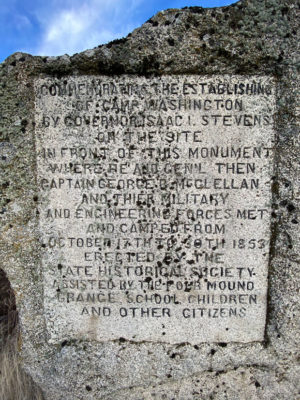
Isaac Stevens was a multitasker long before that word even existed. An old monument near Spokane honoring the first governor of Washington Territory is a reminder of the “two-fer” that Stevens pulled off more than 160 years ago. And the monument itself has a bit of a “two-fer” story, too.
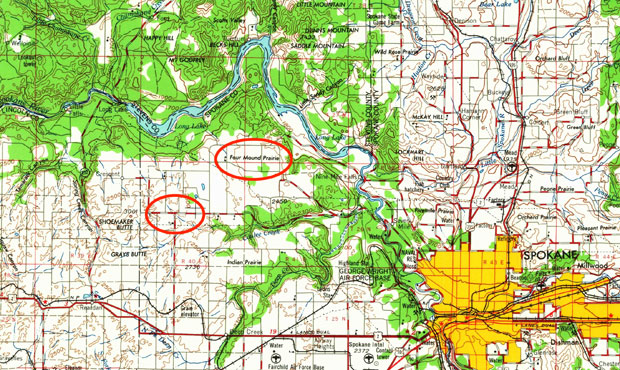
The monument commemorates Camp Washington, a place where Stevens and other members of the U.S. Army comprising a survey party roughed it for a week in October 1853. It’s located in Spokane County a few miles from the town of Reardon on the Coulee-Hite Road.
The desolate, rural spot is in the middle of an agricultural area, and is accessible from I-90 via State Route 902, the road that connects the freeway to the community of Medical Lake.
In the autumn of 1853, Stevens was on his way to Olympia from the east to assume the governorship of Washington Territory after having been appointed by President Franklin Pierce. As part of the journey west – which, in those days, would have been an accomplishment unto itself – Stevens had also convinced Secretary of War Jefferson Davis to allow him to lead a survey team to identify possible northern routes for a transcontinental railroad.
For a few days at the end of October 1853, Stevens spent some time at what the group called “Camp Washington” conferring with George McClellan. McClellan was leading a subgroup of Stevens’ main survey party, and he would ultimately fail in his mission to identify a route through the Cascades.
Later, General McClellan commanded the Union Army in the early years of the Civil War, then ran against Lincoln for the presidency in 1864. After the war, McClellan served as Governor of New Jersey.
In October 1908, the Washington State Historical Society dedicated a monument to Camp Washington. The simple stone weighs six tons, and measures 7 feet tall, 4 feet wide, and 2 feet thick.
At the dedication, Governor Albert Mead spoke, and one account says that 500 people were on hand, including Francis J.D. Wolff, who was one of the last living members of the Stevens surveying expedition. Wolff was in his late 70s, and in written remarks that were read aloud for him, he shared recollections, and thanked the government for his $8-a-month pension.
Also in attendance were 240 soldiers from Fort George Wright in Spokane, and dozens of students from five nearby schools who had been dismissed for the day. A choir of schoolchildren sang the Civil War-era song, “Tenting On the Old Camp Ground.”
Why was this campsite considered worthy of a monument?
In his three-volume history, “Spokane and the Inland Empire,” N.W. Durham quotes W.H. Gilstrap, who was lead staff for the Washington State Historical Society in the early 20th century:
I believe the people of Spokane County can justly make the claim that within their borders was consummated the organization of the new Commonwealth, and in a sense this historic site of Camp Washington was the first capital of the territory. For here Governor Stevens relinquished his duties as explorer and searcher out of routes for future railroads, and entered upon his duties under the president’s commission as governor.
Unfortunately, the monument was initially placed about six miles away from the actual site of Camp Washington. A relative of W.H. Gilstrap had unearthed a musket and sword on his property at Four Mound Prairie, and it was surmised that this was evidence of Camp Washington.
However, a few dogged researchers disagreed, and began publicly pushing to relocate the monument as early as 1918. But World War I got in the way, and the move was delayed.
A settler named Otto Woolweber of Crescent, Washington and a Washington State Historical Society board member from Spokane named W.D. Vincent were ultimately credited with, respectively, identifying the actual location of Camp Washington, and securing land nearby to relocate the monument.
Moving day came in November 1928. It appears as though there was not any kind of re-dedication ceremony, but The Spokesman-Review newspaper took note, with a story headlined “A monumental blunder is rectified.” See what they did there?
Circa 2020, a visit to the monument is certainly worth the detour from I-90 or the much closer US Highway 2. Be warned, however, that there is not much to see beyond the monument itself, though it’s sobering to imagine camping here in the 1850s. It’s also somewhat mind-blowing to think that when the monument was dedicated six miles away in 1908, the event being commemorated was only 55 years in the past.