Pacific Science Center floats replacing iconic pools with meadow
Feb 17, 2023, 9:27 AM | Updated: 9:42 am

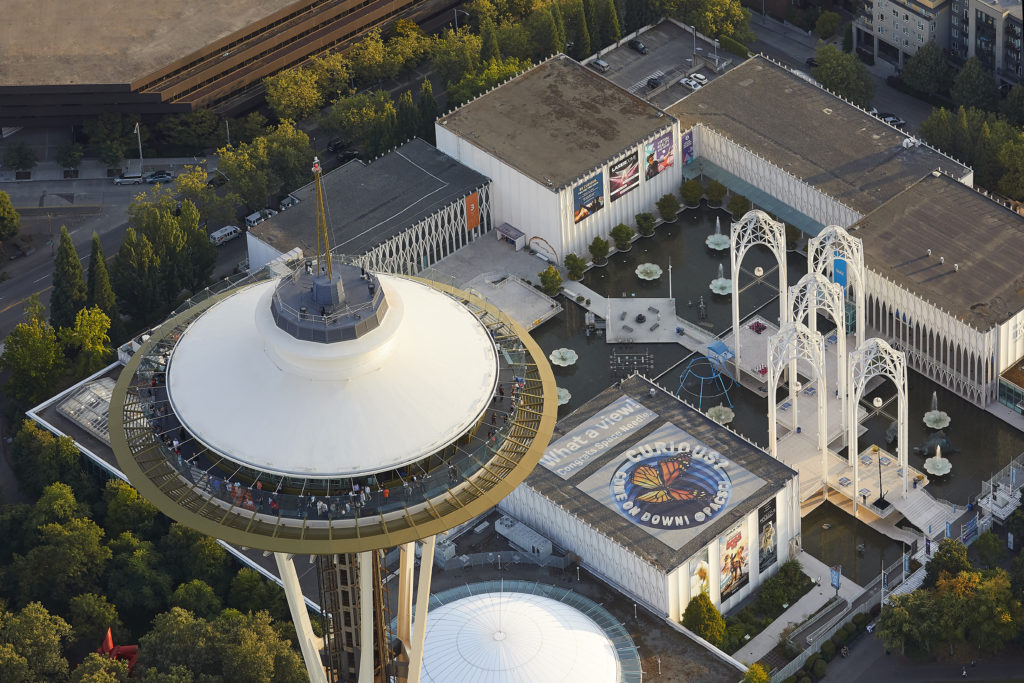
The Pacific Science Center is considering swapping out one of its iconic 1962 reflecting pools and replacing it with an ersatz meadow.
It’s fair to say that 99% of the people reading this story know exactly what someone means when they say (or write) “the reflecting pools at the Pacific Science Center.”
Along with the Space Needle and the Monorail and the International Fountain, and even the old Coliseum roofline at Climate Pledge Arena, those pools, and the arches over them, are among the most recognizable historical landmarks from the 1962 Seattle World’s Fair and from the past 60 years of Seattle Center’s existence.
While they are lovely and iconic and contain tens of thousands of gallons of history, it turns out those big pools are leaking precious water at an alarming rate.
As Crosscut previewed earlier this month, Pacific Science Center staff and consultants made a presentation to the Seattle Landmarks Preservation Board this past Wednesday, Feb. 15. The Pacific Science Center complex was designated a city landmark in 2010, and so that body must approve nearly all proposed changes to the appearance and layout of the facility.
KIRO Newsradio obtained a copy of the Zoom meeting from Landmarks Preservation Board staff. In the presentation, the PacSci team showed pictures of what they say are original pumps and plumbing for the pools and the fountains that go back to 1962 and which have never been replaced. They said the two pools – an upper pool on the north side of the courtyard and a lower pool on the south side – leak or evaporate an average of roughly 76,000 gallons of water a day, which adds up to 26 million gallons a year. They replace it all with tap water from Seattle Public Utilities for an annual cost of about $175,000.
Pacific Science Center CEO Will Daugherty told the Landmarks Board that fixing the leaks and upgrading the pumps – as well as doing some cosmetic restoration to the deck surrounding the pools – will cost an estimated $17 million.
Daugherty asserted that addressing this deferred maintenance and performing restoration of the second-most visible aspects (after the arches) of the historic landmark is not sexy enough for Science Center fundraising staff to be able to secure the funds required.
“It’d be really hard to raise $17 million to keep it as-is,” Daugherty told the Landmarks Preservation Board. “The public is telling us, the broader public is telling us, they want the Science Center to evolve. And where the investment comes from is in that evolution.”
“So the best way to get the ‘imperative work’ done may also be to embrace this ‘future-looking work,’” Daugherty continued.
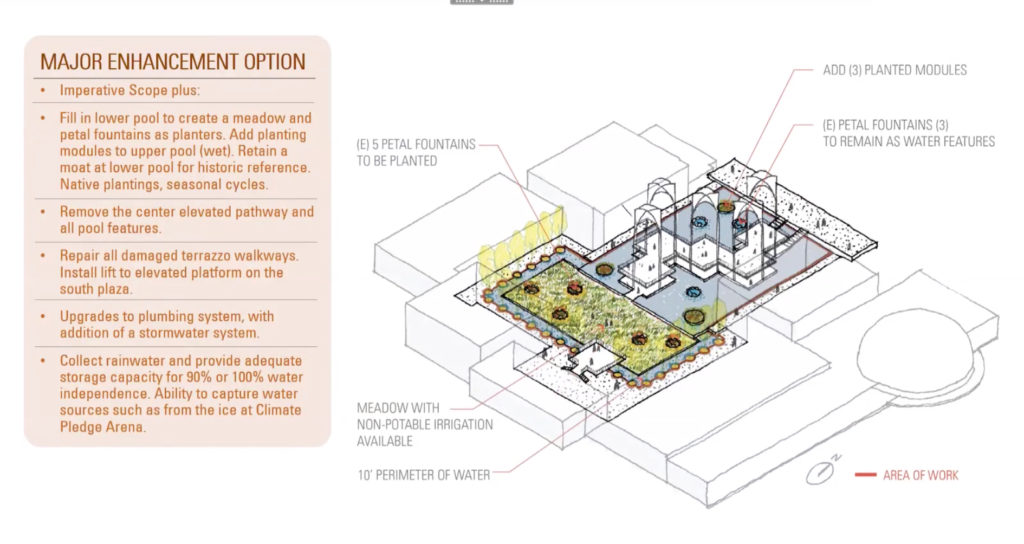
The “imperative work” (which Daugherty and the Science Center team during the meeting also called the “do-nothing option”) is actually a significant restoration of the landmark water features – stopping the leaks, restoring the terrazzo deck surfaces, upgrading the equipment, and increasing accessibility. The “future-looking work” means fixing the leaks and equipment but then pursuing three variations on filling in or partially filling the south pool with soil and native plants to create (in two of the options) an artificial meadow.
The meadow is the “evolution” to which Daugherty referred in his remarks to the board, though he didn’t cite specific research during the presentation.
Already, in advance of Wednesday’s meeting – thanks to a draft of the presentation which was in circulation beforehand – many in the historic preservation community were reacting with alarm at the notion of tinkering in any significant way with the pools.
Several historic preservation advocates submitted comments in advance, and some – including former Pacific Science Center CEO Bryce Seidl, longtime preservation advocate Michael Herschensohn, and Historic Seattle’s Eugenia Woo – also made comments during the meeting.
Objections boiled down to a handful of key points, including that the pools in the courtyard are part of the original design of what was called the “United States Science Pavilion” before and during the fair. The complex was built with $12 million in federal money, which had come at a key moment in the local planning for the event, and which gave a formal and informal boost to the fair’s prospects as a “happening” on a grand scale, worthy of national and international attention.
Thus, the U.S. Science Pavilion – and not the Space Needle – was essentially the heart, soul, and brains of the “Century 21” science-themed fair. Along with this history and context, nearly all those objecting to significant changes also pointed out that the structures, courtyard, pools, and even the planters and benches were designed by Seattle-born Japanese-American architect Minoru Yamasaki, who also designed the World Trade Center, among other notable buildings.
It’s also fair to say that those pools and the courtyard surrounding them are also one of the most – if not the most – elegant and distinctive public spaces in Seattle at any time in the city’s 171-year history. It’s almost impossible to name another place that even comes close.
Perhaps if the $17 million price tag were packaged more attractively – maybe call it “preserving a beloved and sacrosanct space for future generations” rather than the “do-nothing option” – it might be an easier sell to donors who support preserving rather than significantly altering Yamasaki’s designs.
Eugenia Woo of Historic Seattle told KIRO Newsradio that when the Pacific Science Center gave her an advance look at their plans in December, she was “shocked.”
Woo says Minoru Yamasaki is a nationally and internationally treasured architect, and his Seattle work is worthy of being preserved and maintained. Landmarks, by their nature, Woo says, are constantly aging and thus can be maintenance-intensive.
“They’re supposed to be good stewards of it,” Woo said of the Pacific Science Center’s role as inheritors of the U.S. Science Pavilion. “Over time, maintenance is really huge for stewarding historic properties. And so if you let something go, of course, it’s going to keep deteriorating.”
“I first connected with them probably about 12 or 13 years ago, and the issues about the pools came up then,” Woo continued. “And at the time, they did spend money to do some renovations. And, of course, you have to keep it up.”
But, says Woo, it’s worth it for designated landmarks.
“Would you change the reflecting pool on the National Mall in DC? No, I don’t think so,” Woo told KIRO Newsradio Thursday. “So why would you do that here?”
PLEASE SEE IMAGES IN THE THREAD!
In addressing deferred maintenance and aging issues for the historic 1962 Minoru Yamasaki-designed reflecting pools under the arches, I think @PacSci should:
— Feliks Banel (@FeliksBanel) February 17, 2023
A non-scientific (to put it mildly) Twitter poll posted by KIRO Newsradio Thursday night was showing roughly 70% support for restoring the pools. A Facebook post with details about the various options showed roughly the same results, with many people expressing support for the portion of the Science Center’s preliminary proposals, which include removing the dinosaurs and other objects now on display in the pools, as well as finding a way to capture rainwater for pool use rather than relying only on tap water.
This process of coming up with options for the pools has apparently been underway since last year. It’s unclear what comes next or when the Science Center will come back to the Landmarks Board with refinements to their proposals. Again, they will need that board’s approval before making any changes. Also, there will likely be additional opportunities for public comment.
KIRO Newsradio contacted the Pacific Science Center’s media relations staff via phone and multiple emails beginning Wednesday to learn more about the organization’s plans. As of early Friday, no one has responded.
You can hear Feliks every Wednesday and Friday morning on Seattle’s Morning News with Dave Ross and Colleen O’Brien, read more from him here, and subscribe to The Resident Historian Podcast here. If you have a story idea, please email Feliks here.