
It’s too early to call the Second Avenue bike lanes a success
Sep 17, 2014, 5:21 PM | Updated: Sep 18, 2014, 8:32 am
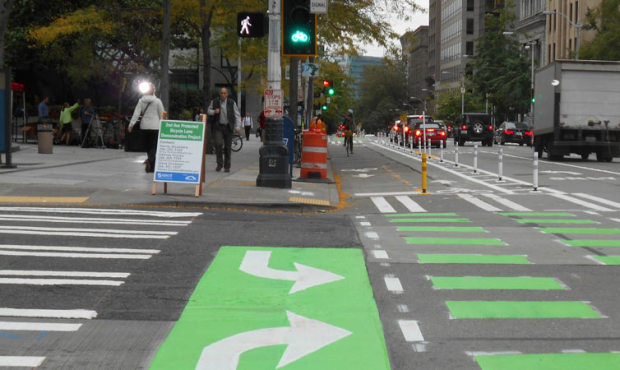
KIRO Radio's Jason Rantz says people declaring the new downtown bike lanes a success are speaking too soon. He says we can learn much more evaluating it over the long term. (SDOT)
(SDOT)
Taken from Wednesday’s edition of The Jason Rantz Show.
I’ve never been a fan of the East Coast mentality that tries to coexist on the West Coast. It always seem forced. They’re aggressive and blunt, we’re laid back and passive.
When Kathleen O’Toole became Chief of Police in Seattle, I wasn’t too excited. What does someone from Boston know about Seattle?
With one simple move, she’s made me a bit of a fan.
I know I’m the most anti-bike show in Seattle, at least according to The Stranger’s Dominic Holden. I guess it shouldn’t surprise anyone that (GASP) I think the police should enforce bicycle laws. I know that’s a controversial opinion if you’re a staff writer at the Stranger, or a bike activist, but for me it makes sense.
Now the Seattle Police Department will be doing just that, as reported by KING 5:
Throughout the video, you see bicyclists breaking the law. Yet, if you were to read some reporting on bicyclists, specifically on Second Avenue, you’d get the impression that bicyclists never do anything wrong, that it’s all cars.
For example, this is what Dominic Holden wrote Tuesday:
“The new cycle track is physically separated from traffic, includes lanes going in both directions, and features traffic signals indicating cars are prohibited from turning left when bicycles have the right-of way. Nonetheless, many drivers have disobeyed the rules-leading the city to install more signs that read, ‘No turn on red.'”
There’s this narrative that activists want to push that bicyclists are angelic and drivers are mean, irresponsible, dangerous and any successful bicycle plan is better for the city, which is why folks reported with glee that riding tripled on Second Avenue with the protected bike lanes in Seattle.
Again, according to Holden at the Stranger:
“The first three days after a protected bicycle lane opened on Second Avenue in downtown Seattle, the number of bicycles using the thoroughfare jumped to 1,099 cyclists a day, according electronic counters monitored by the Seattle Department of Transportation. That’s triple the previous daily average for cyclists on the street.”
This is an article based on a press release sent out by SDOT. This isn’t actual reporting, but a regurgitation of a press release.
Now, this ridership may sound good, but it’s not shocking at all. What’s not reported here is that SDOT said they’d see a big jump in the first few days because people want to try it out.
But it’s being shown as a huge success before it’s actually been proven successful. Part of its success will be dictated by whether or not people continue to use it in these numbers and if people are safe. Part of people being safe requires bicyclists to actually follow the traffic laws, which they’ve not consistently been doing.
Now, ultimately, I hope it’s successful. I hope it’s safe. I hope people use it. I hope more people take a bicycle to work. It’s in everyone’s best interest, especially drivers. The fewer cars on the road (if we assume bicyclists were using a car before), the better it is for traffic.
Bike all you want. Bike more. Everyone bike or take Metro or walk.
Now, that sure doesn’t sound like the stance of the most anti-bike show in Seattle.
People also wondered, myself included, if this would affect traffic times for cars, since we’re killing a lane that could have been used for car traffic on a very busy street for driving. It turns out it did, though not by much.
Holden writes: “City officials reported this afternoon that ‘travel times for drivers on Second Avenue have been better than originally forecasted.’ The first day the cycle track was open, September 8, ‘it took drivers approximately one minute longer to travel the 0.71 miles on Second Avenue than before the conversion.'”
So one minute isn’t that bad. But the city says it could get even better.
As the City of Seattle press release said: “With numerous events occurring that first week, to include opening day of the National Football League season at CenturyLink Field, engineers expect travel times to decrease further as drivers become accustomed to the new roadway configuration.”
So in other words, people getting to the Hawks game is a big reason why there was a minute increase in the drive time. But it turns out, for reporters like Chris Sullivan at MyNorthwest.com who didn’t just copy/paste a press release, there was a pretty big factual error here. Chris writes: “The the Seahawks home-opener was Thursday Sept. 4, four days before the protected bike lane opened.”
So why is all this important? Am I just picking on The Stranger because they’re picking on me? There’s a little of that, but this is important because when you anoint something a success, you tend to stop looking at it. You tend to stop investigating if it works, because well, why would you? It works. It was a success.
But how about we see long-term how many people ride this? If they do continue in big numbers and the traffic is hardly affected (or maybe even gets better), maybe we ought to invest more in those types of lanes. If traffic gets worse, and ridership is low, well maybe we should put the brakes on expanding too quickly elsewhere? These are all important questions to evaluate over the long term, so we can determine the real level value of these types of projects.
Taken from Wednesday’s edition of The Jason Rantz Show.

-
 Tune in to Seattle Red AM 770 weekdays at 3-7pm to The Jason Rantz Show.





