
‘Sound Transit is a disease’: Jake and Spike spar over whether the region’s massive transit investment is worth it
Aug 24, 2026, 4:30 PM

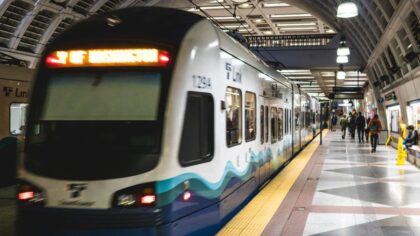
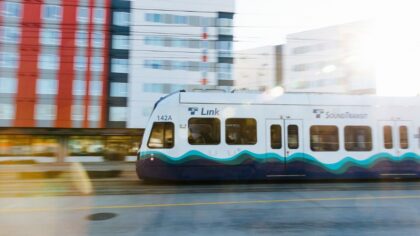
Transit ridership across the Puget Sound region is down 10.5% since 2015, even as the population has grown by 14% and transit funding has nearly doubled from $2.6 billion to $4.7 billion, according to a new analysis by Charles Prestrud, director of transportation policy at the Washington Policy Center.
The numbers set off a sharp exchange between Jake Skorheim and Spike O’Neill, co-hosts of “The Jake and Spike Show” on KIRO Newsradio, with Jake calling the system a failure and Spike arguing it’s a long-term bet the region has to stick with.
The analysis found that total boardings across Metro, Sound Transit, Community Transit, Pierce Transit, and Everett Transit dropped from 176.3 million in 2015 to 157.7 million in 2025. Even Sound Transit, which opened major light rail extensions during that period, reported a 9% decrease in passenger miles. Transit mode share now sits below 3% of all regional trips, with light rail carrying less than 1%, according to the Washington Policy Center.
Jake calls it a boondoggle. Spike calls it a long-term bet
Jake framed the investment as a financial disaster, noting that Sound Transit’s budget has ballooned from an original estimate of roughly $53 billion to more than $185 billion, while delivering less service than originally promised.
“Ninety-eight percent of regional trips are people who are just driving in their cars,” Jake said. “Two percent are on transit. Less than 1% is on light rail. That means 98% of people in the lower-income tax bracket are not using light rail. In fact, I bet you it’s actually fairly affluent, if I had to guess. There’s probably people living close to the downtown city core. They probably live in more expensive areas.”
Jake also highlighted what households are paying for the system: roughly $1,700 per household in Snohomish County, $2,300 in King County, plus a 1.4% sales tax on every purchase.
“From Coke to cars, a bottle of Coke to a brand-new car, you’re paying a 1.4% sales tax to Sound Transit every time you make a transaction,” Jake said.
“I want you to keep your money,” he added. “That’s what I want. I want you, who’s riding in your car, to not have to pay for this silly boondoggle.”
Spike acknowledged the numbers are bad but argued the investment has to be evaluated over decades, not years.
“Was it poorly conceived, or at least shortsightedly conceived? Probably,” he said. “Was it underbid and overpromised? Absolutely. Will the region continue to grow, and be a necessary part of our transportation collection? Absolutely.”
Jake wasn’t buying it.
“Then they’d be in no worse position than they are now, because nobody rides the train,” Jake said.
Jake reaches for an analogy. Spike regrets asking
As the conversation heated up, Jake searched for the right analogy to describe what Sound Transit is doing to the region’s transportation budget.
“Cancer. That’s what it is,” Jake said.
Spike wasn’t letting that one go unchallenged.
“No, cancer grows at a phenomenal rate. Sound Transit is decreasing,” Spike said.
“Cancer grows, and it consumes the host,” Jake responded.
“Sound Transit is the cure for cancer,” Spike pushed back.
“No, Sound Transit is absolutely a disease,” Jake said.
RELATED STORIES

Spike says changing commuting habits takes a generation
Spike argued that ridership numbers don’t tell the full story because the light rail system is still being built out, and changing how people commute takes time.
“Getting people to change their long-term commuting habits takes time,” Spike said. “Maybe even a generation of changing how people view light rail. When you’re planning a city’s long-term transportation needs, you have to make big bets. You have to think long-term.”
He also pointed out that much of the ridership decline in other agencies comes from bus routes that were eliminated or rerouted to feed light rail stations, meaning Sound Transit’s ridership gains are partly cannibalized from other services.
“Those numbers are an interesting amalgamation of bus routes that are no longer being used,” Spike said.
Jake agreed with the observation but drew a different conclusion.
“They’re cannibalizing themselves,” Jake said. “You’re still investing money in the old thing, and the new thing is doing horribly. The whole thing is kind of a fraud.”
Watch the full discussion in the video above.
Listen to “The Jake and Spike Show” weekdays from noon to 3 p.m. on KIRO Newsradio 97.3