Jake: ‘Operation Red Card’ is great police work — but why did it take until the World Cup?
Jul 22, 2026, 12:05 PM
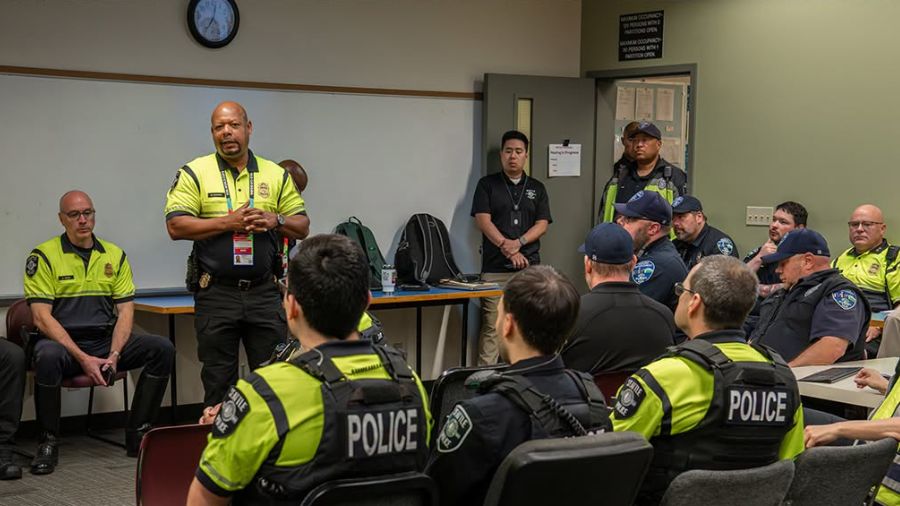
Seattle Police Department Chief Shon Barnes addresses a group of officers ahead of a World Cup security patrol. (Photo courtesy of Seattle Police Department)
(Photo courtesy of Seattle Police Department)
Buried in a recent Seattle Times report are details on “Operation Red Card,” a joint effort by local law enforcement and the FBI’s Seattle Field Office, and the numbers are genuinely impressive.
Working off a compiled list of repeat offenders, investigators conducted months of surveillance and evidence-gathering that led to 17 arrests. Ten of those arrested now face 21 felony charges from the King County Prosecuting Attorney’s Office. Two more were extradited to Colorado and California to face felony charges there.
Roughly 80% of the cases involved alleged gun crimes, with police recovering 12 firearms. Several of which had been illegally modified into fully automatic weapons. Separately, the DEA’s Seattle Division ran drug seizures during the tournament that netted almost three million lethal doses of fentanyl.
RELATED STORIES

The results are impressive, but the timing raises a bigger question
By any measure, that’s a remarkable haul. I’m genuinely glad law enforcement pulled this off, and I’m not here to knock them for it.
But I can’t shake one question: Would any of this have happened if the World Cup hadn’t come to Seattle?
Here’s what gives me a pause. This wasn’t a scramble. The list of repeat offenders already existed, and police knew who these people were. The operation kicked off back in April, months before a single match was played, as a deliberate, preventative move: Clear the streets so the city looks safe for an international audience and a wave of visiting tourists.
Which raises the obvious question — why does it take a global spotlight to unlock this level of coordination and follow-through? The offenders on that list didn’t become dangerous the week the tournament started. They were dangerous the whole time. So were the guns. So was the fentanyl.
I’d hope our safety doesn’t depend on who’s watching. The cameras are off now. Seattle stadium goes back to being Lumen Field. And I’d like to think local law enforcement will keep pushing this hard for the people who actually live here, not just the ones visiting for a few weeks in the summer.
I’d love to connect and hear your thoughts. Follow me on X and Instagram.
Listen to “The Jake and Spike Show” weekdays from noon to 3 p.m. on KIRO Newsradio 97.3 FM. Subscribe to the podcast here.