Young adults turn to Quakers’ silent worship to offset — and cope with — a noisy world
Oct 31, 2025, 5:37 AM | Updated: 6:28 am
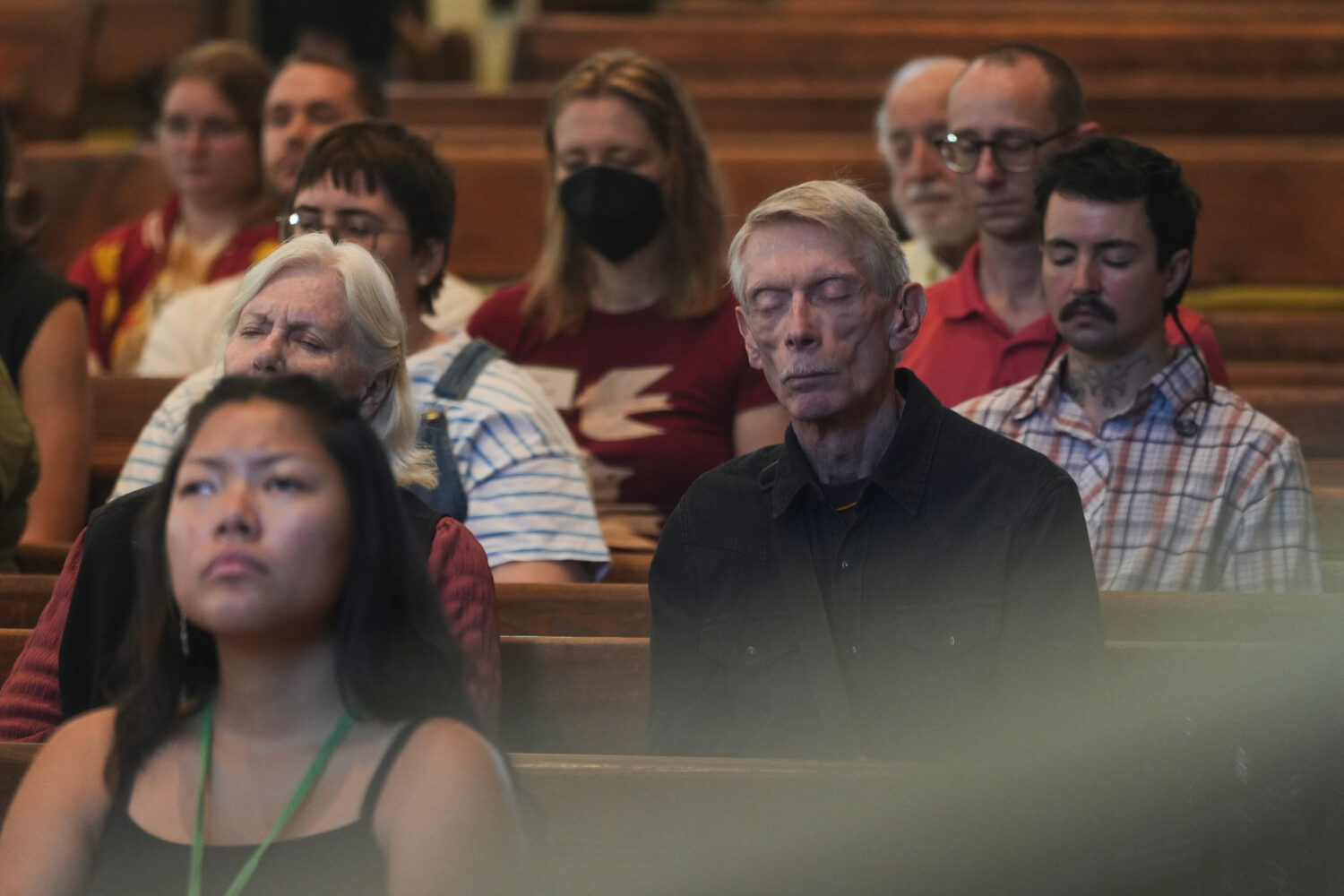
Quakers attend a Sunday worship in the historic West Room of the Arch Street Meeting House in Philadelphia on Oct. 5, 2025. (AP Photo/Luis Andres Henao)
Credit: ASSOCIATED PRESS
(AP Photo/Luis Andres Henao)

PHILADELPHIA (AP) — At the Arch Street Meeting House in Philadelphia’s Old City, more and more young people are seeking respite from a clamorous technological age in the silent worship of a centuries-old faith.
Like other Quaker houses of worship, it follows values of simplicity and equality. There’s no clergy, pulpit or altar. No statues of saints, no stained-glass windows. No one sings or chants, burns incense or lights candles. They simply sit in silence in 200-year-old wooden pews — and wait for a message from God to move through them until they speak.
“This feels different in that it’s so simple. It’s set up in a way that makes you feel like your internal world … is equally as important as the space that you’re in,” says Valerie Goodman, a pink-haired artist reading her Bible outside the meeting house on a recent Sunday before going inside. Goodman, 27, grew up Southern Baptist but left the evangelical church in college.
“It feels like I can have a minute to breathe. It’s different than having a moment of meditation in my apartment because there’s still all of the distractions around. … And it’s crazy being in a room full of other people that are all there to experience that themselves.”
It has been called the “Westminster Abbey of Quakerism.” Yet for years, attendance at Arch Street was so low, and its historic 300-seat West Room felt so empty, that the few people present began to meet in a smaller room. But recent years have produced an unprecedented surge in the number of attendees at Sunday worship — from about 25 before the coronavirus pandemic to up to 100 today.
“One of the things that I’m very excited about is the number of people that we have coming to meeting, and the fact that the majority of them are young,” says Hazele Goodrich, Arch Street’s clerk.
Among them: Emily Philbrook, 24, and Benjamin Barger, 27, who recently married at Arch Street in a traditional Quaker wedding. The couple moved from Washington to Philadelphia so he could attend veterinary school and began to worship at Arch Street three years ago.
He in a dark suit, she in a white wedding dress, they sat on chairs upfront facing hundreds of guests in wooden pews. Eyes shut, they held a long period of silence broken only when they stood to exchange their vows. Like other Quaker weddings, it was a self-uniting ceremony: They married each other, without an officiant. At the end, the guests lined up to sign, as witnesses, a marriage certificate.
Two days later, the couple returned to Arch Street for Sunday worship, wearing jeans, sneakers and Philadelphia Eagles T-shirts.
“It’s really nice to have that hour of silence when so much is going on in the world,” Barger says. “Kind of like stepping back into time a little bit in this building.”
It isn’t merely the silence. Philbrook says she values the faith’s long tradition of Quaker activism that she believes is attracting young people at a time of deep divisions and political violence in America.
Historically, Quakers have been involved in peaceful protests to end wars and slavery, and support women’s voting rights in line with their commitment to justice and peace. Earlier this year, Quakers marched from New York City to Washington to demonstrate against the Trump administration’s crackdown on immigrants.
“In times of national distress, people tend to turn towards something that is historically a peaceful and social justice-oriented faith,” Philbrook says. “They just want a place to sit and reflect and be in a like-minded community.”
William Penn, an English Quaker, who founded Pennsylvania following the faith’s emphasis on religious tolerance. It remains one of the world’s largest active meeting houses.
“It’s the most important building in the Quaker faith, probably because it is that sort of mecca of Quakerism,” says Sean Connolly, executive director of the Arch Street Meeting House Preservation Trust. “It was built to be the largest, grandest Quaker meeting house in the world.”
But not many knew about it. Tourists visiting Independence Hall and other historic Philadelphia attractions would walk into the meeting house’s brick building and were often surprised Quakers even existed, says Hazele Goodrich, a member of Arch Street for more than 25 years.
“They think, ’Oh, they must have all died out because probably they don’t hear too much about us,” says Goodrich, who is also the first Black clerk in Arch Street’s history. “They think of Quakers as a historic construct, something that used to be around.”
Others, she says, would confuse them with Amish or Mennonites or would invoke Quaker Oats, which is unrelated to the faith. The company describes the logo as “a figure of a man in ‘Quaker garb’” with white hair and a tall black hat on its label that the owners picked along with the Quaker name more than 150 years ago “as a symbol of good quality and honest value.”
“Quakers didn’t haggle,” Goodrich says. “Quakers were fair businesspeople. And they made good products — the benches are proof of it!”
Arch Street’s original wooden pews withstood the test of time. But how does a religion that offers the solace of quiet make itself known and compete against all the loud noise of the modern world?
Part of the challenge, Goodrich says, was that Quakers — those in the northeastern United States, at least — don’t proselytize. Arch Street, though, has more leeway because it’s a historic site with exterior exhibits that talk about the Quaker faith. That has helped increase visitation.
The museum run by Arch Street’s preservation trust has also held organized tours and virtual resources. One of them challenges visitors to test their knowledge of Quakerism with questions painted on a wooden panel. Among them: “Do Quakers quake?” “Do Quakers eat Quaker Oats?” and “Are Quakers still around today?”
The Religious Society of Friends — the Quakers — originated in 17th-century England. The Christian group was founded by George Fox, who objected to Anglican emphasis on ceremony. In the 1640s, he said he heard a voice that led him to develop a personal relationship with Christ, described as the Inner Light.
Fox taught that the Inner Light emancipates a person from adherence to any creed, ecclesiastical authority or ritual forms. Brought to court for opposing the established church, Fox tangled with a judge who derided him as a “quaker” in reference to his agitation over religious matters.
In the United States, Quakers became highly influential in cities like Philadelphia and founded colleges in Pennsylvania. But members of the group also faced scorn for refusing to join wars due to their belief in nonviolence. Some were persecuted and even executed for trying to spread their religious beliefs.
Today, there are an estimated 400,000 Quakers worldwide. About half live in Africa; most are in Kenya, where they use bands and choirs and evangelize.
Arch Street Quakers, though, want to remain traditional. But members credit its outreach clerk, Alec Unkovic, for raising awareness about the often-ignored contributions of Quakers by redesigning the congregation’s site and posting about events on social media.
“The stillness in meeting and the way of silence is atypical for our current moment,” says Unkovic, who grew up Catholic. “This meeting made a really conscious choice to acknowledge that many people were interested in this.”
On a recent Sunday, Aurora Reardanz sat with dozens of others at Arch Street. After worship, she shared that she had decided to become a full member.
Though she was baptized Catholic, Reardanz never practiced. Instead, she found her spiritual home in Quakerism and the faith’s values, known as SPICES — Simplicity, Peace, Integrity, Community, Equality, and Stewardship. Today, she also appreciates silence, calling it “beautiful and alluring.” But it wasn’t always that way.
“My first meeting for worship at 15, I thought I was in a cult. I was terrified. The silence was deafening,” she says. “And it’s something that grew on me, and I think it grows on a lot of people, and they learn to appreciate it in a world of constant noise.”
___
Associated Press religion coverage receives support through the AP’s collaboration with The Conversation US, with funding from Lilly Endowment Inc. The AP is solely responsible for this content.