State Hospital Association urges indoor masking as COVID hospitalizations rise
Jun 7, 2022, 6:00 AM | Updated: 11:49 am
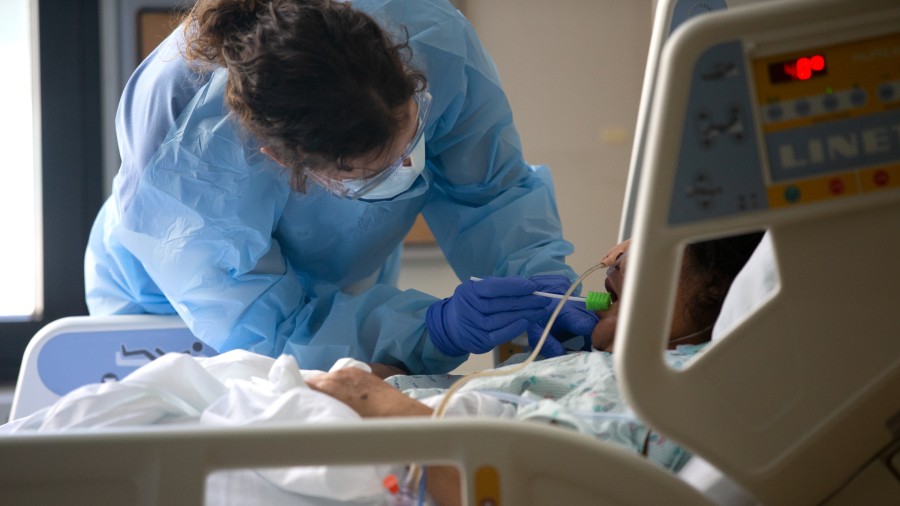
Nurse Karen Hayes uses an oral hygiene tool to administer care to a patient in the acute care COVID unit at Harborview Medical Center on May 7, 2020 in Seattle, Washington. (Photo by Karen Ducey/Getty Images)
(Photo by Karen Ducey/Getty Images)
State hospital leaders are alarmed at the recent rise in COVID hospitalizations.
Speaking at a media briefing on Monday, Washington State Hospital Association CEO Cassie Sauer said COVID hospitalizations had increased 10% in Washington in just the past week.
“[That] is a pretty big growth,” Sauer said.
It was the first time in three months the Washington State Hospital Association held a briefing, a sign of the virus numbers ramping back up. During previous COVID waves, briefings were held sometimes as frequently as once per week.
Washington’s COVID emergency order will not end yet, says Governor Inslee
“I’m sorry to say that we are back here today to talk to you about COVID,” Sauer began the briefing. “I’m sorry to say it because we really would like to not have to talk about COVID.”
Sauer said the end of last week reached nearly 600 COVID hospitalizations, with another 75 suspected cases. In comparison, she noted that April saw an average of 230 COVID hospitalizations on any given day.
“Right now, we’re in the ‘very concerned’ stage,” she said.
For this reason, the WSHA is asking people to wear masks indoors again. Sauer also encouraged people who suspect they have COVID to get a PCR test in addition to a home test because PCR tests are more accurate.
At this point, hospitalizations still remain far below the omicron wave over the winter and the delta wave last summer.
“The good news on COVID is that most people are not getting as sick from COVID as they were in the past,” Sauer said.
This is due to a variety of reasons, she noted.
“This variant [BA.2] seems to not make people quite as sick. We have a high vaccination rate — and vaccination definitely protects people from severe illness, hospitalization, and death,” she said. “And we have a better understanding of the disease and more effective treatments available.”
Currently, Washington is experiencing 0.6 deaths per 100,000 or 6-7 deaths per day across the state.
Still, hospital leaders are worried about medical facilities getting overwhelmed again, as in previous waves. For many hospitals, there is already not much of a buffer for a COVID increase.
“Right now, across the Puget Sound, we are running about 120% of our normal capacity,” said Dr. David Carlson, chief physician officer for MultiCare. “And yet only a fraction of that is due to COVID.”
Some of those patients are people who delayed routine care during the pandemic and are now discovering problems at more serious stages.
Other patients are ready to be discharged to a long-term care facility, but remain in hospitals taking up beds because they cannot get a place.
“By and away, the number-one issue facing our health care system now remains the inability of our patients to be able to transition to that post-acute care setting, such as a skilled nursing facility or nursing home,” said Dr. Stephen Mitchell, medical director of Harborview’s Emergency Department.
Some people are not able to get into nursing homes because those facilities are understaffed. Others are held up by legal red tape, an ongoing issue in Washington.
“If you don’t have Power of Attorney, but you have a spouse or adult child with you in the hospital, by virtue of being next of kin in the state statute, they can make major, major decisions for you,” Sauer said. “They can consent to massive surgery, they can withdraw life support treatment … but for some reason, our state has decided they cannot consent to move [you] to a nursing home, and that a court-appointed guardian must be named. We believe we are the only state in the country that has this interpretation.”
The Legislature state set aside money this past session to speed up the paperwork process, but did not change the guardianship law.
Follow Nicole Jennings on Twitter or email her here.