Seattle was conceived in Eastern Oregon, thanks to this mystery man
Aug 29, 2018, 9:18 AM | Updated: 10:27 am

It was late August back in 1851 when the Denny Party, the eventual founders of Seattle, arrived in Portland, Oregon. But they didn’t stay in Portland long, because of what they had heard from a “mystery man” who had crossed their path in eastern Oregon.
Arthur Denny was the leader of the Denny Party, a group of settlers who left Illinois and headed for the Willamette Valley in 1851. They ultimately settled on Native land off Puget Sound, and founded the City of Seattle, instead of sticking around in Oregon.
Along the Oregon Trail, Arthur Denny met a man named Brock — no first name given — at a place called Burnt River. This is close to what’s now Huntington, Oregon, along the Snake River. It’s not far from the Idaho border, and is about 85 miles from Boise.
RELATED: Without Captain Cook, we might all be speaking Russian
What we know from Arthur Denny about Brock (from Denny’s memoir) is that Brock lived in Oregon City, south of Portland. Brock was at Burnt River in the summer of 1851 expecting to meet friends coming from the east. The friends didn’t arrive, so Brock ended up traveling west with the Dennys, from Burnt River a few hundred miles along the Oregon Trail to The Dalles.
Somewhere along the way, Brock told Arthur Denny that all the desirable land in the Willamette Valley had already been claimed by settlers. But, he also said, there was plenty of good land still available around Puget Sound.
From The Dalles, the women and children and a few of the men floated the rest of the way to Portland by boat, while
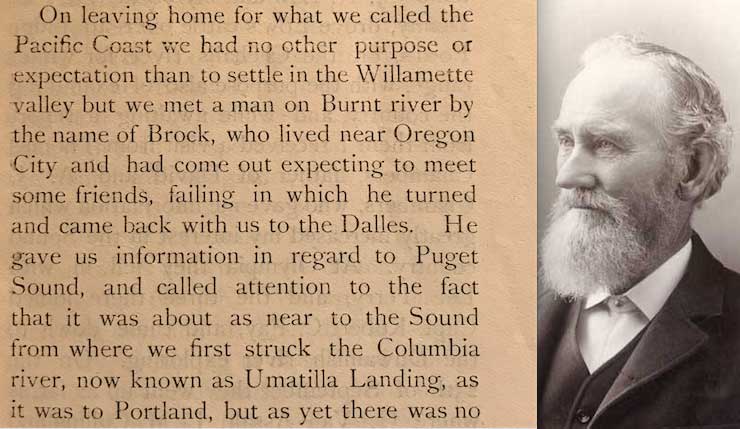
Seattle founder Arthur Denny described a mystery man named “Brock” who suggested the group settle near Puget Sound, rather than in Oregon as intended. (MOHAI)
the other men in the party drove the wagons and livestock to the city via the Barlow Road.
In September 1851, Arthur Denny, lay sick in bed in Portland. He recalled what Brock had told him, and he sent brother David Denny north in search of suitable land, and the rest is history.
Mystery man
For about 150 years, this was pretty much all anyone knew about Brock. He was a man of mystery, an Oregon Trail archetype, a Pacific Northwest enigma, as well as the occasional subject of speculation by newspaper columnists (including John Hinterberger of The Seattle Times).
But, with some expert help from a handful of local historians, and a little digging in the archives, it turns out that much has already been discovered about Brock, and few more dots were connected this week.
Amy Platt works for the Oregon Historical Society, researching, writing, and editing the online resource called the Oregon Encyclopedia. Apart from trying to identify who Brock was, Amy Platt also wondered about his motivations.
“Why is he telling the Dennys to go north?” Platt asked. “I, at first, thought he was being kind of sneaky about it, ‘There’s no land in Oregon, you don’t want to go there.’ But by [1851], most of the Upper Willamette was settled and the land was claimed. There was quite a bit of land south still available, but he might not have known that.”
Amy Platt wasn’t able to determine Brock’s motivations, but she’s a talented researcher, and right away, she tracked down two potential Brocks, who both happened to be named George. One was from Kentucky, and one was from Ohio.
Then, Platt found that historian Coll Thrush had, in fact, already identified “George Brock” and mentioned him by his full name in a book called “Native Seattle,” which was published by University of Washington Press back in 2005.
Coll Thrush grew up in Auburn, and he’s now a history professor at the University of British Columbia in Vancouver.
For Professor Thrush, there was no “aha moment” when he first identified George Brock back in the 1990s, as he was doing research that would later inform “Native Seattle.” He can’t even recall exactly how he came across the evidence: microfilm of a tiny scrap of newspaper with an undated obituary for George Brock, pasted in a scrapbook at the Oregon Historical Society in Portland.
In some ways, it seems as if the specifics of who Brock was don’t even matter that much. Whatever his name or background, he’s enough of an archetype of the Oregon Trail — an American of European descent — that perhaps little is to be gained from investing too much in the way of time and resources to try to identify him.
But then again, there’s something tantalizing about specificity, especially for what is such a pivotal moment in Seattle history. Does Professor Thrush think it’s silly to even wonder who Brock really was? Yes and no, he says.
“The Denny Party and the other people who came in those early years are part of much broader waves of migration and immigration, so a single figure like that doesn’t matter so much,” Thrush said. “I think it tells us more about ourselves and our interest in finding that single moment where everything changes. And as a historian, I struggle with that in my own writing, too, where I’m always looking for those moments when things could’ve gone differently.”
“But it’s important that we think about the bigger stories, and not get too caught up in which George it was,” he said.
Thrush’s research has often focused on the Native Americans who were here long before Denny or Brock.
Finding George Brock
But we know that others have wondered about Brock, and it turns out that Oregon historian John Engeman also identified George Brock. This happened around 2000, at the behest of then MOHAI historian Lorraine McConaghy.
Neither Engeman nor McConaghy can narrow the date of this discovery. Engeman says that, as it was for Thrush, there was no “Eureka!” moment when he found George Brock, that it was “just another day at the archives.”
Meanwhile, back at the Oregon Historical Society, Amy Platt says she is 70 percent sure that Thrush and Engeman were right: George Brock from Ohio is our mystery man, the mystical midwife of metropolitan Seattle.
So, what do we know about him, exactly?
George Brock was born in 1814 in Belmont County, in eastern Ohio and came to the Oregon Country in 1843, which was the first really big year of migration on the Oregon Trail.
George Brock married a woman named Eunice Davis in 1857; he was in his early 40s, she was 17 or 18. They had two sons and a daughter, and eventually owned many acres of agricultural property in Forest Grove, west of Portland off of Highway 26.
George Brock lived to be 80 years old and died in 1894. He’s buried in Forest Grove, Oregon.
Somewhere along the line, George Brock and his wife Eunice divorced. She married Newton J. Walker in 1884 or 1885 and they operated a hotel in Gaston, Oregon, south of Forest Grove. Eunice Davis Walker died in 1928 and is buried in Forest Grove a few feet away from her first husband, George Brock.
One thing that’s not clear is if Arthur Denny and George Brock ever met again once they’d parted ways at The Dalles. From the tone of Denny’s memoir, written in the 1880s, this seems unlikely. Arthur Denny died in 1899 at age 76.
A monument to Arthur Denny and George Brock?
Nearly 170 years later, do people in Huntington, Oregon, the community nearest to the spot where Arthur Denny and George Brock first met, know about their town’s proximity to this pivotal moment in Northwest history?
A phone call to Huntington City Hall rang directly to Mayor Candy Howland. She’s in her sixties, and grew up not too far away in Boise, Idaho.
“I’ve been here for 35 years and I’ve never heard that story,” Mayor Howland said.
But, Mayor Howland said, even though the city of Huntington didn’t yet exist in 1851, there’s a place a few miles outside of town called Farewell Bend that she theorizes might be just the spot where history was made 167 years ago.
“The Snake River runs through there, and that is where all of the people that came from the east going west (on the Oregon Trail) stopped … it was like a trading post,” Mayor Howland said.
“Some of them would cross the Snake River at Olds Ferry, and go into (the) Idaho side, some would go on into Willamette Valley, and some would go out toward (the) Bend area. This is kind of where everybody kind of broke up, depending on what direction they went,” she said.
“The reason it’s called Farewell Bend,” the mayor added, “is because that’s where everybody said ‘farewell’ to everybody.”
One other version of the origin of Farewell Bend name is because this is where Oregon Trail travelers said “farewell” to the plentiful water supply of the Snake River before heading up and over the hills.
Modern Huntington
Much has changed since 1851 in the area that’s now called Huntington. The Burnt River still runs north of town, but the Old Oregon Trail was supplanted by old US Highway 30, which is now the main street through town. Then, Interstate 84 bypassed that stretch of US 30 – and Huntington – years ago, though the freeway is easily accessible just a few miles outside of town.
Huntington was a staging area for the railroad for decades, and a small rail yard is still in operation between the north edge of town and the Burnt River.
About 400 people live there nowadays, and the town has become somewhat infamous in recent years these as a destination for Idahoans looking to buy legal marijuana, much to the chagrin of Mayor Howland.
Since Seattle as we know it wouldn’t exist were it not for what happened near Huntington, how would Mayor Howland feel about installing a new sign on the outskirts of town? It could say, “Welcome Idahoans for your marijuana needs … and The Cradle of Seattle.”
“Hey, that’s a good idea,” said the mayor, who’s obviously a good sport. “I’ll have to bring that up to the council.”
Do you know more about George Brock or are you a descendant? If so, please send email to Feliks Banel (fbanel@kiroradio.com) and share your story.
Follow @https://twitter.com/feliksbanel