Gov. Inslee: Chinese president’s travel agenda ‘out of our hands’
Sep 24, 2015, 10:24 AM | Updated: 4:41 pm
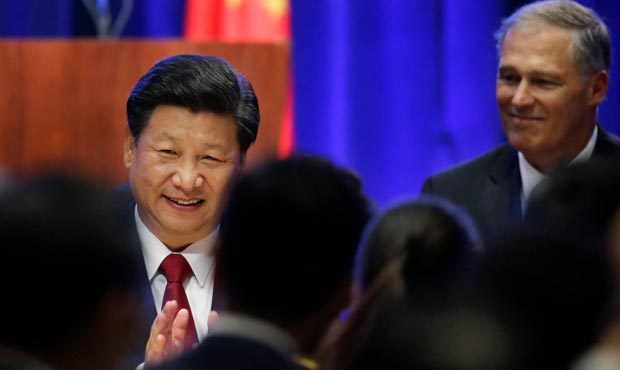
Chinese President Xi Jinping, left, applauds guests as he stands with Washington Gov. Jay Inslee, right, following his speech at an October 2015 banquet in Seattle. (AP Photo/Ted S. Warren)
(AP Photo/Ted S. Warren)
Chinese President Xi Jinping’s visit to the Puget Sound garnered both a reception of honor from local leaders, and ire from commuters who were stuck in bumper-to-bumper traffic as the president traveled the area.
Commuters were brought to a halt as express lanes and freeways were closed to provide exclusive access to the president, backing up drivers headed to work and other appointments. That led to many asking why the president didn’t use alternate transportation, such as a helicopter, or why didn’t any local authority speak up for the thousands of locals affected by the visit?
Actually, local elected officials did speak up. It just didn’t matter.
“I know there’s huge frustration about this,” Governor Jay Inslee told Seattle’s Morning News on KIRO Radio. We tried to get the Chinese to change their itinerary to reduce some of this, to limited success. The Secret Service, federally, actually controls these security decisions.
“It is by-in-large out of our hands. But we did ask the Chinese to change some of their itinerary to reduce some of the traffic congestion,” he continued. “Frankly, we had limited success in that, in part because this president really wanted to get to know our community — he went to Tacoma, he went to Everett, Madam Peng [the president’s wife] went to Fred Hutchinson Hospital.”
That sentiment echoes what Washington Secretary of Transportation Lynn Peterson told Seattle’s Morning News and Dori Monson: “We did let the Secret Service know about our obvious congestion issues during the peak periods in the Puget Sound region. We were pretty candid with them but ultimately these decisions are not in our control.”
The lack of local control over the roads during such a situation is not uncommon, according to KIRO Radio political analyst Rob McKenna.
“Even though the state actually owns the interstate highway system in Washington, the Secret Service comes in — and they don’t have to go to court for this — they just ask for it or demand cooperation of local authorities,” McKenna explained. “And they get it, because after all, they are the Secret Service. DOT was correct in saying they are at the mercy of those orders.”
McKenna notes that there are two legal principles at play in this instance: federal preemption and supremacy. Federal law trumps local law in any conflict. It also means that federal authority is supreme over the states in matters of national security and foreign affairs.
“It doesn’t mean they couldn’t push back harder. They have voices, they could speak up and demand more say,” McKenna said. “Here … I think the Chinese delegation, the president’s people, wanted a really big show and they are used to getting their way — not only with transportation but also with the very tightly controlled media access we’ve seen this week. It shows that they want it their way, and apparently the state department and the Secret Service are willing to give it to them.”
McKenna said despite the lack of control, locals should still contact their elected officials.
“To the governor’s office and to the director of the department of transportation,” he said. “And maybe more thought should be given in the future to mitigating the impacts of these visits, instead of just giving them a blank check.”