Small town in Western Washington wants to move away from flooding to higher ground
Sep 10, 2018, 3:02 PM
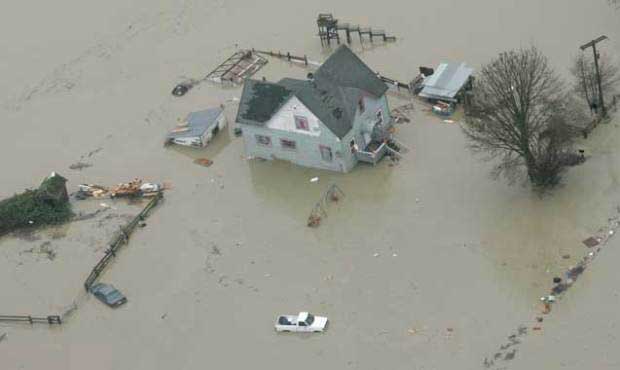
A home flooded by the Skagit River is shown from the air Tuesday, Nov. 7, 2006 near Mount Vernon, Wash. not far from Hamilton. (AP Photo/Ted S. Warren, Pool)
(AP Photo/Ted S. Warren, Pool)
As the flood waters rise on the Skagit River, one town is asking state officials to help move it to higher ground.
RELATED: Skagit County offers straightforward fire prevention advice
Hamilton is a small town of about 300 people along the banks of the Skagit River. It’s roughly a 25-minute drive from Burlington. Highway 20 runs through it; most of the town is located to the south of the highway and on the other side is the banks of the river. The Skagit Valley Herald reports that the town is requesting $1.5 million to relocate it to a drier locale. The city is working with Skagit Fisheries Enhancement Group and the Skagit Land Trust and is seeking the funds from the Floodplains by Design grant program. The program aims to better manage floodplains in the state.
If approved, the plan will move willing residents out of areas in Hamilton that regularly flood. It will also help purchase other properties to further move the community. Those vacated areas will be returned to wildlife. The town could be moved north of Highway 20 within 100 years, according to Mayor Joan Cromley, in seven phases. Relocating Hamilton is part of the town’s updated comprehensive plan’s goals. Money could become available as soon as July 2019 if state officials approve the grant.
It’s not just the Skagit River that poses flooding problems for Hamilton. Carey’s Slough feeds into the river and is located under few of Hamilton’s streets. That wetland doesn’t drain too well and often floods, too. The newspaper notes that the area has flooded into Hamilton about every 3.4 years since it was founded in 1877. In 2017, flooding caused $15,000 in damage and $10,000 in environmental cleanup. Not to mention all the insurance claims.
Hamilton is not alone when it comes to flooding concerns. Flood warnings go into effect every rainy season for Snohomish, White, Snoqualmie and other regional rivers, often closing roads and trails. The National Weather Service also operates a website just for Washington flooding.
Seattle’s Georgetown neighborhood is watching the waterline as years pass. That neighborhood occasionally floods due to insufficient infrastructure. The area is along the Duwamish River as it meets Elliott Bay. Many outflows feed into the river and the bay, including sewage (combined sewer outflows) which commonly overflows into area waters. That means Georgetown could be under more sewage, more often as sea levels are expected to rise over the next century.
Not far away, a Seattle sewage and wastewater treatment plant has had trouble keeping up with the flow.
Follow @http://twitter.com/Mynorthwest