How bad is the air after a fireworks show?
Jun 30, 2015, 12:27 PM | Updated: 1:44 pm
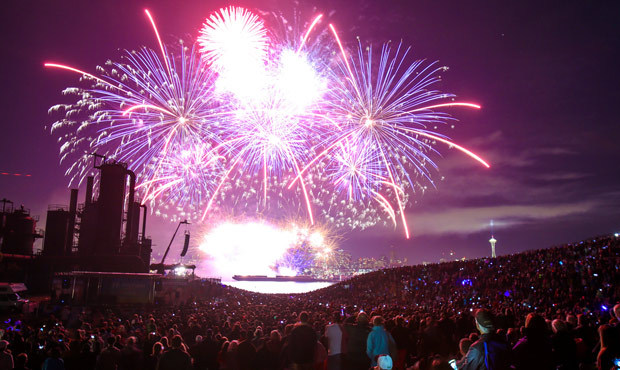
Fireworks explode over Lake Union during the Seafair Summer Fourth at Gas Works Park Friday, July 4, 2014, in Seattle. (AP Photo/seattlepi.com, Joshua Trujillo)
(AP Photo/seattlepi.com, Joshua Trujillo)
Don’t hold your breath waiting for Fourth of July fireworks. Hold it after the big show.
A new study from the National Oceanic and Atmospheric Administration determined that yes, the air gets bad during fireworks shows.
“We chose the holiday, not to put a damper on celebrations of America’s independence, but because it is the best way to do a nationwide study of the effects of fireworks on air quality,” said Dian Seidel, a senior scientist at NOAA’s Air Resources Laboratory in College Park, Maryland. “These results will help improve air quality predictions, which currently don’t account for fireworks as a source of air pollution. The study is also another wake-up call for those who may be particularly sensitive to the effects of fine particulate matter.”
The study was carried out by Seidel along with a student intern, Abigail Birnbaum. It debuts in the journal “Atmospheric Environment” and focuses on “fine particulate matter” that are 2.5 microns in diameter. The microns are so small they can enter deep into a person’s respiratory system, according to the study, causing a variety of health problems, including coughing, asthma attacks, heart attack and stroke, and premature death in people with heart or lung disease.
Such levels explode after a fireworks show, especially in the United States where approximately 14,000 fireworks displays occur on July 4. Seidel and Birnbaum looked at data from 315 air quality monitoring stations across the United Stations from 1999-2013.
Air pollution reaches its highest levels from 9-10 p.m. on July 4, with an average increase of 42 percent of air pollution over the previous day. Those levels drop back to normal by noon on July 5.
Scientists admit that a few elements of the study threw off readings, mainly because of the distance of air quality monitoring sites to the places where fireworks are set off. The study notes that one station was directly next to a fireworks site. Concentrations rose by 370 percent at that location.