‘I am blessed’: Local Catholics celebrate first American pope at St. James Cathedral
May 8, 2025, 9:40 AM | Updated: 3:08 pm
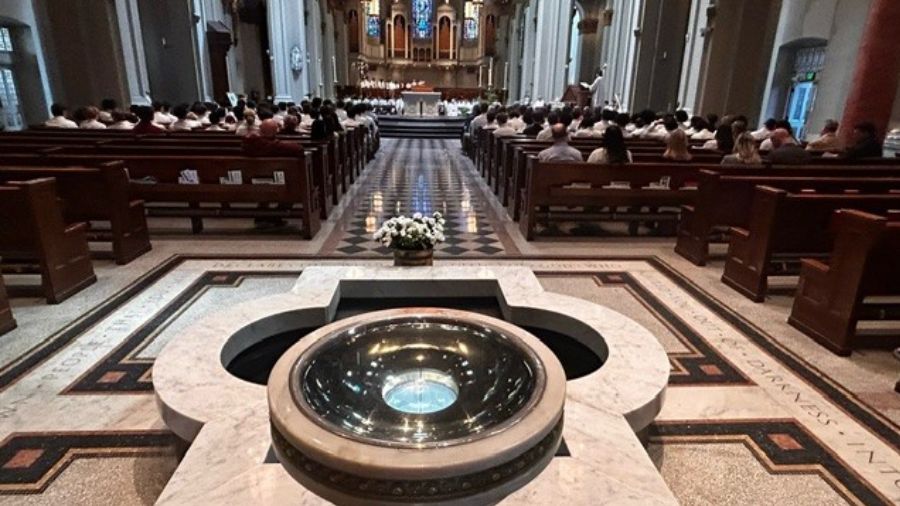
Local Catholics gathered at Seattle's St. James Cathedral after the announcement of a new Pope. (Photo: James Lynch, KIRO Newsradio)
(Photo: James Lynch, KIRO Newsradio)
Local Catholics gathered at Seattle’s St. James Cathedral after the announcement that American Cardinal Robert Prevost has been selected as the next pope.
“I just heard some noise erupting, and I just heard them clapping and cheering, so I was like, ‘Oh, they found a new pope!'” Parishioner Joseph Jackson told KIRO Newsradio.
Prevost, 69, took the name Pope Leo XIV.
“Fingers crossed, everything turns out smoothly,” local Catholic Shannon Burnett said.
Burnett told KIRO Newsradio she hopes Pope Leo will have values more in line with the Catholic Church than his predecessor, the late Pope Francis.
“We have poverty, we have the homeless, we have the drug epidemic, we have, you know, the suicides, we have massive, massive, massive issues. Bring Jesus, bring God back into everyday life, and all of this will change,” she said.
Meanwhile, Geraldine Carey told KIRO Newsradio she’s hopeful Pope Leo will continue the ways of Pope Francis.
“I am blessed, definitely, to have Pope Leo,” Carey said. “What do I look forward to seeing? Maybe a continuity of some of the things of Pope Francis. Bless his soul. And a continuation of inclusivity.”
The U.S. president posted his reaction on his Truth Social social media platform.
“Congratulations to Cardinal Robert Francis Prevost, who was just named Pope. It is such an honor to realize that he is the first American Pope,” Trump said on social media. “What excitement, and what a Great Honor for our Country. I look forward to meeting Pope Leo XIV. It will be a very meaningful moment!”
Who is Robert Prevost?
The former pope, Francis, brought Prevost, 69, to the Vatican in 2023 to serve as the powerful head of the office that vets bishop nominations from around the world, one of the most important jobs in the Catholic Church. As a result, Prevost has a prominence going into the conclave that few other cardinals had.
The new pope was formerly the prior general, or leader, of the Order of St. Augustine, formed in the 13th century as a community of “mendicant” friars dedicated to poverty, service and evangelization.
The order’s requirements and ethos are traced to the fifth century St. Augustine of Hippo, one of the theological and devotional giants of early Christianity.
The order works in about 50 countries, according to its website, promoting a contemplative spirituality, communal living and service to others.
From the loggia of St. Peter’s Basilica, history’s first American pope recalled that he was an Augustinian priest, but a Christian above all, and a bishop, “so we can all walk together.”
He spoke in Italian and then switched to Spanish, recalling his many years spent as a missionary and then archbishop of Chiclayo, Peru.
Which cardinals were the leading contenders?
There are never official candidates for the papacy, but some cardinals were considered “papabile,” or possessing the characteristics necessary to become pope. Some names include Pietro Parolin, who oversaw the conclave, Luis Tagle, dubbed the “Asian Francis,” Fridolin Ambongo Besungu, a conservative cardinal native to the Congo, and Pierbattista Pizzaballa, potentially the first Italian pope in decades.
In the crowd at St. Peter’s Square
Pedro Deget, 22, a finance student from Argentina, said he and his family visited Rome during the Argentine pope’s pontificate and were hoping for a new pope in Francis’ image.
“Francis did well in opening the church to the outside world, but on other fronts maybe he didn’t do enough. We’ll see if the next one will be able to do more,” Deget said from the piazza.
The Rev. Jan Dominik Bogataj, a Slovene Franciscan friar, was more critical of Francis. He said if he were in the Sistine Chapel, he’d be voting for Cardinal Pierbattista Pizzaballa, the Latin Patriarch of Jerusalem who is on many papal contender lists.
“He has clear ideas, not much ideology. He’s a direct, intelligent and respectful man,” Bogataj said from the square. “Most of all, he’s agile.”
A long wait on the first ballot
On Wednesday night, the black smoke of the first ballot poured out of the chapel chimney just after 9 p.m., about 4.5 hours after the cardinals filed into the Sistine Chapel to take their oaths at the start of the conclave.
The late hour prompted speculation about what took so long: Did they have to redo the vote? Did someone get sick or need translation help? Did the papal preacher take a long time to deliver his meditation before the voting began?
“They probably need more time,” said Costanza Ranaldi, a 63-year-old who traveled from Pescara in Italy’s Abruzzo region to the Vatican.
Some of the cardinals had said they expected a short conclave. But if recent history is any guide, it will likely take a few rounds of voting to settle on the 267th pope.
For much of the past century, the conclave has needed between three and 14 ballots to find a pope. John Paul I — the pope who reigned for 33 days in 1978 — was elected on the fourth ballot. His successor, John Paul II, needed eight. Francis was elected on the fifth in 2013.
Conjecture on contenders
The cardinals opened the secretive, centuries-old ritual Wednesday afternoon, participating in a rite more theatrical than even Hollywood could create. Bright red cassocks, Swiss Guards standing at attention, ancient Latin chants and oaths preceded the slamming shut of the Sistine Chapel doors to seal the cardinals off from the outside world.
Cardinal Pietro Parolin, the 70-year-old secretary of state under Francis and a leading contender to succeed him as pope, assumed leadership of the proceedings as the most senior cardinal under age 80 eligible to participate.
Parolin seemed to have received the blessings from none other than Re, the respected elder among the cardinals. During the traditional exchange of peace during the pre-conclave Mass on Wednesday, Re was caught on a hot mic telling Parolin “auguri doppio” or “double best wishes.” Italians debated whether it was just a customary gesture acknowledging Parolin’s role running conclave, or if it might have been an informal endorsement or even a premature congratulations.
The voting process
The voting follows a strict choreography, dictated by church law.
Each cardinal writes his choice on a piece of paper inscribed with the words “Eligo in summen pontificem” — “I elect as supreme pontiff.” They approach the altar one by one and say: “I call as my witness, Christ the Lord who will be my judge, that my vote is given to the one who, before God, I think should be elected.”
The folded ballot is placed on a round plate and tipped into a silver and gold urn. Once cast, the ballots are opened one by one by three different “scrutineers,” cardinals selected at random who write down the names and read them aloud.
The scrutineers, whose work is checked by other cardinals called revisers, then add up the results of each round of balloting and write them on a separate sheet of paper, which is preserved in the papal archives.
As the scrutineer reads out each name, he pierces each ballot with a needle through the word “Eligo.” All the ballots are then bound together with thread, and the bundle is put aside and burned in the chapel stove along with a chemical to produce the smoke.
Contributing: The Associated Press; James Lynch, KIRO Newsradio