A mom meets her son every Sunday at 12th and Jackson. Nine Puget Sound mayors will hear families like hers in Kent
Sep 22, 2026, 11:00 AM | Updated: 3:07 pm
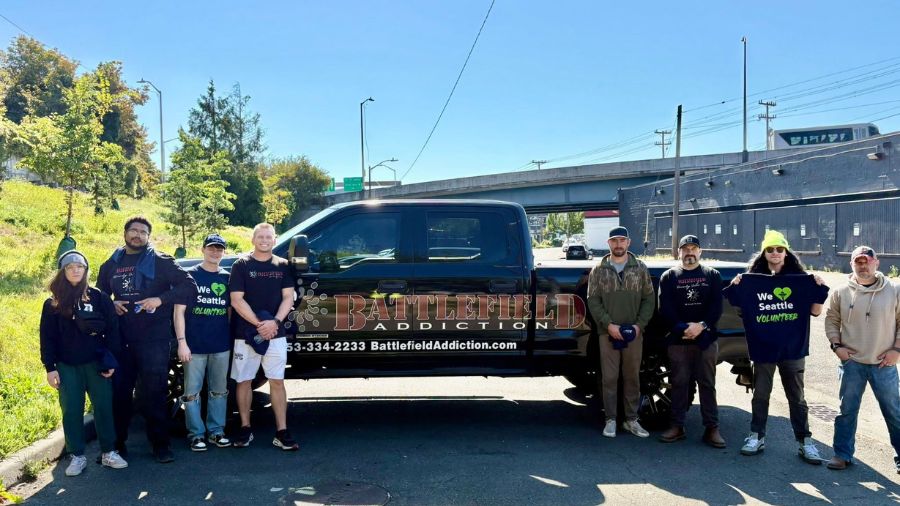
Battlefield Addiction volunteers pose during a joint outreach event with We Heart Seattle. (Photo courtesy of Battlefield Addiction)
(Photo courtesy of Battlefield Addiction)
At least nine Puget Sound mayors will gather in Kent on Oct. 8 for a community conversation on Washington’s fentanyl crisis, and the man bringing them together wants families who’ve lost someone to the streets to ask them one question.
“How does fentanyl end in our state?” Art Dahlen, founder of the nonprofit Battlefield Addiction, said on KIRO Newsradio’s “Seattle’s Morning News” on Tuesday.
The mayors, joined by state legislators and other elected officials from across the region, will meet at the Kent-Meridian High School Performing Arts Center. Battlefield Addiction is calling the free event “Enough is Enough,” and it’s asking Gov. Bob Ferguson to lead a shift in Washington drug policy: stronger penalties for fentanyl dealers, accountability for drug possession paired with diversion programs, and an end to government-funded distribution of the supplies used to smoke fentanyl. Dahlen wants the governor as a partner. The people filling the seats will be parents who’ve watched their kids disappear into addiction, and local leaders who share their frustration.
Confirmed so far: Kent Mayor Dana Ralph, Issaquah Mayor Mark Mullet, Normandy Park Mayor Eric Zimmerman, Bonney Lake Mayor Terry Carter, Renton Mayor Armando Pavone, Pacific Mayor Vic Kave, Sumner Mayor Carla Bowman, Black Diamond Mayor John Adler, and Enumclaw Mayor Anthony Wright.
12th and Jackson: a Seattle mother’s Sunday visits with her son on the street
Most families find Battlefield Addiction the same way, Dahlen said. A parent calls with a story that doesn’t fit the usual picture of homelessness in Seattle.
“It’s a family member that’s going, ‘Hey, my kid’s not homeless, he’s just on the streets of Seattle,'” Dahlen said.
He had a text from one of those mothers. She’d met her son at 12th and Jackson the day before, and the two now have a standing arrangement: every Sunday at 1 p.m., she comes to that corner to spend time with him, hoping he’ll be there. That he’ll be alive.
“We are dealing with family members who say, ‘My kid has a home. My kid can come home,'” Dahlen said. “They won’t. And it’s these service-resistant people that are really on the streets, and family members have lost them to the streets.”
When a loved one is finally arrested on a misdemeanor drug possession charge, those families let themselves hope.
“The families get real hopeful that this time someone’s going to help them,” Dahlen said. “And then the person’s released, normally at 12:01 a.m. at night, right back to the same environment.”
Washington drug decriminalization left mayors’ hands tied, Dahlen says
Dahlen said the forum will walk through what’s happened since the Washington Supreme Court’s 2021 Blake decision struck down the state’s drug possession law, the legislature’s 2023 possession fix, and where that fix stalled.
“How local mayors, maybe a lot of their hands are tied,” Dahlen said. “They don’t want to just arrest someone on a misdemeanor and then have to take care of them in the jail overnight and worry about their safety, and then kick them out the next day.”
He says he’d rather skip the endless argument over what causes homelessness and focus on the person in front of you.
“Let’s go talk to the person. Let’s determine what’s causing that person’s homelessness,” he said. “What’s the best policy for that person who’s now addicted to fentanyl, who’s now addicted to meth, who’s on the streets?”
RELATED STORIES

Harm reduction saved lives, Battlefield Addiction says, but cartels hear a different message
Dahlen gives harm reduction some credit. Naloxone, he said, and the speed with which Washington adapted to fentanyl have kept people alive.
“What we’ve done to adapt to the fentanyl crisis is actually remarkable: how we’ve adapted, and how we’ve saved lives, and the destigmatization is good, and all that stuff is good,” he said.
His worry is the message the state sends to the people selling the drugs.
“It’s the symbolism,” Dahlen said. “It’s saying, ‘Hey,’ to the cartel, ‘come sell drugs here. And by the way, if they don’t have the supplies to do them, we’ll provide them.'”
He pointed to the mixed signals inside government itself: one agency handing out paraphernalia such as pipes, needles, and foil while another is still arresting people for using them.
Arrest as intervention: Battlefield Addiction’s case for accountability
Dahlen says the word “accountability” gets misheard in Seattle’s addiction policy debates.
“The misconception is that the accountability is somehow punishment,” he said. “Nobody I know, nobody at Battlefield, nobody I know wants anyone punished. They don’t want someone’s record stained for life; they don’t want someone’s life to be more difficult. They want arrest used as a tool.”
“An intervention,” I offered.
“Yes,” Dahlen replied.
He pointed to a man in the program named Corey Rattleff. Corey had worked with We Heart Seattle, Hope and Chance, and a team of outreach workers. What finally changed things was jail, and enough time away from drugs for his brain to heal.
“I have kids in the program that I call ‘the lucky ones,'” Dahlen said. “And the lucky ones have had enough arrests and enough stuff that they’re tired.”
He has little patience for the idea that putting barriers in front of drug use doesn’t work.
“Everyone that comes to me, they ended up with too many barriers to their drug use in some way,” he said. “Either they lost their kids, or their family, or they’ve been put in jail, or whatever it is.”
Dahlen also rejects the argument that Seattle lacks addiction treatment for people ready to take it. “There are so many resources. If somebody wants it, there are so many resources,” he said. What’s changed, he said, is how few people ask. “I don’t see anyone really coming and asking for help anymore.”
Hayden Panettiere’s fentanyl overdose shows how far the drug reaches
The Kent forum announcement lands the same week the Greenville County Coroner’s Office in South Carolina ruled actress Hayden Panettiere’s Aug. 16 death an accidental overdose from the toxic effects of fentanyl and other drugs. The 36-year-old starred in “Heroes” and “Nashville.”
Dahlen said families in his program know that story well.
“We have a lot of mothers and fathers whose kids got into this illicit supply unbeknownst to them, through other drugs or using other drugs that they thought were just the drug they were going to do, like cocaine or something like that,” he said.
He questioned calling it an accident.
“I think a lot of things have to happen for an accident like that to happen, and a lot of things have to be allowed and kind of line up to have an accident of that nature,” Dahlen said.
Kent fentanyl forum: Oct. 8 date, time, and free tickets
The Battlefield Addiction fentanyl forum is Thursday, Oct. 8, at the Kent-Meridian High School Performing Arts Center, 10020 SE 256th St. in Kent. Doors open at 6:30 p.m., and the program starts at 7. Admission is free, and you can register for tickets here.
“Come have your voice heard,” Dahlen said.
Follow @https://twitter.com/kirocharlie