Harger: ‘Hey Bob, enough is enough.’ A Kent sober home’s plea to Gov. Ferguson on fentanyl
Jun 10, 2026, 2:00 PM | Updated: 2:20 pm
Nehemiah was almost a year sober.
The young man known to friends as Nemo had come to Art Dahlen’s Battlefield Addiction sober-living home in Kent with legal troubles and a desire to get clean. He stayed. He worked the program. He was building something.
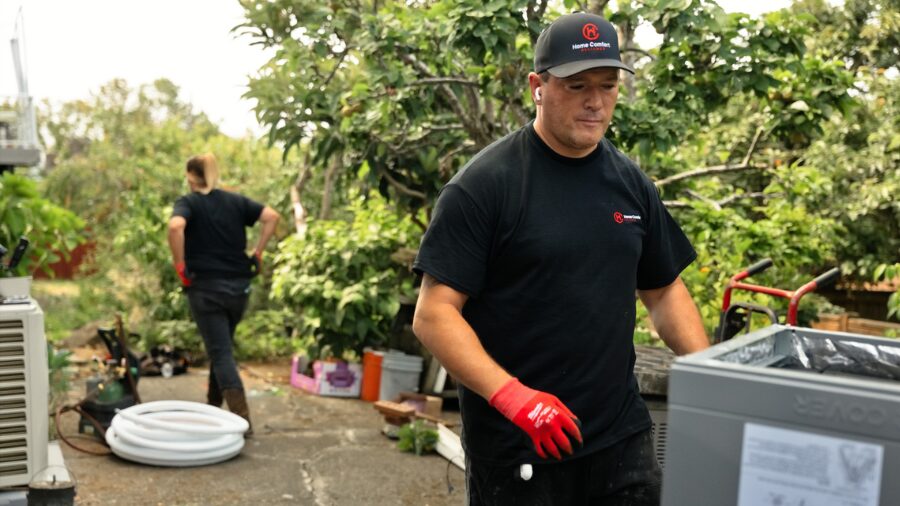
On the morning of May 28, Dahlen took a crew from Battlefield out to a client’s property to do yard work. It’s one of the ways the program raises money. Nemo asked to stay behind, and Dahlen trusted him enough to leave his car keys with him.
They believe Nemo drove down the street to the park at one end or the grocery store parking lot just down the hill, and scored quickly. Then he came home.
A couple of hours later, the others in the house realized Nemo was nowhere to be found.
The bathroom door was locked. They called Dahlen, and he drove back. He broke down the bathroom door himself.
He found Nemo’s body. He made the call to Nemo’s mother. He stood there as she rushed over and crumpled over her son, first while the paramedics worked, then the coroner.
Nemo died of a fentanyl overdose inside the house where he was rebuilding his life.
Dahlen has spent 15 years doing this work. This is one of the few times he’s lost someone in one of his recovery houses.
“Nehemiah was a young man in my program, and he came to me and had legal troubles and needed to get sober,” Dahlen told KIRO Newsradio. “Nehemiah did almost a year sober with me.”
He wept as he told me this. A man who has spent his life pulling people back from the edge, who has buried more friends than most of us will ever make, sat across from me and cried.
“It really got us to a point where we want to make it not political and be done arguing about things and just get an acknowledgment that enough is enough,” Dahlen said. “Enough is enough.”
Those two words have become the rallying cry behind a new campaign Dahlen and Andrea Suarez of We Heart Seattle are launching together, with a Facebook group already collecting stories. They call it a plea, directed at one person they believe has the power and the credibility to break the silence around fentanyl in Washington: Governor Bob Ferguson.
A man who knows the road back from opioid addiction
Dahlen has lived this from the inside.
He spent 17 years trapped in opioid addiction. He clawed his way out. For the past 15 years, he has spent his life helping other people do the same, building Battlefield Addiction into sober houses in Kent and Auburn that keep people alive and help them rebuild.
His goal has never been complicated: Get people sober, get them functioning, get them back into their families, their jobs, and their communities. He’s done it hundreds of times.
Nemo was one of those people. Almost a year clean. A young man who had decided he wanted out and was getting there.
And then he wasn’t.
The dead-end street in Kent
The sober house where Nemo died sits on a dead-end street in Kent, with a park at one end and a grocery store just down the hill. People walking from the store to the park to use drugs cut right past the front door. When Nemo went looking on May 28, the farthest he had to travel was a couple of blocks.
“I can’t even keep the fentanyl from coming to the front door of a dead-end street in Kent,” Dahlen said. “I can’t help people get clean when it’s this prevalent, and this cheap. It’s here, and we don’t talk about it anywhere.”
Before you tell yourself that’s a Kent problem, or an Aurora Avenue problem, check the distance from your own front door to the nearest park and the nearest grocery store. That’s the supply chain now. It’s in every neighborhood.
Washington recorded 3,145 drug overdose deaths in 2024, according to the Centers for Disease Control (CDC) data. That works out to nearly nine people a day. Fentanyl and other synthetic opioids were involved in 73% of them.
In King County alone, 914 people died of fatal overdoses in 2025, with fentanyl involved in 78% of those deaths.
Nationally, the CDC’s provisional count for 2025 is 69,973 overdose deaths.
“That’s a football stadium that we’re losing,” Dahlen said.
He said he has never heard Washington’s top elected leaders say the word out loud.
“Fentanyl.”
Harm reduction v. sobriety: two philosophies, two outcomes
This is where Dahlen’s work runs headlong into the dominant approach in King County and most of Washington: harm reduction and Permanent Supportive Housing.
Under the harm reduction model, you don’t push someone into detox or treatment. You wait until the user asks. In the meantime, make the user as comfortable as possible. Keep someone alive one more day, and maybe today’s the day they decide they want out.
The heart is in the right place, I’ll grant that. Keeping someone breathing matters, but there’s a difference between keeping someone alive and helping them live.
Dahlen’s model is the opposite. Sobriety first. Structure. Accountability. A bed, yes, but also a path. He’s spent his career proving that path works.
Overdose deaths did decline in Washington last year. We point to that as progress. The catch: Washington’s decrease ran far below the national average, and we were one of the last states to bend the curve at all. Fewer bodies than the year before. That’s the metric we celebrate.
A peer-reviewed meta-analysis published in Campbell Systematic Reviews in April 2024 examined 48 studies involving more than 15,000 participants experiencing homelessness. Its conclusion: Abstinence-based and harm reduction-based interventions “make little real difference to the outcomes achieved in comparison to treatment as usual.” The confidence intervals for both approaches cross zero. Neither dramatically outperforms the other.
In other words, the state’s preferred model isn’t measurably better than the model Dahlen is running on a shoestring out of Kent. He just doesn’t have the funding, the platform, or the political wind at his back.
Fentanyl breaks the math entirely. There is no safe amount, and no safe way to smoke it.
“It is a poison that kills,” Dahlen said. “There is no reducing the harm of fentanyl. It kills people when you smoke it. You can’t smoke it any safer whatsoever. There is no safer way.”
RELATED STORIES


Nemo’s family and Cory Ratliff: the stories behind the campaign
The campaign is built on real stories.
Nemo’s family has asked Dahlen to keep saying their son’s name.
“Nehemiah and his family stand with us, and they want us to say enough is enough,” Dahlen said. “They’ve asked me to say enough is enough.”
The other voice belongs to Cory Ratliff, who testified at Seattle City Hall about his years on the street, from Aurora down to Tacoma.
“I just want to speak on the fact that it took me 45 days in jail to finally get my mind right and hold myself accountable,” Ratliff said. “Before that, I was in the streets all the way from Aurora down to Tacoma, and I was being enabled from the city with free pipes, free foil, free housing, places that police can’t really come in and do anything about.”
Suarez says Ratliff’s story tracks with what We Heart Seattle has been documenting for six years: The trajectory from heroin to fake Percocets to pure fentanyl, and the homelessness explosion that has followed.
“Half a million people have lost their lives in the last five years in our country,” Suarez said. “And they should not die in vain.”
What recovery from fentanyl actually feels like
Ratliff is sober now. He was asked what hope feels like after years on the street. His answer was simple.
“It’s intense. It’s incredible,” Ratliff said. “I wake up energetic every day. I have something to live for. My confidence is up. I’m secure with myself. I’m not ashamed. I don’t feel sorry for myself. I don’t feel alienated. I feel like I can be a part of things. I can show my face in the world and be proud of that. To have that sense back and instilled in myself is incredible. It’s a blessing.”
That is what Dahlen and Suarez want for the people still out there. They said they cannot do it alone.
Why they’re asking Gov. Bob Ferguson in 2026
Let’s be precise about what this campaign is and what it isn’t, because Dahlen was precise with me.
This is apolitical. Dahlen and Suarez aren’t policy wonks, and they don’t pretend to be. They know addiction, homelessness, and mental illness tangle together in ways that defy easy answers. They know the budget is a mess. They know the politics are complicated. They are not asking Ferguson to adopt their platform because they don’t have one.
They are asking for an ally.
They picked Ferguson because he has the track record to be a powerful voice on exactly this issue.
As attorney general, Ferguson recovered more than $1.2 billion from opioid companies that fueled the epidemic. His official priorities page as governor still cites that settlement, pledging to use it to implement a fentanyl crisis response plan that includes treatment and law enforcement cooperation.
When Ferguson ran for governor, his own campaign platform laid out a fentanyl crisis response plan in plain language:
- Deploy a statewide, interagency crisis response unit, bringing together state and local law enforcement, prosecutors, judges, and treatment and diversion experts.
- Combat fentanyl trafficking and increase state funding for Washington’s 16 multijurisdictional drug and gang task forces.
- Expand opioid use disorder screening in the state’s jails, where only 60 percent can currently prescribe medication to treat it.
- Increase first responders and support the firefighters, EMS professionals, and nurses on the front lines of the crisis.
- Build more crisis facilities statewide, modeled on the five that King County voters approved.
The plan is on paper. The settlement money is real. What Dahlen and Suarez said has been missing is the governor’s voice, putting fentanyl front and center, telling Washington this is a crisis and pulling the levers his office controls.
Look at his big moments since taking office. His inaugural address named housing, affordability, ferries, police staffing, and “a behavioral health crisis.” That last phrase covers fentanyl the way a tarp covers a crater. His State of the State this year made news for the millionaire’s income tax and immigration enforcement.
That’s the whole reason Dahlen wants Ferguson to say it. A bill would help. A budget line would help more. But it starts with the word. Because a governor naming the thing that killed Nemo tells every family hiding their grief in shame that the silence is over.
And the levers are heavy. Harm reduction is orthodoxy in King County and in Olympia. Question it here, and you pay a political price, even though plenty of other states take a sobriety-first approach without controversy. Two volunteers running a sober house and a street cleanup crew can’t move that kind of weight. A governor with a decade of credibility on this exact issue can. Ferguson is one of the few people in Washington powerful enough to change the conversation.
They believe he wants to. They believe the man who spent a decade in court fighting Purdue Pharma and Johnson & Johnson did it because he cares. That’s why they’re asking him, and asking nicely.
How to join ‘Hey Bob, enough is enough’
The campaign describes itself as a respectful call for action to Governor Bob Ferguson. It’s asking Washingtonians to share their own stories, photos, memories, losses, and hope. Any way fentanyl has touched their life.
Follow the Hey Bob – Enough is Enough Facebook page, like, share, and most importantly, tell your story there. Use the hashtags #HeyBob and #EnoughIsEnough, and tag Battlefield Addiction and We Heart Seattle.
Dahlen and Suarez plan to bring the stories to the governor and ask him to help.
“We don’t want to be political. We want to get above politics,” Dahlen said. “On this issue, can we please just get above politics and acknowledge that people are dying and they need help. They’re not going to stop if we just allow it. They will not stop until they die. We don’t want them hurt. We don’t want them marginalized. We don’t want them put in jail and throw away the key. We want help to help them. That’s it. We want to get this stuff away so people stop dying.”
“Enough is enough, Bob,” Dahlen said. “Please, listen to us.”
RELATED STORIES
A Kent house, an empty bed
Back at the sober house in Kent, Nemo’s bed is empty.
Dahlen said he is tired. He said he is fighting with every dollar and every person he has. He said Suarez is doing the same on the streets of Seattle, begging people to come inside.
They are asking for a partner. Any party. Any politics. One governor, one phone call.
They are hoping the man who fought the opioid companies and recovered the money meant for exactly this fight, picks up the phone.
Charlie Harger is the host of “Seattle’s Morning News” on KIRO Newsradio. You can read more of his stories and commentaries here. Follow Charlie on X and email him here.