‘He did it in bad faith’: Rantz challenges AG Brown’s handling of I-638 defense, Seattle schools’ legal action
Nov 17, 2026, 12:00 PM

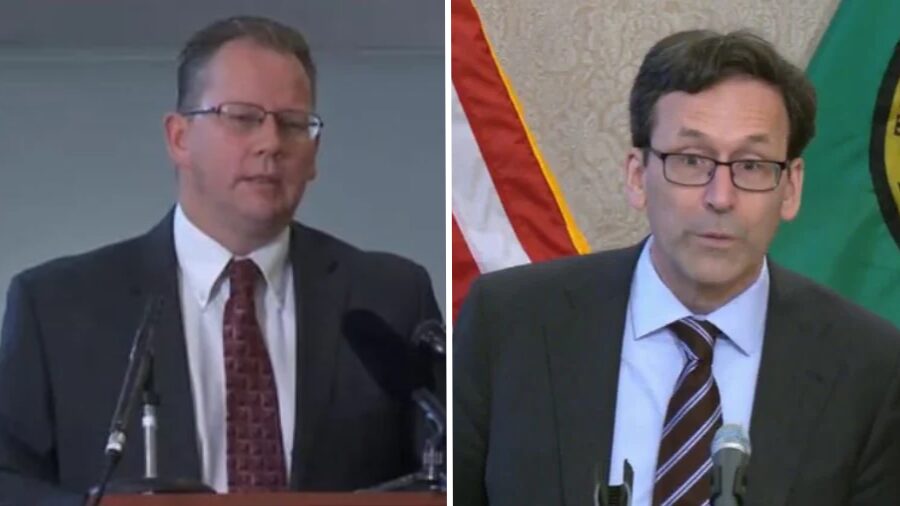
Jason Rantz, host of “The Jason Rantz Show” on Seattle Red 770 AM, criticized Washington Attorney General Nick Brown’s handling of the legal defense of Initiative 638, arguing that Brown undermined the voter-approved measure even as his office appointed outside attorneys to defend it.
“He did it in bad faith,” Rantz said on “The Jake and Spike Show” on KIRO Newsradio.
Speaking with KIRO host Jake Skorheim and fill-in host Greg Tomlin, Rantz also questioned Seattle Public Schools’ decision to authorize a legal challenge, arguing that the district should not spend money pursuing arguments other organizations were already bringing to court.
Voter-approved I-638 bars transgender girls from participating in girls’ school sports.
Rantz questions the district’s spending priorities
Jake opened the discussion by asking about Seattle Public Schools’ move to challenge the initiative.
Rantz distinguished authorization to pursue legal action from an established legal argument. He explained that the district had agreed to retain legal representation, but its precise case was not yet clear.
“We don’t know precisely what their legal argument is going to be yet, because all they did at this point was agree to hire an attorney or a firm to take on Seattle Public Schools to take on this particular initiative,” Rantz said.
The Seattle School Board authorized potential legal action over I-638.
“The argument essentially that they were making in their meeting was that they feel that they can’t fully implement this initiative without violating state law around discrimination,” Rantz noted. “They’re not the only one suing, and they knew they weren’t going to be the only one suing.”
Greg asked whether hiring outside counsel to challenge an initiative was unusual for the district.
“And this is pretty rare for Seattle Public Schools to take a step like this, historically speaking, is it not to challenge the will of the people, an initiative that they don’t like, and hire outside counsel?” Greg asked.
Rantz cautioned that he did not have historical data to establish how frequently the district had pursued such cases.
“They certainly are not shy about suing when they feel like they are at a disadvantage,” Rantz said. “I don’t know what the data is.”
Outside counsel draws scrutiny
Jake then turned to Brown’s responsibility to defend laws voters approved.
The attorney general’s office appointed an outside law firm to defend I-638.
Rantz identified the firm as Bryan Cave Leighton Paisner. He supported using outside counsel but criticized how Brown explained the decision.
“His decision is the right one, but the way that he handled it, I think, is the wrong way,” Rantz said.
When Greg asked whether the problem was timing, Rantz pointed instead to Brown’s public explanation.
“It’s the statement that he put out, essentially arguing that this initiative is unconstitutional,” Rantz said. “He did it in a roundabout way, so he wanted to be a hero for making this decision.”
Rantz interpreted that explanation as an effort to emphasize Brown’s opposition to the measure rather than simply defend it.
“He wants everyone to know where he stands on it because he couldn’t just step aside and say, ‘Okay, I’m going to allow someone else to do this,’” Rantz said. “He did it in bad faith.”
That was Rantz’s assessment of Brown’s motives, not an established finding.
Jake asks why Brown chose the firm
“Why wouldn’t he hire a law firm that does?” Jake asked. “There’s got to be other law firms out there.”
Rantz acknowledged that he did not know Brown’s reasoning.
“I have not heard him specifically defend this particular law firm, so I don’t know the answer to that,” Rantz said.
When Jake asked for a cynical interpretation, Rantz offered one while explicitly identifying it as speculation.
“The cynical view is that he wants them to fail, and he found a law firm that will fail,” Rantz said. “That’s the cynical view. It would be deeply unethical for them to do that.”
Rantz also acknowledged that he did not know which attorneys would handle the case.
“And I think those are reasonable questions that he should answer to,” Rantz said.
The interview offered no evidence that the firm intended to weaken the initiative’s defense. Prior advocacy on a related issue does not, by itself, establish that attorneys cannot represent a client in a different case.
RELATED STORIES

An initiative vote beyond party labels
Greg asked whether I-638’s passage offered lessons for conservatives seeking support in Washington.
Rantz characterized the sports initiative as a fairness question that crossed party lines. He argued that supporting the measure did not necessarily reflect hostility toward transgender people.
“It’s not seen as political by most people. Democrat, Republican, or Independent look at this pretty much the same way, saying this is just about basic fairness,” Rantz said. “It doesn’t mean that you’re quote unquote anti-trans. It doesn’t mean that you’re a bigot. It doesn’t mean that you hate trans people at all.”
Jake viewed the result as evidence that voters could depart from Washington’s usual partisan patterns. Rantz cautioned, however, that passage did not settle the legal fight.
“So perhaps this is something that ends up getting to the U.S. Supreme Court again, but I wouldn’t hold my breath,” Rantz said.
Watch the full discussion in the video above.
Listen to “The Jake and Spike Show” weekdays from noon to 3 p.m. on KIRO Newsradio 97.3