Ryanair gives Boeing a boost by ordering 75 more MAX jets
Dec 3, 2020, 8:38 AM | Updated: 8:56 am
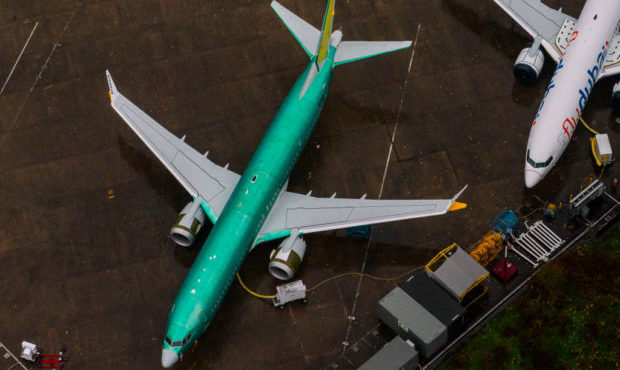
Boeing 737 Max airplanes sit parked at the company's production facility in Renton, Washington. (Photo by David Ryder/Getty Images)
(Photo by David Ryder/Getty Images)
Irish budget airline Ryanair is ordering more Boeing 737 MAX jets just weeks before the plane returns to flying after two crashes in March 2019 that killed 346 people in Indonesia and Ethiopia.
Ryanair said Thursday it was placing 75 more orders for the MAX, increasing its orders to 210 planes.
The announcement was a boost for Boeing, which has suffered cancellations of the plane while it was grounded for nearly two years, and while demand for new jets plummeted because of the ongoing coronavirus pandemic.
In November, the U.S. Federal Aviation Administration issued a recertification for Boeing’s 737 MAX, allowing it to once again carry passengers, and effectively ending its 20-month grounding by prescribing new flight-control software and other changes.
After 20-month grounding, FAA recertifies Boeing 737 MAX to fly passengers
Recertification does not mean the single-aisle airplane will return to service immediately. Thousands of pilots worldwide will require retraining on the MAX’s new flight software, originally the issue that got the aircraft grounded in the first place.
Ryanair CEO Michael O’Leary said the planes offer lower fuel consumption and quieter flying than other aircraft. He expressed confidence that customers will fly on the plane, and that demand for travel will recover next year as virus vaccines become widely available.
Between cancellations and orders threatened by airlines’ pandemic losses, Boeing’s backlog of MAX jets has shrunk by more than 1,000 this year.
Boeing CEO David Calhoun said he was confident that the Ryanair move was the beginning of the company’s bid to rebuild its MAX order book.
Financial terms of the deal were not disclosed. In normal times, airlines receive deep discounts off list prices, and Boeing may be under more pressure to cut prices because of recent cancellations.
The Associated Press contributed to this report.
Follow @http://twitter.com/Mynorthwest