Why Seattle’s cobblestone streets are here to stay
Jun 25, 2019, 11:44 AM | Updated: 11:46 am
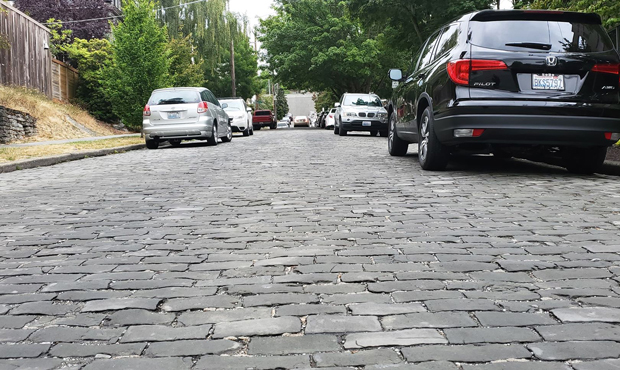
Cobblestone in Seattle's Eastlake neighborhood. (MyNorthwest photo)
(MyNorthwest photo)

For as long as there have been cars in Seattle, cobblestone streets have been the bane of drivers across the city. But why exactly are these 100-plus-year-old holdovers from a bygone era still around to plague your suspension?
Have you noticed this change at Seattle intersections?
To understand that better, we first need to understand the history of Seattle’s streets.
“If you came to Seattle in the 1850s up through the 1880s, even well into the 20th century, a lot of our streets were just dirt and mud,” KIRO Radio historian Feliks Banel describes.
A need for usable streets predated the existence of machines that could lay large quantities of asphalt and concrete, and so Seattle streets were paved with red brick. That brick was too slick for horses and buggies on the city’s many hills, hence the presence of cobblestone on some of Seattle’s steepest inclines across Queen Anne, First Hill, and beyond.
Starting around the 1920s, the rise of cars and the death of the streetcar system saw Seattle’s streets paved over with concrete and asphalt. Lesser-traveled streets fell to the bottom of the list, leaving the city with a smattering of cobblestone roads over a century old even today.
Any easy fix with a hefty price tag
So, why not simply pave over them entirely?
“If you don’t need to spend the money to replace cobblestones that have been there for, in some cases 120 years, why spend that money?” Banel posits.
While acknowledging that it would like to be rid of some of Seattle’s most worn-down cobblestone, the city says its hands are largely tied by its budget.
“Some of the more deteriorated (cobblestone) you see, we would like to pave over them with asphalt — we just don’t have the funding to make that happen,” SDOT Civil Engineer Ben Hansen told MyNorthwest.
Seattle has roughly 100 total cobblestone streets; 50 of those were designated for historic preservation in the 1990s. The remaining 50 were deemed “too deteriorated to preserve.” Hansen estimates that replacing a single city block of cobblestone with asphalt would cost upwards of $200,000, when accounting for both paving and a city mandate that requires upgrades to existing ADA curb ramps.
How congestion tolling could help solve Seattle’s traffic woes
Paving over just the 50 cobblestone streets that aren’t historically preserved would run the city $10 million. That would cost around 20 percent of SDOT’s total yearly budget for road maintenance and repair. Pave over every last cobblestone in Seattle and it would eat through almost half that budget.
That also doesn’t factor in that a majority of the city’s budget for road maintenance is devoted to high-volume streets.
“The bottom line with non-arterial streets in the city — and almost all of the cobblestone streets across the city are non-arterials — is we don’t really have a lot of funds for maintenance,” Hansen said.
Maintaining Seattle’s cobblestone
What SDOT does have the money for are “spot repairs” and filling potholes.
Seattle’s 50 historically preserved cobblestone streets are just that: Historically preserved. Oftentimes, the city will even use spare cobblestones cannibalized from the other non-preserved streets for in-kind repairs. The 50 streets too deteriorated to preserve get a simple asphalt patch any time a pothole or defect appears.

A repair done on a cobblestone street not being historically preserved
While some argue that the potential damage to vehicles caused by cobblestone merits a full-on replacement, others note the historical significance of a small slice of Seattle history.
“When you think about a city crew back in the 1890s spending several days carefully putting all those cobblestones in place, it’s cool to think that … we here in Seattle can partake of these civic improvements that taxpayers paid for hundreds of years ago,” Banel points out.
That’s at least some consolation for that fact that, love them or hate them, Seattle’s cobblestones are here to stay.
What do you think?