Seattle council considers new business head tax and more
Mar 14, 2018, 6:10 AM | Updated: 5:09 pm
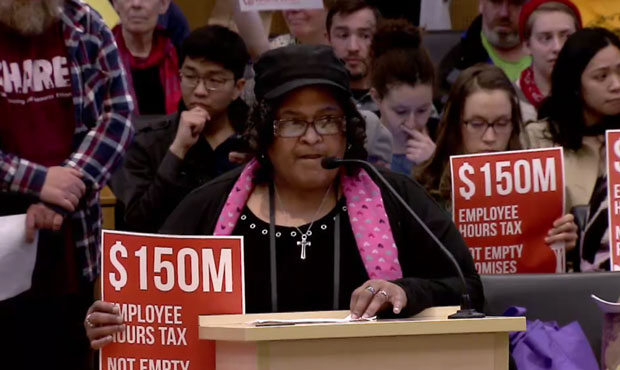
Supporters of a Seattle head tax on businesses crowd into city hall to support the proposal. (Seattle Channel)
(Seattle Channel)
The Seattle City Council was swarmed with supporters of a head tax on the city’s businesses Wednesday. But that is only one means of raising new revenue the council is being presented with.
“Tax burdens should not be increased slightly … “ Lisa Daugaard, a member of Seattle’s Progressive Revenue Task Force on Housing and Homelessness told a council finance committee Wednesday.
“We have to go big or go home,” she said. “We must make a discernible impact on the situation and the number of people living in public and experiencing homelessness. Proposals that fumble around and don’t achieve that mark should not be supported.”
RELATED: Seattle starts employee tax 2.0
There is no official employee hours tax proposed yet. The task force recommends the city develop a head tax on businesses, along with other taxes to fund housing and homelessness programs. A head tax alone on Seattle businesses will not be enough to solve the crises, it concludes, and provide “deeply affordable housing.”
“We therefore believe that the City of Seattle should pass legislation this year to generate $150 million per year in new progressive revenue, including an Employee Hours Tax,” the task force states in its report to the council. “… wisely invested over the next 10 years, will result in significant and measurable progress toward ending the crisis of homelessness and housing insecurity in our city.”
Task force report
The March 9 report from Seattle’s Progressive Revenue Task Force on Housing and Homelessness primarily proposes an employee hours tax — also referred to as a head tax. But it also proposes new taxes, including estate and CEO taxes.
The task force also recommends the city change its approach to the homeless crises. For example, providing special RV tags allowing them to park without fear of being ticketed.
The task force notes that cuts could be made to some city spending, such as the criminal justice budget. But it concludes that new revenue is the main solution to the homelessness crisis. The task force states that “tax burdens should not be increased lightly,” and that the homeless crisis is caused, in part, by Seattle’s economic boom.
Employee hours tax
The task force recommends the city establish an employee hours tax to go into effect Jan. 1, 2019. It provides a range of options based on employer size and type. In the end, it aims to raise between $25 million to $75 million a year. The reports states:
Employers that can afford to contribute more should pay more, while employers that cannot afford to contribute as much should pay less.
Noting that it may not be perfect, the report encourages the council to “not let the perfect be the enemy of the good.”
Care should be taken not to disproportionately impact POC- and other minority-owned businesses and employers, or to speed the process of gentrification and displacement that are already transforming business districts as well as residential areas in many neighborhoods where communities of color have historically resided.
The city would tax employers either with a flat fee per employee or as a percentage of payroll. It also suggests the council design the tax to vary depending on business size. The report states that the council should design exceptions, such as businesses under a certain revenue threshold.
Other new taxes
The task force recommends additional taxes to raise beyond the $75 million employee hours tax. It admits that the amount it proposes won’t cover the entire housing need, but will be “a solid start” to solving the problem through affordable housing programs.
The city can leverage state and federal funding, but still Seattle must pitch in ~ $170,000 per unit. That means we need a total of $3.4 billion, or $340 million per year for 10 years.
That $340 million annual need only covers capital costs, not ongoing operations. The task force therefore proposes a variety of additional tax strategies beyond an employee hours tax.
- Local Estate Tax: Washington allows a tax on estates after an owner is deceased. The task force recommends increasing the estate tax locally by as much as 50 percent.
- Exceptionally high compensation: A tax on companies that have a CEO-to-worker pay ratio above 100-to-1. Portland passed a similar pay ratio surtax in 2016.
- Raise the REET: Seattle could lobby lawmakers in Olympia to get a new real estate excise tax authority. This would be a tax on property sales more than $1 million, for example. It is also referred to as a mansion tax.
- The task force asks the council to lobby state lawmakers to give the city the authority to tax: second homes; vacant/unoccupied property; and speculative real estate investment activity.
Strategies
The report also suggests a range of strategies to help combat the homelessness crisis.
Strategies include:
- A portion of the new revenue could be provided to faith communities in the form of grants.
- Split employee hours tax revenue by 80-20 percent between affordable housing programs and emergency shelters.
- Construct new shelter options until more affordable housing is available.
- Support people living in their vehicles: Modify scofflaw rules; make safety lots for off-street parking with access to bathrooms and trash pickup; provide waste removal for RVs; payment of tickets beyond what vehicle residents can pay; provide repair for vehicles that cannot move; provide fuel; assist with insurance and drivers license issues; issue RV tags allowing them to park in designated areas without fear of being ticketed.
- $10 million should be used annually to augment the Veterans, Seniors & Human Services Levy.
- Support communities of color developing affordable housing. Prioritize projects that help “anchor communities of color and assist these organizations in developing internal capacity to conceive, design, finance, construct, and manage affordable housing projects.”
Follow @http://twitter.com/Mynorthwest