Whale watching experts conclude newest J Pod orca calf has died
Nov 2, 2025, 1:43 PM | Updated: 1:45 pm

Whale researchers conclude that J64, an orca calf similar in appearance to this one, J63, has died. This photo of J63 was taken in April of this year. (Photo: Center for Whale Research)
(Photo: Center for Whale Research)

Whale watching experts are sharing sad news this week.
They believe a baby orca named J64 that was born in early September has now died.
On October 23rd, researchers took several photos of J pod whales, on boats that came close enough to record their activity, just north of Sidney, B.C., near Village Bay on Mayne Island, in the Southen Gulf Islands.
They were eager to see the latest addition, J64.
They were able to identify and observe the baby orca’s mother, J42.
However, there was no sign of the newest calf.
While they will continue to watch for the young orca, researchers have concluded that J64 is likely deceased, based on this latest encounter.
According to the Center for Whale Research, the standard protocol for whale researchers is to consider an orca deceased after observing three consecutive encounters without the whale present in the pod.
On the center’s Facebook page, it described the orca activity near Mayne Island.
“We began taking our ID shots and worked to get photos of all whales present,” the researchers stated in their Facebook post. “J16, J26, and J42 were oh-so peripheral to the rest of the pod, being just a couple of dozen yards to the northwest of the others.”
The group anticipated the newest calf, J64 would soon surface as they watched. On several occasions, they spotted the baby orca’s mother, J42. But her apparent offspring, J64, remained out of sight.
“We found J42 and held the camera trigger down while waiting for J64 to pop up behind her. Unfortunately, J64 did not surface after J42,” the observers reported on Facebook. “We hoped it was nursing or something, but we kept seeing J42 surface repeatedly, and there was no calf with her. After a few long dives and still no calf, we had to conclude that J64 did not survive and was now gone.”
Despite that assessment, they still harbored some hope the calf was just being elusive and avoiding the lenses of their cameras.
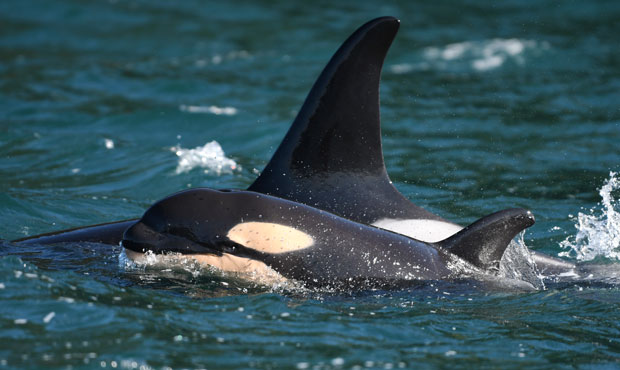
Orca calf L125 swimming with its mother, Surprise. (Center for Whale Research)
“We kept taking photos of the whole group, hoping J64 was playing with other whales. However, there was no sign of the newest calf, even though we kept seeing J62 and J63.”
On September 23rd, the center’s researchers spotted whales from J pod in the Georgia Strait. They were able to take several photos. They also got their first look at the newest calf, J64.
The recent addition to the pod had been originally reported by the Orca Network and SeaDoc Society on September 18th.
At the time, the calf was consistently traveling alongside its mother, J42. It also showed surfacing patterns consistent with a calf that is nursing.
Previously, it was apparent J42 was heavily pregnant, prior to the appearance of the baby orca.
Based on that information, researchers were certain J42 was J64’s mother.
The new orca was J42’s first confirmed calf.
Biologists say the mortality rate for young calves are very high for orcas born in the Southern Resident population, especially those born to first-time mothers.
Some of the reasons for the high death rate, include poor nutrition and toxins transferred from a mother to her calf during gestation and lactation.
The lack of food supply is also a factor.
Orcas require healthy, abundant Chinook salmon populations to survive.
The Center for Whale Research dispatched the team of observers to capture images of the J pod after receiving reports in late October that it was headed north at the south end of Swanson Channel.
Disappointed they were unable to observe and identify the newest orca, the team slowly departed, watching as the pod rounded Helen Point and headed into Active Pass, in the Southern Gulf Islands of British Columbia.