The Spin: KIRO Newsradio uncovers voicemail telling police to delay Bite of Seattle shooting briefing
Nov 2, 2026, 12:39 PM | Updated: 5:28 pm
A voicemail from Seattle Mayor Katie Wilson’s public safety director adds a new dimension to questions about why the city waited roughly five hours to publicly brief the media after a deadly shooting at the Bite of Seattle.
In crisis communications, the first response can be just as important as the response itself. And when the facts change, an organization’s credibility can be at stake.
A newly uncovered voicemail from Wilson’s director of public safety, Alison Holcomb, adds a significant new piece of evidence to the ongoing dispute over why it took the city roughly five hours to hold its first news briefing after a deadly shooting at the Bite of Seattle.
KIRO Newsradio uncovered the voicemail, in which Holcomb told Seattle police to hold off on a press conference that night.
The recording raises new questions about what the mayor knew, who directed the delay, and whether the administration’s public explanations accurately reflected what happened.
The shooting sent thousands of people fleeing the event. Others took shelter inside nearby stores and restaurants, waiting for information from city leaders about what had happened and whether they were safe.
As the hours passed without a public briefing, questions emerged about why the city was taking so long to communicate with the public. There was also speculation about whether political or public relations considerations had influenced the timing.
What followed was a series of competing explanations from the mayor’s office and Seattle police.
Mayor initially denied her office delayed briefing
On July 28, days after the shooting, a reporter asked Wilson whether anyone in her office had pushed to delay a press conference until dignitaries could arrive.
“That is not my understanding,” Wilson responded.
Three days later, the mayor’s explanation shifted.
Wilson acknowledged there had been communication problems, pointing to failures within the Seattle Police Department and communication errors between police and her office.
“I think part of this is communications failures in SPD and part of that is communication errors between SPD and my office,” she said.
Weeks later, Seattle Police Department (SPD) Assistant Chief Tyrone Davis gave the Seattle City Council a different account.
Davis testified that police were prepared to hold a press conference that night. He said he was getting ready to go downstairs and speak to reporters when he contacted Deputy Mayor Brian Surratt as a courtesy.
Davis said Surratt told him they needed to wait for the mayor.
“We were ready to go. I was getting ready to walk down there and handle it,” Davis told council members. “I did talk to the deputy mayor — just to kind of let him know as a courtesy that we’d go down and conduct the conference — and I was told we need to wait for the mayor.”
About two weeks later, Wilson disputed Davis’ account.
“My deputy mayor did not do that,” she said, adding that her office had asked the Office of the Inspector General to review communications from that night rather than rely on people’s recollections.
That review was intended to establish what actually happened, including who communicated with whom and when.
Newly uncovered voicemail raises more questions
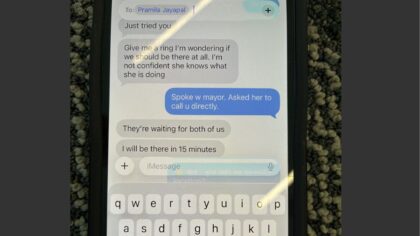
The voicemail uncovered by KIRO Newsradio adds another member of the mayor’s staff to the timeline: Holcomb, the mayor’s director of public safety.
Her message to police instructed them to hold off on a press conference that night.
That raises an important distinction in Wilson’s earlier statements.
When the mayor said her deputy did not tell police to wait, did she know another member of her administration had delivered that instruction?
Did she know Holcomb had left the voicemail?
And was the administration’s response based on a narrow distinction over which staff member communicated with police, rather than a full accounting of whether the mayor’s office had intervened?
Those questions are particularly significant because Wilson had previously pointed to the need for a full review of communications rather than relying on individual recollections.
RELATED STORIES
Mayor’s office points to response changes made after shooting
In its latest response to the voicemail, the mayor’s office pointed to an acknowledgment of “missteps” and reiterated a crisis-response framework announced in September.
But a plan introduced after the shooting does not establish what happened during the hours immediately following it.
Nor does it answer why police were told to hold off on speaking publicly while people at and around the event were waiting for information.
The distinction matters. Improving future emergency communications is important, but it is not a substitute for explaining past decisions.
For public officials, crisis communications should be built around anticipating scrutiny, preparing for difficult questions and being transparent from the beginning.
That is what future-proofing a public response looks like.
When explanations change, different officials offer conflicting accounts and new evidence emerges, the questions only multiply.
And when the public is waiting for answers during an emergency, credibility is not something an administration can simply restore with a new communications plan.
It has to be earned through transparency and accountability.
Follow Luke Duecy on X. Read more of his stories here. Submit news tips here.