Alaska Native villages have few options and little US help as climate change devours their land
Nov 22, 2025, 6:10 AM
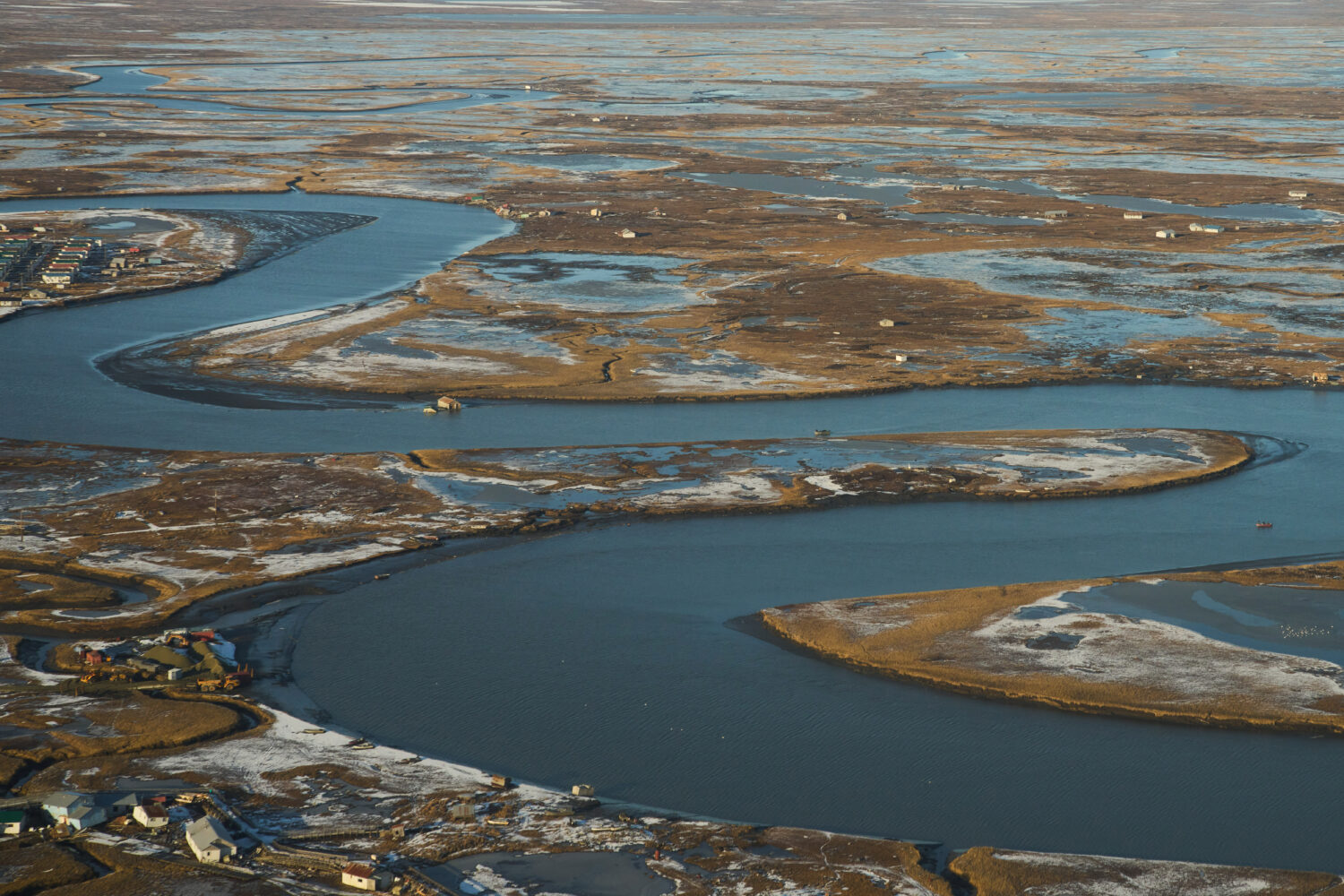
Some homes and buildings that were torn off their foundations and floated away are seen near the village of Kwigillingok, Alaska, Monday, Oct. 27, 2025, after Typhoon Halong hit the region earlier in the month. (AP Photo/Lindsey Wasson)
Credit: ASSOCIATED PRESS
(AP Photo/Lindsey Wasson)

JUNEAU, Alaska (AP) — Storms that battered Alaska’s western coast this fall have brought renewed attention to low-lying Indigenous villages left increasingly vulnerable by climate change — and revived questions about their sustainability in a region being reshaped by frequent flooding, thawing permafrost and landscape-devouring erosion.
The onset of winter has slowed emergency repair and cleanup work after two October storms, including the remnants of Typhoon Halong, slammed dozens of communities. Some residents from the hardest-hit villages, Kipnuk and Kwigillingok, could be displaced for months and worry what their futures hold.
Kwigillingok already was pursuing relocation before the latest storm, but that can take decades, with no centralized coordination and little funding. Moves by the Trump administration to cut grants aimed at better protecting communities against climate threats have added another layer of uncertainty.
Still, the hope is to try to buy villages time to evaluate next steps by reinforcing rebuilt infrastructure or putting in place pilings so homes can be elevated, said Bryan Fisher, the state’s emergency management director.
“Where we can support that increased resilience to buy that time, we’re going to do that,” he said.
Alaska is warming faster than the global average. A report released last year by the Alaska Native Tribal Health Consortium found 144 Native communities face threats from erosion, flooding, thawing permafrost or a combination.
Coastal populations are particularly vulnerable, climate scientist John Walsh said. Less Arctic sea ice means more open water, allowing storm-driven waves to do damage. Thawing permafrost invites more rapid coastal erosion. Waves hitting permafrost bounce like water off a concrete wall, he said, but when permafrost thaws, the loose soil washes away more easily.
Wind and storm surge from the remnants of Halong consumed dozens of feet of shoreline in Quinhagak, disturbing a culturally significant archaeological site. Quinhagak, like Kipnuk and Kwigillingok, is near the Bering Sea.
Just four times since 1970 has an ex-typhoon hit the Bering Sea coast north of the Pribilof Islands, said Rick Thoman, a climate specialist with the Alaska Center for Climate Assessment and Preparedness. Three of those have been since 2022, starting with the remnants of Merbok that year.
The damage caused by ex-typhoon Halong was the worst Fisher said he has seen in his roughly 30 years in emergency management. About 700 homes were destroyed or severely damaged, estimates suggest. Some washed away with people inside and were carried for miles. Kipnuk and Kwigillingok — no strangers to flooding and home to around 1,100 people — were devastated. One person died, and two remain missing.
At-risk communities can reinforce existing infrastructure or fortify shoreline; move infrastructure to higher ground in what is known as managed retreat; or relocate entirely. The needs are enormous — $4.3 billion over 50 years to protect infrastructure in Native communities from climate threats, according to the health consortium report, though that estimate dates to 2020. A lack of resources and coordination has impeded progress, the report found.
Simply announcing plans to relocate can leave a community ineligible for funding for new infrastructure at their existing site, and government policies can limit investments at a new site if people aren’t living there yet, the report said.
It took decades and an estimated $160 million for the roughly 300 residents of Newtok in western Alaska to move 9 miles (14.5 kilometers) to their new village of Mertarvik. Newtok was one of the first Alaska Native communities to fully relocate, but others are considering or pursuing it. In Washington and Louisiana, climate change has been a driving force behind relocation efforts by some tribes.
But many villages, including Kipnuk and Kwigillingok, “don’t have that kind of time,” said Sheryl Musgrove, director of the Alaska Climate Justice Program at the Alaska Institute for Justice. The two are among 10 tribal communities her group has been working with as they navigate climate-adaptation decisions.
Kipnuk before the last storm had been planning a protect-in-place strategy but hasn’t decided what to do now, she said.
Musgrove hopes that in the aftermath, there will be changes at the federal level to help communities in peril. There is no federal agency, for example, tasked with coordinating relocation. That leaves small communities trying to navigate myriad agencies and programs, Musgrove said.
“I guess I’m just really hopeful that this might be the beginning of a change because I think that there is a lot of attention to what happened here,” she said.
With money from the Infrastructure Investment and Jobs Act and Inflation Reduction Act, the U.S. Bureau of Indian Affairs in 2022 created the Voluntary Community-Driven Relocation Program and committed $115 million for 11 tribes’ relocation efforts, including $25 million each for Newtok and Napakiak. In Napakiak, most of the infrastructure is expected to be destroyed by 2030, and the community is moving away from the banks of the Kuskokwim River.
That is not enough to move a village, and additional funding opportunities are scattered across other agencies, including the U.S. Department of Agriculture and the National Oceanic and Atmospheric Association.
Sustained federal support is uncertain as the Trump administration cuts programs related to climate change and disaster resilience. Trump in May proposed cutting $617 million from the Bureau of Indian Affairs’ tribal self-governance and communities programs but did not specify which programs.
The Department of Interior said in an email that new grant funding is “under review as part of a broader effort to improve federal spending accountability,” but that the Bureau of Indian Affairs was “helping tribes lay the groundwork for future implementation when funding pathways are clarified.”
Other federal money that could help Alaska villages has already been cut. Federal Emergency Management Agency awards to Newtok and Kwigillingok for projects related to relocation didn’t arrive before the administration in April halted billions of dollars in unpaid grants.
Trump has also stopped approving state and tribal requests for hazard mitigation funding, a typical add-on that accompanies federal support after major disasters.
Even the data that villages need to assess how climate change is affecting them are at risk. The Trump administration has removed information related to climate change from government websites and has fired scientists in charge of the nation’s congressionally mandated climate assessment reports.
___
Aoun Angueira reported from San Diego.