Apply safety rules to more trains carrying flammable cargo, lawmakers urge
Aug 21, 2025, 12:43 PM | Updated: Aug 22, 2025, 10:22 am
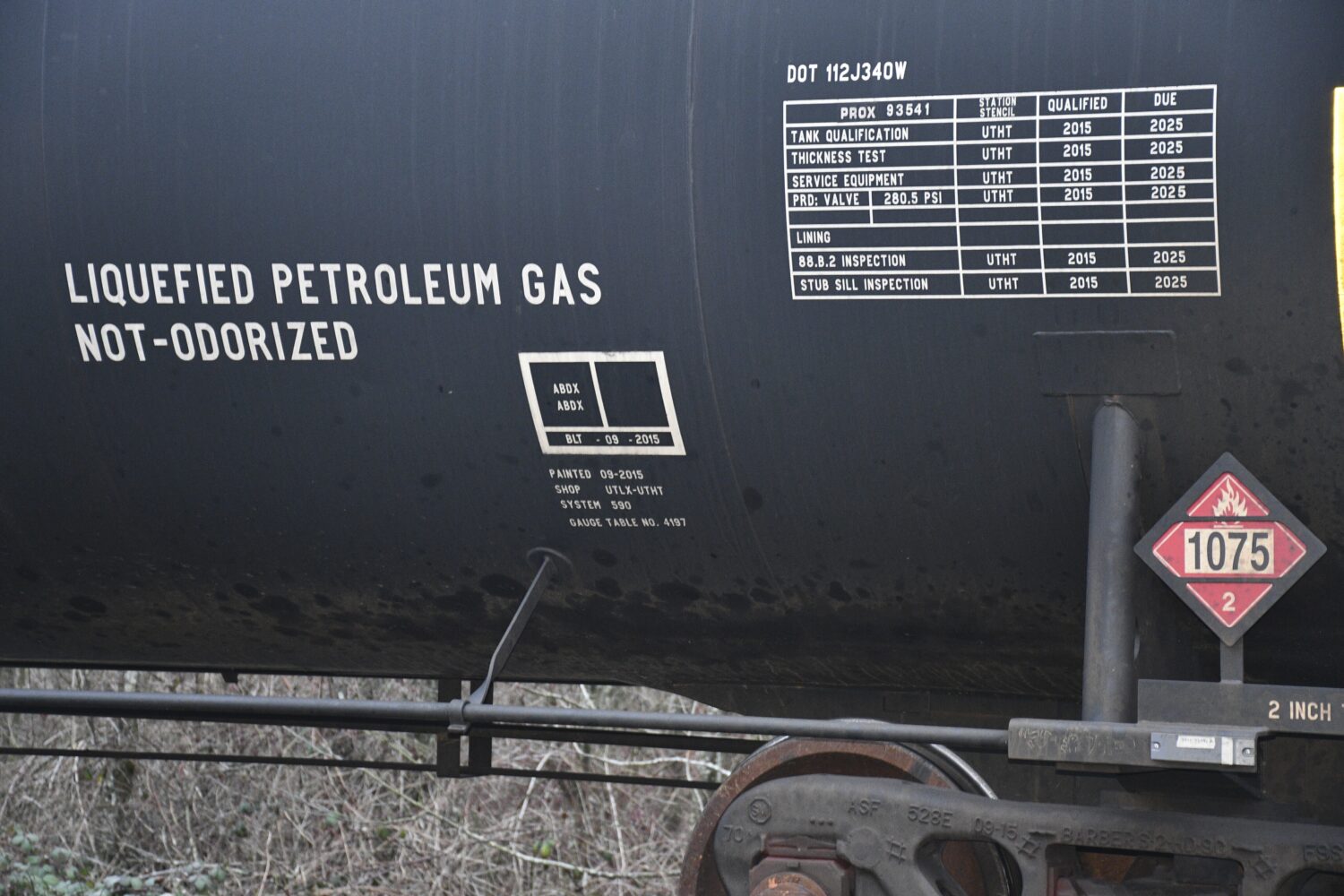
This image provided by the Howard Center for Investigative Journalism shows a Class 2.1 hazardous material placard, warning of flammable gases, on a tank car carrying liquified petroleum gas sits on the railway tracks in Blaine, Wash. on March 3, 2025. (Daranee Balachandar/Howard Center for Investigative Journalism via AP)
Credit: ASSOCIATED PRESS
(Daranee Balachandar/Howard Center for Investigative Journalism via AP)

When a BNSF freight train carrying six cars of liquefied petroleum gas derailed near Manuelito, New Mexico, in 2024, the resulting fire shut down more than 100 miles of an interstate highway.
The train carried enough flammable material to send a column of fire and black smoke high into the thin, dry air — but not enough to qualify as a “high-hazard flammable train” under federal rules.
That meant the train was not obligated to follow federal safety rules that require high-hazard flammable trains, or HHFTs, to operate at slower speeds, and use safer braking systems and tank cars.
It also meant BNSF was not obligated to include the train in federally-mandated reports to New Mexico emergency management officials estimating the movement of HHFTs through the state.
Federal safety investigators and some lawmakers want to change that. For more than a decade, the National Transportation Safety Board, which investigates major train accidents, has tried and failed to convince federal regulators to make HHFT safety rules apply to a much larger number of trains. In an investigation report on the Manuelito disaster released in June, the NTSB again called for changes.
The current definition of an HHFT only covers trains carrying large quantities of flammable liquids, such as crude oil or alcohol. The safety board wants to expand the definition to include liquefied petroleum gas and other flammable gases.
The issue generated intense interest from lawmakers following the catastrophic derailment of a Norfolk Southern train that caught fire, resulting in the release of a toxic plume of vinyl chloride — a flammable gas — over East Palestine, Ohio, in 2023. The train wasn’t classified as an HHFT, even though it was carrying three loaded tank cars of flammable liquid. That’s because the federal definition requires a train to carry at least 35 loaded cars of flammable liquid — or at least 20 cars in a row – to qualify.
In the wake of that accident, some members of Congress filed legislation that overlaps with the NTSB recommendation and goes one step further. The DERAIL Act, introduced by Rep. Chris Deluzio, D-Pa., would define an HHFT as one carrying even a single car of a flammable gas or a flammable liquid.
“I think what we saw in the East Palestine derailment is a pretty blunt reality that even just a single train carrying something flammable and toxic — say, like vinyl chloride — can cause a lot of harm to people who live near the tracks,” said Deluzio, whose Pennsylvania district sits just across the border from East Palestine.
The bill stalled in the House after being introduced in 2023, but Deluzio reintroduced it in January. Supporters say the legislation, which has not moved in Congress, could provide U.S. communities with a more accurate picture of risk from train derailments.
That’s because there are many more trains carrying small amounts of flammable material than there are trains carrying large amounts, according to a Howard Center for Investigative Journalism analysis of data that details the precise movement of freight trains.
Federal transportation officials have recognized rail as the “safest land-based method of moving large quantities of chemicals over long distances” when compared with movement on trucks.
The Association of American Railroads — an industry lobbyist and trade group with significant sway over rail safety practices — “has concerns with a number of the provisions in (the DERAIL Act) and similar bills,” spokesperson Jessica Kahanek said. The industry follows its own protocol that limits the speed of trains carrying more than 20 cars of hazardous material, she noted.
The association is open to discussing the HHFT definition, but changes “must be driven by an assessment of actual risk,” Kahanek said, and must allow railroads “to continue safely delivering the goods Americans depend on each day.”
Railroads closely protect real-time and location-specific information about the movement of freight trains carrying hazardous materials, saying public disclosure presents a public safety risk.
To analyze the potential impact of the proposed change to the definition of HHFTs, the Howard Center relied on data from RailState LLC, a company that independently captures detailed information on train movements.
The company has placed optical sensors on private land at key locations across the North American rail network. The sensors take pictures of each passing train. They use artificial intelligence to extract information about the cargo, identifying hazardous materials by reading warning placards displayed on rail cars.
The firm sells its information to government agencies in the U.S. and Canada, as well as to shippers and other clients.
Only the railroads — and not the U.S. government — know the precise number and real-time location of HHFTs. It’s not possible, even with RailState’s data, to precisely compare the number of trains that meet the current definition to the number of HHFTs that would meet the proposed definition.
One major reason: both definitions only consider loaded tank cars, and RailState’s data cannot automatically determine whether a tank car is loaded — or only contains chemical residue.
What is clear from the RailState data, however, is that there are many more trains with a smaller number of cars with hazmat placards indicating the presence of a flammable gas or a flammable/combustible liquid than there are trains carrying a large number of cars with placards for a flammable/combustible liquid.
The Howard Center counted trains that passed RailState sensors over the last six months with at least one car with a hazmat placard indicating it carried a flammable gas or a flammable/combustible liquid. Then the Howard Center counted the number of trains with at least 35 cars bearing a placard for a flammable/combustible liquid, and compared the two numbers.
At RailState sensors located near the East Palestine accident site, the data captured six times as many trains with at least one car of flammable gases or flammable/combustible liquids.
At the sensor closest to the Manuelito crash site, there were five times as many trains.
At the company’s U.S.-Canadian border sensor in Blaine, Washington, there was a 16-fold difference.
Across the RailState sensor network, the smallest difference observed by the Howard Center was a three-fold difference — at a sensor near the U.S.-Mexico border in Laredo, Texas.
While RailState does not monitor the entire U.S. rail system, the analysis showed a tenfold difference, on average, across its sensors in the United States. The company has nearly 100 U.S. sensors located in 18 states, along with more than 150 across Canada.
In Custer, Washington, along a stretch of rail just south of RailState’s Canadian-border sensor in Blaine, Jennifer Reich was cleaning the kitchen floor of her art studio in December 2020 when she saw a black smoke plume emerge from the railroad tracks across the street from her shop.
A BNSF train carrying 106 cars of petroleum crude oil derailed near the end of its trip from the Bakken oil fields in North Dakota to a refinery in nearby Cherry Point, Washington. Nearly 30,000 gallons (113,000 liters) of oil caught fire and burned uncontrolled for two hours, according to the NTSB, prompting Reich and her neighbors to evacuate.
The derailment caused at least $1.5 million in damages, according to the NTSB, but no one was injured.
“That was very lucky because it could have been a whole lot worse,” said Reich, the owner of Whimsy Glass Art Studio.
Over the last decade, at least six trains that met the HHFT classification derailed — including the incident in Custer, a Howard Center review of federal accident data found.
— A BNSF train on Sept. 19, 2015, spilled nearly 50,000 gallons (190,000 liters) of ethanol near Lesterville, South Dakota, after it derailed on a small bridge. The train carried 96 loaded cars of ethanol, according to investigation reports.
— A Union Pacific train with 96 loaded tank cars derailed in Fort Worth, Texas, on April 24, 2019, and leaked around 65,000 gallons (246,000 liters) of denatured ethanol, which ignited and formed pool fires. Some of the denatured ethanol entered a tributary of the Trinity River, according to investigation reports.
— On Feb. 13, 2020, a mudslide led to a CSX Transportation train derailment near Draffin, Kentucky, and released more than 38,000 gallons (144,000 liters) of denatured ethanol, which combined with diesel fuel from the derailed locomotives and ignited. The train carried 96 loaded tank cars, according to the investigation report.
— On January 8, 2022, 37 tank cars of a BNSF train derailed and 28 of them released around 601,000 gallons (2.27 million liters) of denatured ethanol in Oklaunion, Texas. The leaked ethanol resulted in a pool fire that burned for around four hours, according to investigation reports.
— On March 10, 2017, a Union Pacific train derailed carrying 98 loaded tank cars, releasing 322,000 gallons (1.25 million liters) of ethanol that caught fire near Graettinger, Iowa.
The U.S. Pipeline and Hazardous Materials Safety Administration proposed a federal regulation classifying HHFTs in 2014, a year after one of the worst rail disasters in modern North American history.
In 2013, a train carrying more than 70 cars of flammable Bakken crude oil derailed in Lac-Mégantic, Quebec, Canada, killing 47 people and leveling dozens of buildings.
The accident helped popularize the nickname safety and environmental activists use to describe the movement of large quantities of flammable liquid by rail: “bomb trains.”
___
The Howard Center for Investigative Journalism at the University of Maryland is funded by a grant from the Scripps Howard Foundation in honor of newspaper pioneer Roy W. Howard.