Arkansas campaign ad sparks conservative backlash for portraying lazy welfare recipient as white
Oct 5, 2026, 9:07 PM | Updated: Oct 6, 2026, 8:40 am
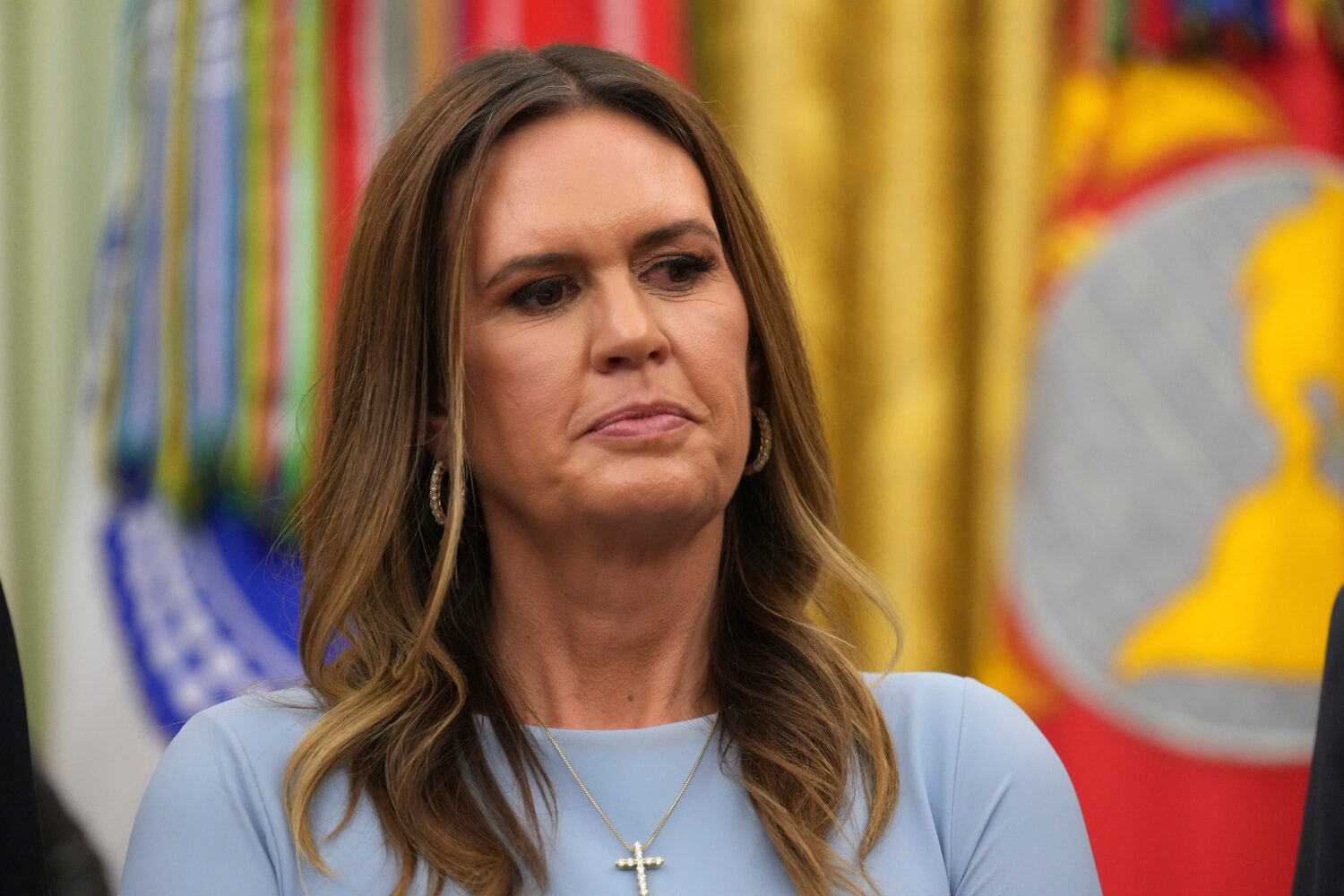
Arkansas Gov. Sarah Huckabee Sanders listens as President Donald Trump speaks during an event about healthcare in the Oval Office of the White House, Friday Sept. 18, 2026, in Washington. (AP Photo/Jacquelyn Martin)
Credit: AP Photo/Jacquelyn Martin
(AP Photo/Jacquelyn Martin)

LITTLE ROCK, Ark. (AP) — A new video from Arkansas Gov. Sarah Huckabee Sanders was standard issue Republican messaging for promoting her state’s stricter rules for people on Medicaid. No more could able-bodied people lounge around while receiving taxpayer-funded healthcare, she said — they needed to work.
But the decision to portray an unemployed moocher as a young, white, cheeseball-chomping gamer named Brad upset some conservative commentators last week. Five decades after Ronald Reagan popularized the “welfare queen” trope about people living luxuriously while not working, they wanted to know why the video wasn’t featuring a Black woman instead.
“Republicans don’t have the balls to do this ad with ‘Shaniqua’ as the villain,” posted Matt Walsh, a conservative writer. “Even though that would actually be an accurate portrayal of the problem at hand.”
Sean Davis, co-founder of the Federalist website, wrote that “our government has systematically discriminated against white men for decades now, and yet now has the audacity to dishonestly mock young white men as welfare queens.”
Never mind that the video was about Medicaid and not welfare, or that most Medicaid recipients in Arkansas are white. The outrage was a reminder of how old tropes are “chronically accessible” images in some voters’ minds, said Ange-Marie Hancock, author of “The Politics of Disgust and the Public Identity of the ‘Welfare Queen.’”
She thinks the Arkansas video was supposed to appeal to older voters living with unemployed adult children. But conservatives could only focus on race, Hancock said, because the idea of a Black welfare abuser has worked for them for decades.
“The longer race and gendered history really points to ideas that African Americans are lazy, they don’t do the right thing,” she said.
The debate that streaked across social media was the latest example of how conservatives have recently wrestled with racist views. Last month, a Texas political candidate named Bo French posted a picture of nonwhite students cheering at a University of Texas football game, saying “the problem is now obviously far worse than anyone imagined.” Some Republicans denounced French’s post, while it was embraced by those who fear the country’s changing demographics.
Sanders, who is running for reelection this year, “stands by the ad,” said Jordan Powell, her campaign manager.
“We should never confiscate money from hard-working Arkansans to give it away to those who simply choose not to work at all,” Powell told The Associated Press in an emailed statement.
The “welfare queen” trope is often used to advance restrictions on public assistance programs.
While unsuccessfully running for president in 1976, Reagan complained about a woman in Chicago who was using “80 names, 30 addresses, 12 Social Security cards” to game the system. The story was embellished, but Reagan worked to reshape public assistance programs after winning the White House in 1980.
Allison Butler, author of “The Judgment of Gender: How Women are Centered and Silenced in Pop Culture,” said the debate perpetuated a powerful myth that women of color were siphoning government assistance.
“When you deconstructed that narrative and actually tried to find the source of it … there was no woman of color who wouldn’t get a job and had multiple televisions and a Mercedes-Benz,” Butler said.
Barry Jefferson, president of the NAACP Arkansas State Conference, has condemned the Sanders ad for reducing low-income people to a stereotype where poverty is seen as a flaw. It ignores the complexities that make it harder for low-income people, regardless of race, to support themselves, he said.
“We shouldn’t betray anyone because they are asking for help and they don’t meet your standards,” Jefferson said.
Created in 1965 as a joint federal and state health insurance program, Medicaid offers free or low-cost medical coverage to people with limited income including the elderly, children or adults with disabilities who cannot work. Nearly 66 million people were enrolled in Medicaid as of June, according to the Medicaid.gov website.
Over 38% of beneficiaries between the ages of 0-64 are white, according to 2024 data from research organization KFF. Nearly 19% are Black.
More work requirements for some Medicaid beneficiaries kicked in across the U.S. this year under President Donald Trump’s big 2025 tax cut and policy law. A handful of Republican-led states, including Arkansas, are going beyond what the law calls for to prevent fraud including demanding more documentation if someone is too medically frail to work.
In July, Sanders soft-launched mandating that healthy people ages 19 to 64 find work, volunteer or attend school at least 80 hours per month to stay in the Arkansas Health and Opportunity for Me Medicaid program, or ARHOME.
Robert Coon, managing partner at Impact Management Group, a political consulting and public-opinion firm with an Arkansas office, said that welfare work requirement policy is generally favored in Arkansas.
But suggestions the person in the ad should be Black are “overtly racist” and “inaccurate,” Coon said.
About 60% of ARHOME recipients are white and around 18% are Black, according to recent data from the state Department of Human Services.
Right-wing rhetoric about Black Americans and public assistance often ignores how generations of structural racism have produced economic disparities that contribute to their disproportionate participation in these programs.
Fewer Black people than white people overall use social service programs like Medicaid and the Supplemental Nutrition Assistance Program, or food stamps. But at roughly 13% of the U.S. population, Black people make up the largest overrepresentation of any racial group. They are 18.5% and 25%, respectively, of Medicaid and SNAP recipients.
Those statistics reflect an extremely difficult road for poor Black communities looking to rise out of poverty and build generational wealth.
Arkansas Democratic congressional candidate Chris Jones, who is Black, grew up in a family relying on food stamps. A welfare recipient is not “looking for a way out of work,” but “for a way forward,” he told AP in a statement.
The bigger question, Jones said, is not race but “why so many people who are working hard still struggle to afford groceries, housing, health care and the basic necessities of life.”
___
Tang reported from Phoenix.