California, Nevada and Arizona announce temporary plan to save water from the Colorado River
May 8, 2026, 12:21 PM
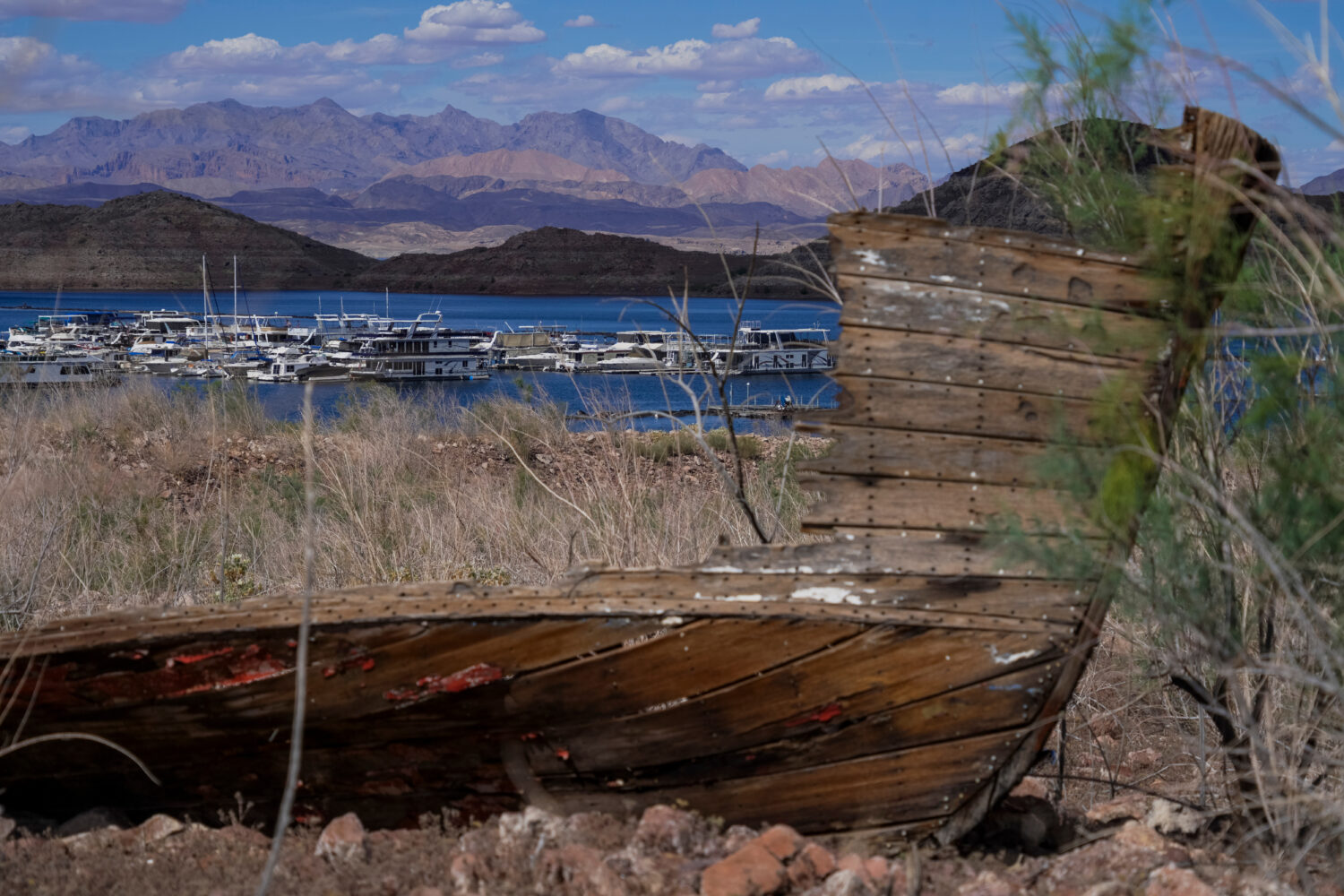
The remains of a boat sit out of the water at the Lake Mead National Recreation Area on Wednesday, Apr. 01, 2026, Boulder City, Nev. (AP Photo/Ty ONeil)
Credit: ASSOCIATED PRESS
(AP Photo/Ty ONeil)

LOS ANGELES (AP) — Absent a longer term deal on how to share a key but dwindling water source in the U.S. West, three states say they’ll cut back significantly to prop up reservoirs in a short-term agreement following the driest winter on record.
Arizona, California and Nevada announced a plan this month to save up to 1 million acre-feet (44 billion cubic feet) of Colorado River water through 2028. That’s on top of cuts already announced by the three states and Mexico, bringing the total proposed savings to 3.2 million acre-feet (139 billion cubic feet), or about enough water to serve more than 25 million people a year.
“We have kind of a crisis situation that this past winter has created,” Tom Buschatzke, Arizona’s lead negotiator, said earlier this week. “We need to do everything we can, and that’s what our plan does, to find a short-term fix.”
Already, the U.S. Bureau of Reclamation says it will release more water and earlier than usual into the badly depleted Lake Powell, one of the two biggest reservoirs on the river and in the country, to keep its hydropower humming.
The plan from Arizona, California and Nevada needs approval from federal officials and state lawmakers. Still, the states called it ambitious and far-reaching with benefits to the entire river basin.
The river supports 40 million people across seven U.S. states, two Mexican states and Native American tribes. Farmers rely on it, too, to irrigate millions of acres. And some 155 utilities depend on it for hydropower.
Some of the rules that govern the water-sharing agreement expire this year, but negotiations have mostly broken down among the states. About four months have passed since they had any substantive talks. The states in the river’s Upper Basin — Utah, Colorado, Wyoming and New Mexico — have suggested a mediator is needed. Meanwhile, the Reclamation Bureau is moving ahead with a plan in case the states don’t reach consensus in time.
Kevin Moran, of the Environmental Defense Fund, said he’s hopeful the water-reduction pledge is a catalyst for a collaborative solution among the states.
“The Colorado River is tanking,” he said. “We are at the 11th hour in needing to have strong and collaborative solutions to protect the health of the river.”
Nevada, Arizona and California make up the river’s Lower Basin. Under their proposal, Nevada and Arizona would take about one-third less water of what they’re entitled to annually from Lake Mead along the states’ border. California, which has the largest and most senior rights to the water, would shrink its use by about 13%.
How those cuts will trickle down hasn’t been worked out, but the states say they’ll come by August.
The Central Arizona Project manages much of Arizona’s share that’s delivered through a 336-mile (540-kilometer) canal system to 6 million people in central and southern Arizona. It, too, has a priority system. Farmers, cities, tribes and industry could be affected.
Most of the river’s water goes to agriculture. That’s evident in the Imperial Irrigation District, the largest single user of the river’s water, where much of the nation’s winter vegetables are grown.
The Metropolitan Water District of Southern California, which supplies water to 19 million people, relies on the river for about 20% of its supply. Reducing reliance on the Colorado River will stave off worse situations, said board member Mark Gold, but there’s still a risk.
The Lower Basin plan also depends on state and federal funding. Among the water-saving measures could be farmers leaving fields dry or replacing thirsty crops like alfalfa with drought-tolerant ones.
In cities, the reduced supply could contribute to higher water bills for residents and businesses, Gold said.
Chronic overuse, drought and rising temperatures linked to climate change mean there’s less water in the river than what was divvied up among states more than 100 years ago.
Lake Powell and Lake Mead, reservoirs that are key indicators of the river’s health, are not healthy. Both have been declining over time. If they fall below certain levels, that means hydropower production comes to a halt and water can’t be delivered to downstream users.
The Bureau of Reclamation announced plans recently to release as much as one-third of the water in Flaming Gorge reservoir upstream of Lake Powell to ensure that doesn’t happen. The hydropower from Glen Canyon Dam that holds back Lake Powell serves more than 350,000 homes.
Reclamation officials said they are reviewing the Lower Basin’s proposal while still emphasizing that they are looking for a broader agreement.
Becky Mitchell, Colorado’s lead negotiator, said the Lower Basin plan is a good first step but doesn’t do enough to protect Lake Powell.
The Upper Basin states want the Lower Basin states to commit to avoiding litigation, something that’s unlikely.
“While the Lower Division States have made progress, more is needed to protect the Colorado River System now and into the future,” she said in a statement. “These differences highlight the urgent need to come back together with the help of a mediator.”
The seven states are wrangling over who should reduce water use and by how much during a drought that’s lasted more than two decades.
Recently, Upper Basin states agreed to federal officials’ plan to send nearly one-third of the states’ annual water use to Flaming Gorge to protect Lake Powell. Water users with long-standing water rights are also cutting their water use earlier in the season than usual, with some only getting 14% or less of their annual allocations.
___
The Associated Press receives support from the Walton Family Foundation for coverage of water and environmental policy. The AP is solely responsible for all content. For all of AP’s environmental coverage, visit https://apnews.com/hub/climate-and-environment