Q&A: A look at the National Guard’s role as Trump seeks to deploy troops in Oregon and Chicago
Oct 7, 2025, 2:28 PM
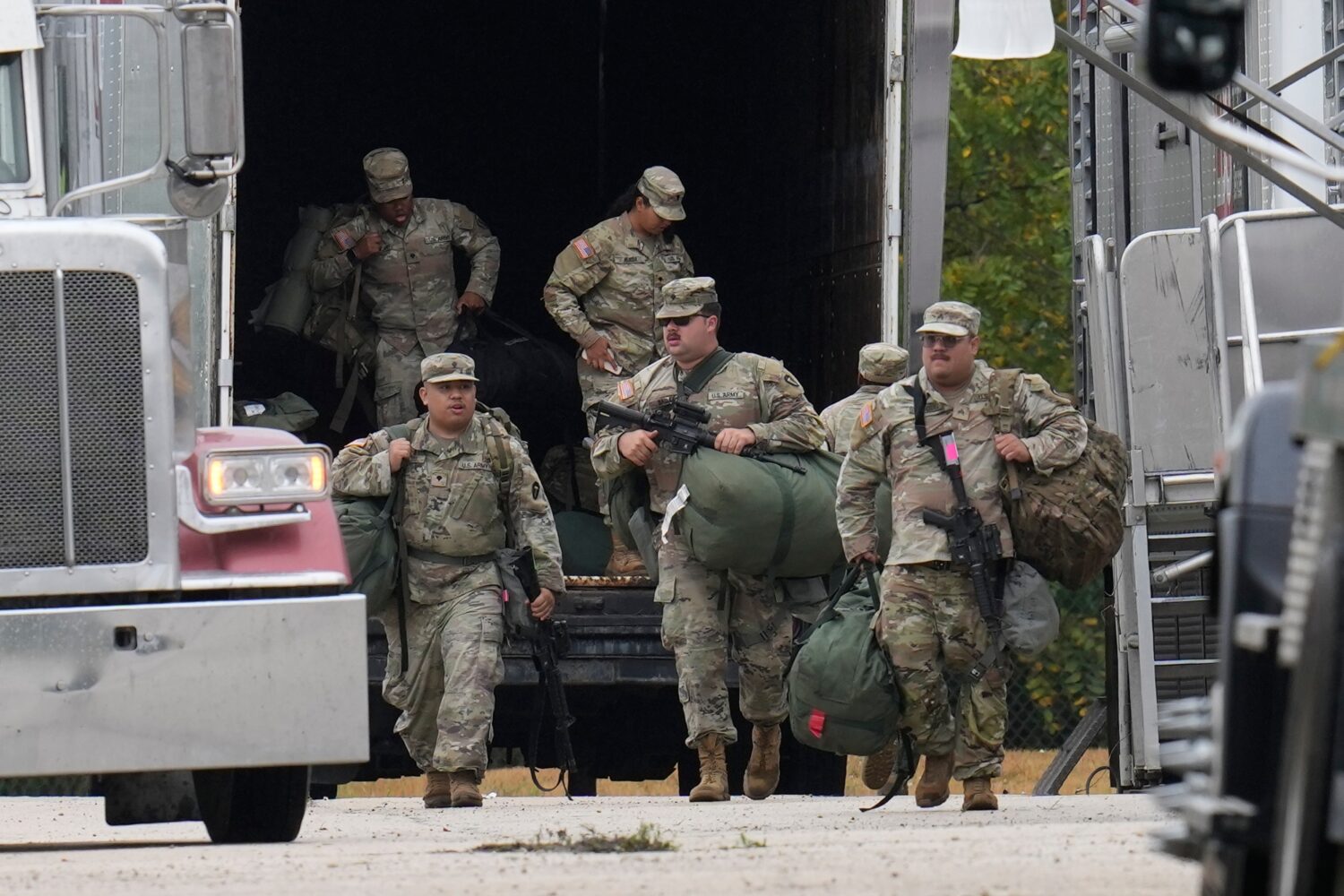
Military personnel in uniform, with the Texas National Guard patch on, are seen at the U.S. Army Reserve Center, Tuesday, Oct. 7, 2025, in Elwood, Ill., a suburb of Chicago. (AP Photo/Erin Hooley)
Credit: ASSOCIATED PRESS
(AP Photo/Erin Hooley)

President Donald Trump’s efforts to send National Guard troops into U.S. cities — including Los Angeles, Portland, Oregon, and Chicago — over the objections of Democratic mayors and governors have prompted a host of questions about the president’s authority and who controls the Guard.
A judge in California has ruled that the deployment of 4,000 National Guard members — along with 700 Marines — in Los Angeles earlier this year violated federal law. A judge in Oregon issued two temporary restraining orders over the weekend blocking the administration from deploying federal troops to protect federal property in that state. Chicago and Illinois have sued in hopes of obtaining a similar order there. National Guard troops from Texas have arrived in that state.
Amid the rapid developments as the administration appeals, here’s a look at National Guard deployments, how they have been done before and the legality of Trump’s efforts to send troops into Democratic-led cities.
National Guard units are under the control of governors, who may activate them to respond to disasters such as hurricanes or wildfires in their own or other states, unless they are called up by the president.
Under federal law, the president can take command of a state’s National Guard troops in limited circumstances: when the U.S. is being invaded or is in danger of invasion by a foreign nation; when there is a rebellion or danger of a rebellion against the United States; or when the president is “unable with the regular forces to execute the laws of the United States.”
Trump says those conditions are occurring in cities that he believes are overrun with crime and immigration protests. But his efforts in California and Oregon have been rejected by federal judges who believe he is overstepping his authority. A similar battle is brewing in Illinois, where the Democratic governor is adamantly opposed to having Guard troops deployed.
A key issue in the lawsuits brought by states and cities seeking to block the deployment of National Guard troops in their communities is whether a president’s determination is final on whether there is a danger of rebellion, or that the laws can’t be executed with “regular forces.”
The law requires that the conditions actually exist, noted Brenner Fissell, a Villanova University law professor who is also vice president of the National Institute of Military Justice.
In the Los Angeles case, the 9th Circuit Court of Appeals has said that a president’s determination is entitled to “a great level deference” but that courts can review it to ensure it fits “within the realm of honest judgment.”
In Oregon, U.S. District Judge Karin Immergut temporarily blocked Trump’s deployment of the Guard, saying the facts on the ground — involving nightly protests typically numbering a couple dozen people, with occasional larger crowds and skirmishes — did not meet that test or warrant the federalization of 200 troops.
The administration’s lawyers have asserted that courts cannot second-guess the president’s determinations. The Portland protests have strained the resources of the U.S. Department of Homeland Security, requiring agents to be transferred there from other parts of the U.S. and to work 12-hour shifts seven days a week. That shows the department cannot protect federal property with “regular forces,” they argued.
But Fissell suggested the consequences would be dire if the president can call out the National Guard over the objections of state and city leaders in response to such small protests.
“If the president on his own, unreviewably, could determine when any of these prongs exist, then there is effectively no judicial protection against a military coup in this country,” Fissell said.
Presidents assumed command of state National Guard units repeatedly during the Civil Rights Era to enforce federal court orders when Southern governors openly refused to comply with them. That included in 1957, when President Dwight D. Eisenhower took control of the Arkansas National Guard and sent in the Army’s 101st Airborne Division to allow nine Black students to integrate Central High School in Little Rock.
In 1965, President Lyndon Johnson took control of the Alabama National Guard to ensure civil rights demonstrators could march from Selma to Montgomery after state troopers attacked them. That was the last time a U.S. president deployed the National Guard against the wishes of a governor.
Presidents have also federalized the National Guard at the invitation of governors to quell unrest. Examples include when Michigan’s governor sought help controlling rioting in Detroit that left dozens of people dead in 1967, and in 1992 when California’s governor asked President George H.W. Bush to help end riots over the acquittal of four white police officers who severely beat Black motorist Rodney King.
Generally speaking, not when they fall under the command of the president. The Posse Comitatus Act, which dates to 1878, is a criminal law that bars the use of the military for domestic policing.
U.S. District Judge Charles Breyer in California found last month that Trump’s use of the Guard in Los Angeles this summer violated that law. His ruling is on hold as the administration appeals.
The cities and states challenging the deployments say they are fully capable and willing to execute the laws on their own and don’t need federal interference. Civilian police — not military troops — are the ones trained in protecting First Amendment rights; in conducting arrests, traffic stops and crowd control; in de-escalation; and in using less-lethal force.
Posse Comitatus Act violations can be punished by up to two years in prison, but no such prosecution has ever been brought in U.S. history, said Syracuse University law professor William Banks, an expert in constitutional law and national security.
“The criminal law aspect of it is not the point,” Banks said. “The point is that it establishes a presumption that we just don’t want soldiers on the street.”
There is one major exception to the Posse Comitatus Act: The president can invoke the Insurrection Act, which allows him to deploy military forces inside the U.S. to suppress rebellion or to enforce the law. Presidents Eisenhower, Kennedy and Johnson used the Insurrection Act to take control of the Guard during the Civil Rights era, and Bush to quell the LA riots.
Trump has suggested he is open to invoking it.
In that case, Banks said, “All brakes are off the administration. He can entirely militarize the city if he wanted to. He can tell everybody to stay in their houses.”
The National Guard has hundreds of thousands of part-time troops, many of whom are college students or have day jobs in their civilian life. They regularly drill one weekend a month, with an annual two-week training. They can be deployed overseas in support of combat or to conduct missions like building schools, or they can be sent out within the U.S. in response to disasters or civil unrest.
The Guard’s origins date back as far as 1636, when the first colonywide militia regiments in North America were organized in Massachusetts. The other colonies formed their own militias, which fought under Gen. George Washington during the Revolutionary War.
Because of the abuses of the British army, the framers of the Constitution opposed the idea of a standing army controlled by the president. The militias were kept under the control of the states, and Congress was given the responsibility of determining under what circumstances the president could call them into service.