There was ‘a bridge called Jesse Jackson’ across decades of civil rights advocacy
Feb 17, 2026, 8:02 AM | Updated: 11:30 am
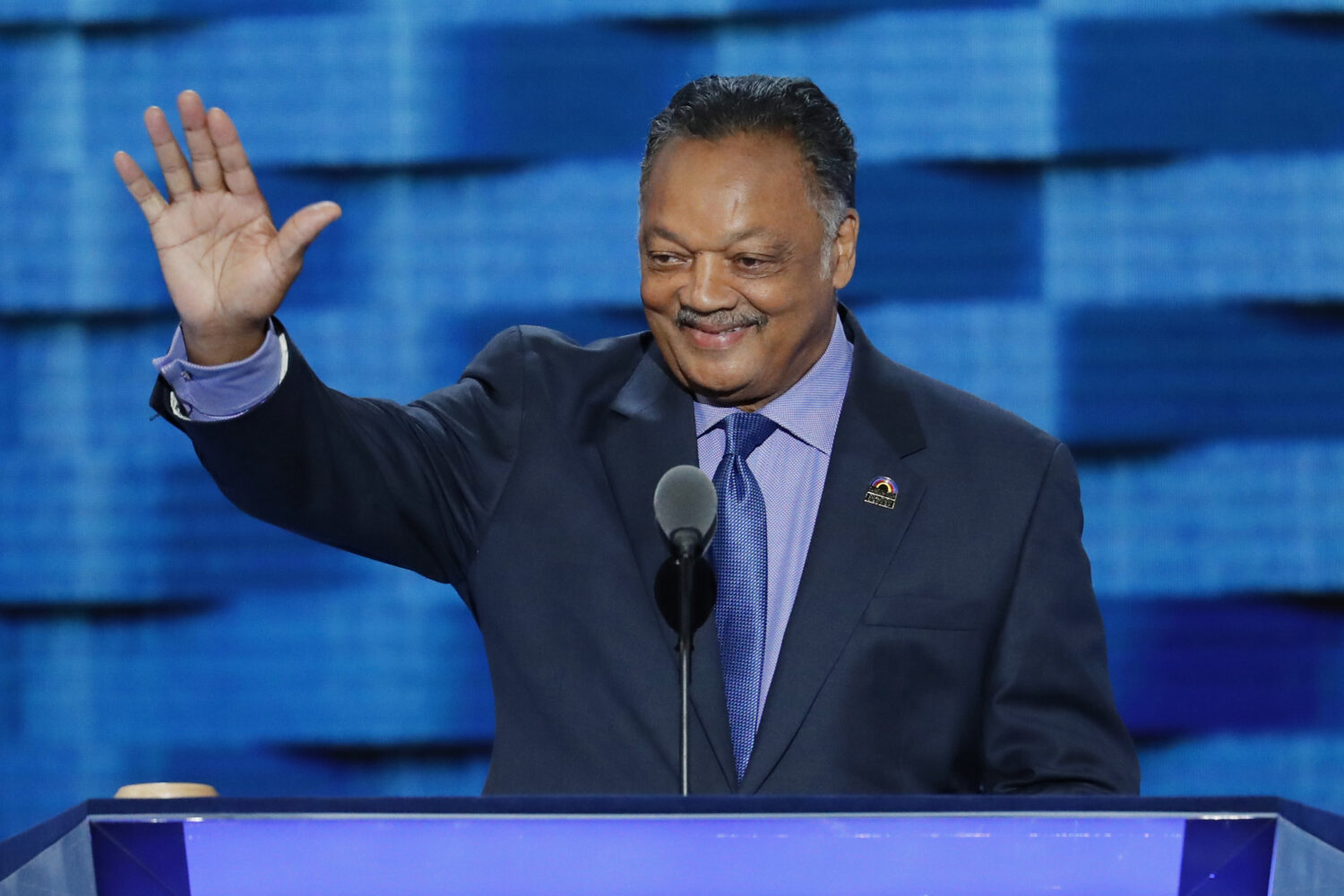
FILE - Rev. Jesse Jackson waves as he steps to the podium during the third day of the Democratic National Convention in Philadelphia, July 27, 2016. (AP Photo/J. Scott Applewhite)
Credit: ASSOCIATED PRESS
(AP Photo/J. Scott Applewhite)

CHICAGO (AP) — From the moment the Rev. Jesse Jackson stepped forward as torchbearer to what was then a largely Southern civil rights struggle — a movement with much unfinished business — he created a bridge.
From the South’s fight with Jim Crow to the North’s battle with systemic racial inequality, from the buttoned-up, conservative generation of King’s circle to the dashiki-wearing Black Power leaders and the activists of the hip-hop generation, Jackson forged a link between improbable dreams and political power.
“From Martin Luther King to Barack Obama, there’s a bridge called Jesse Jackson,” the Rev. Al Sharpton said.
Jackson, a protégé of the Rev. Martin Luther King Jr. who led the Civil Rights Movement for decades after the revered leader’s assassination, died on Tuesday, his family said. He was 84.
Jackson kept up his public advocacy for racial justice, economic and political inclusion, and civil and human rights for more than a half-century, even after a neurological disorder in his later years affected his ability to move and speak.
Weighing in on political events, supporting the families of Black Americans killed by police and participating in COVID-19 vaccination drives to battle hesitancy in Black communities, Jackson built on a career that included running for president, international diplomacy and influencing the lexicon of racial identity in America.
Jackson clearly wasn’t the lion he had been toward the end, but his presence at racial justice protests and COVID-19 advocacy events, and his arrest outside the U.S. Capitol while calling on Congress to end the filibuster to protect voting rights displayed the bite left in his bark.
“We’ve always had a place for him,” said the Rev. William Barber II, co-chair of the Poor People’s Campaign and one of many activists who have followed in his footsteps. Jackson urged them to “live life so that it’s not your alarm clock that awakes you in the morning, but a purpose. … A purpose will get you up when you want to stay down.”
At George Floyd’s memorial service, Jackson’s plaintive call, “I can’t breathe!” pierced the collective silence in a Minneapolis cathedral. He cried out twice more as the minutes ticked by to symbolize how long Floyd had a police officer’s knee pressed on his neck.
It was not only Jackson’s powerful expression of his own grief over Floyd’s death, which sparked global protests against racial injustice. It was a reminder that his voice still carried the singular resonance that for decades made him an international figure for civil and human rights.
Jackson returned to rally demonstrators marching through downtown Minneapolis, and stood with Floyd’s family when a jury convicted former Minneapolis police officer Derek Chauvin of murder in Floyd’s death. “Even if we win,” he told the marchers, “it’s relief, not victory. They’re still killing our people. Stop the violence, save the children. Keep hope alive.”
“I think the fact that he came and then came back for the judge’s verdict, suffering with Parkinson’s, shows the determination that Jesse Jackson had all the way to the end,” Sharpton said about his longtime mentor. “He once said to me, years before he was diagnosed with Parkinson’s, ‘I’m not going to stop until I drop. I’m going to die on the battlefield.’”
Early in the COVID-19 pandemic, Jackson got vaccinated and urged others to get the shot. He pointed out racial disparities in heath care and partnered with the National Medical Association, which represents Black physicians and patients, on a public health campaign to improve testing and treatment data and to recruit more African Americans to the medical field.
“It’s America’s unfinished business — we’re free, but not equal,” Jackson told The Associated Press in a 2020 interview. “There’s a reality check that has been brought by the coronavirus, that exposes the weakness and the opportunity.”
Jackson had his share of critics both within and outside the Black community. Some considered him a grandstander, too eager to seek out the spotlight.
Jackson was widely known for his appearance in photographs taken moments after King was assassinated on the balcony of a Memphis hotel on April 4, 1968. For two days afterward, Jackson wore a turtleneck he said was soaked with the venerated civil rights leader’s blood, including at a King memorial service where he told the Chicago City Council: “I come here with a heavy heart because on my chest is the stain of blood from Dr. King’s head.”
Two decades later, Jackson made history with his runs for the White House. Until Barack Obama’s election in 2008, Jackson was the most successful Black candidate for the U.S. presidency, winning 13 primaries and caucuses for the Democratic nomination in 1988, four years after his first failed attempt.
“I was able to run for the presidency twice and redefine what was possible; it raised the lid for women and other people of color,” he told the AP in 2011. “Part of my job was to sow seeds of the possibilities.”
Jackson’s cultural impact extended to the American lexicon on race and identity. In 1988, he was among a group of leaders to assert that Black people wanted to be called “African Americans,” establishing an identity that honored the population’s origins as well as their citizenship.
As the founder and leader of Operation PUSH, which later evolved into the Rainbow/PUSH Coalition, Jackson channeled cries for Black pride and self-determination into corporate boardrooms, pressuring executives to make America a more open and equitable society. His high-profile diplomatic victories included the release of American civilians abroad during conflicts.
Jesse Louis Jackson Sr. was born Oct. 8, 1941, in Greenville, South Carolina, to Helen Burns, an unmarried high school student, and Noah Louis Robinson, a married man who lived next door. Jackson was later adopted by Charles Henry Jackson, who married his mother.
Jackson played quarterback at Sterling High School in Greenville and accepted a football scholarship from the University of Illinois, but said he was told Black people couldn’t play quarterback. So he transferred to North Carolina A&T in Greensboro, arriving just months after students there launched the sit-in movement to desegregate restaurants across the South. He became first-string quarterback, student body president, and an honor student in sociology and economics.
Jackson was soon leading demonstrations, and traveled to Alabama to meet King during the march for voting rights from Selma to Montgomery in 1965. He was moving to Chicago to study theology, so King’s Southern Christian Leadership Conference assigned him the task of launching Operation Breadbasket, a campaign to pressure companies to hire more Black workers.
He later called his time with King “a phenomenal four years of work,” learning how to agitate within the law for social change.
The constant campaigns often left the college sweetheart he married in 1963, Jacqueline Lavinia Brown, taking the lead in raising their five children: Santita Jackson, Yusef DuBois Jackson, Jacqueline Lavinia Jackson Jr., and two future congressmen, former Rep. Jesse L. Jackson Jr., and Rep. Jonathan Luther Jackson. A frequent houseguest was Santita’s friend Michelle Robinson, the future first lady.
Jackson, who was ordained as a Baptist minister in 1968 and earned his Master of Divinity in 2000, also acknowledged fathering a child, Ashley Jackson, with one of his employees at Rainbow/PUSH, Karen L. Stanford. He said he understood what it means to be born out of wedlock and was supporting her emotionally and financially.
When the Southern Christian Leadership Conference and Jackson parted company in 1971, Jackson formed his own sweeping civil rights organization based in Chicago’s South Side, with a mission ranging from social services in communities of color to persuading corporate executives to hire more minorities. He formed the Rainbow Coalition after his first presidential run, then merged the political and social justice organizations into the Rainbow PUSH Coalition in 1996.
While Jackson was known for his powerful voice, his words sometimes got him in trouble. In 1984, he apologized for calling New York City “Hymietown,” a derogatory reference to the city’s large Jewish population, in what he said he believed were private comments to a reporter.
And in July 2008, he made headlines when a hot mike caught him complaining that Obama was “talking down to Black people.” Still, tears streamed down his face when he joined the immense crowd in Chicago’s Grant Park to celebrate Obama’s 2008 election victory.
“I wish for a moment that Dr. King or (assassinated civil rights leader) Medgar Evers … could’ve just been there for 30 seconds to see the fruits of their labor,” he told the AP years later. “I became overwhelmed. It was the joy and the journey.”
____
Morrison reported from New York City.