To hit back at the United States in their trade war, China borrows from the US playbook
Oct 19, 2025, 5:01 PM
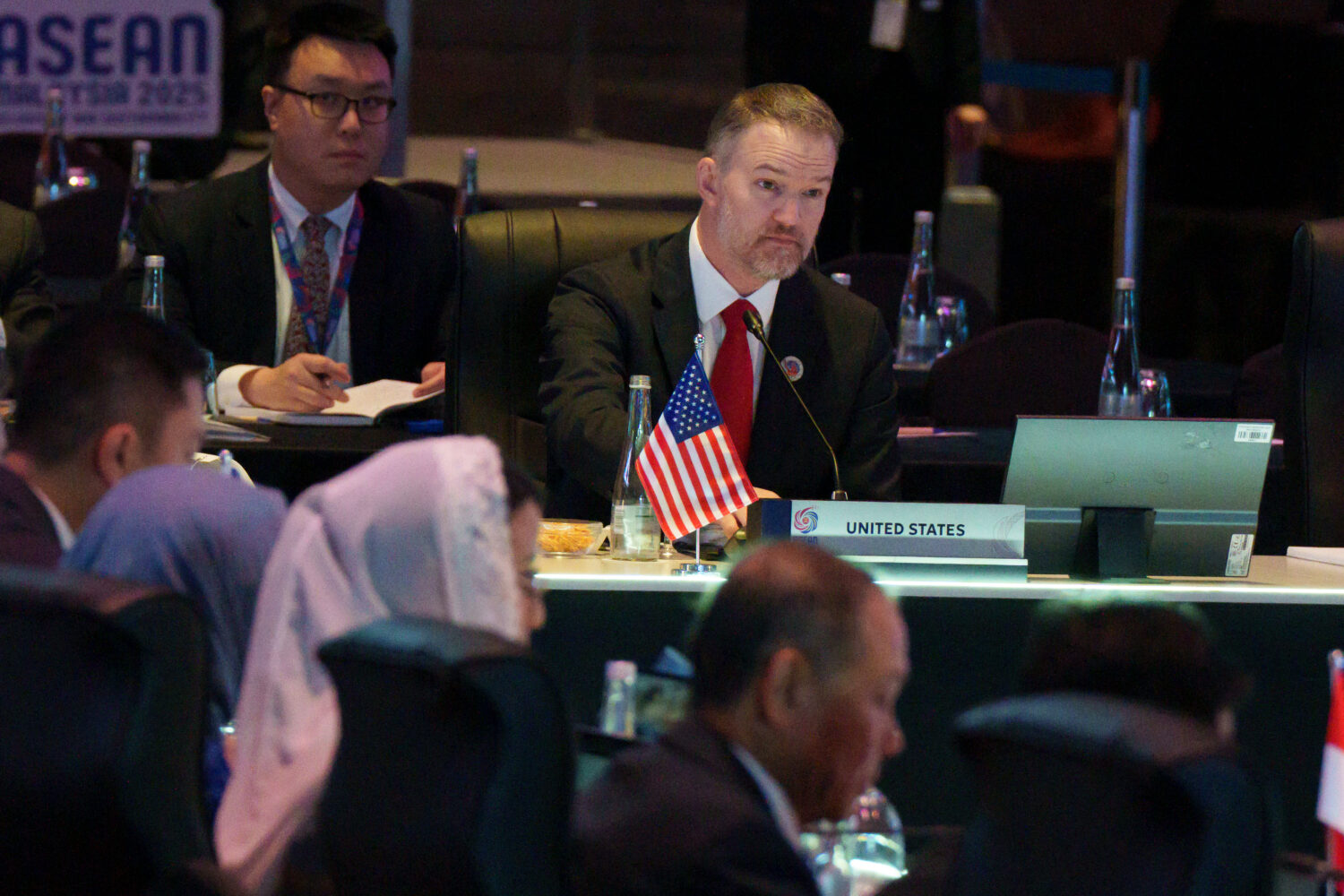
U.S. Trade Representative Jamieson Greer attends the ASEAN Economic Ministers' Meeting and related meetings in Kuala Lumpur, Malaysia, Wednesday, Sept. 24, 2025. (AP Photo)
Credit: ASSOCIATED PRESS
(AP Photo)

WASHINGTON (AP) — China likes to condemn the United States for extending its arm too far outside of its borders to make demands on non-American companies. But when it sought to hit back at the U.S. interests this month, Beijing did exactly the same.
In expanding export rules on rare earths, Beijing for the first time announced it will require foreign firms to obtain approval from the Chinese government to export magnets containing even tiny amounts of China-originated rare earth materials or produced with Chinese technology.
That means a South Korean smartphone maker must ask for Beijing’s permission to sell the devices to Australia if the phones contain China-originated rare earth materials, said Jamieson Greer, the U.S. trade representative. “This rule gives China control over basically the entire global economy in the technology supply chain,” he said.
For anyone familiar with U.S. trade practice, China is simply borrowing a decades-long U.S. policy: the foreign direct product rule. It extends the reach of U.S. law to foreign-made products, and it has been used regularly to restrict China’s access to certain U.S. technologies made outside of the United States, even when they are in the hands of foreign companies.
It is the latest example of Beijing turning to U.S. precedents for tools it needs to stare down Washington in what appears to be an extended trade war between the world’s two largest economies.
“China is learning from the best,” said Neil Thomas, a fellow on Chinese politics at Asia Society Policy Institute’s Center for China Analysis. “Beijing is copying Washington’s playbook because it saw firsthand how effectively U.S. export controls could constrain its own economic development and political choices.”
He added: “Game recognizes game.”
It was in 2018, when President Donald Trump launched a trade war with China, that Beijing felt the urgency to adopt a set of laws and policies that it could readily deploy when new trade conflicts arise. And it looked to Washington for ideas.
Its Unreliable Entity List, established in 2020 by the Chinese Ministry of Commerce, resembles the U.S. Commerce Department’s “entity list” that restricts certain foreign companies from doing businesses with the U.S.
In 2021, Beijing adopted the anti-foreign sanction law, allowing agencies such as the Chinese Foreign Ministry to deny visas and freeze the assets of unwelcome individuals and businesses — similar to what the U.S. State Department and the U.S. Department of Treasury can do.
Calling it a toolkit against foreign sanctions, intervention and long-arm jurisdiction, the state-run news agency China News in a 2021 news report cited an ancient Chinese teaching, saying Beijing would be “hitting back with the enemy’s methods.”
The law “has combed through relevant foreign legislation and taken into consideration the international law and the basic principles of international relations,” said the Chinese scholar Li Qingming as quoted in the news report. He also said it could deter the other side from escalating.
Other formal measures Beijing has adopted in the past several years include expanded export controls and foreign investment review tools.
Jeremy Daum, a senior research scholar in law and senior fellow at Yale Law School’s Paul Tsai China Center, said Beijing often draws from foreign models in developing its laws in non-trade, non foreign-related areas. As China seeks capabilities to retaliate in kind in trade and sanctions, the tools are often “very parallel” to those of the U.S., he said.
Both governments also have adopted a “holistic view of national security,” which expands the concept to justify restrictions on each other, Daum said.
When Trump launched his trade war with China shortly after he returned to the White House earlier this year, Beijing readily deployed its new tools in addition to raising tariffs to match those imposed by the U.S. president.
In February, in response to Trump’s first 10% tariff on China over allegations that Beijing failed to curb the flow of chemicals used to make fentanyl, the Chinese Commerce Ministry put PVH Group, which owns Calvin Klein and Tommy Hilfiger and the biotechnology company Illumina, on the unreliable entity list.
That barred them from engaging in China-related import or export activities and from making new investments in the country. Beijing also announced export controls on tungsten, tellurium, bismuth, molybdenum and indium, which are elements critical to the production of modern high-tech products.
In March, when Trump imposed the second 10%, fentanyl-related tariff, Beijing placed 10 more U.S. firms on its unreliable entity list and added 15 U.S. companies to its export control list, including aerospace and defense companies like General Dynamics Land Systems and General Atomics Aeronautical Systems, among others, asserting that they “endanger China’s national security and interests.”
Then came the so-called “Liberation Day” tariffs in April, when Beijing not only matched Trump’s sky-high tariff of 125% but also blacklisted more U.S. companies and announced export controls on more rare earth minerals. That led to a pause in the shipment of magnets needed in manufacturing a wide range of products such as smartphones, electric vehicles, jet planes and missiles.
While the new tools have allowed China to stare down the United States, Daum said they are not without risks.
“The dangers in such a facially balanced and fair approach are, one, what one side sees as reciprocity the other might interpret as escalation,” he said. And second, “in a race to the bottom, nobody wins.”