Tribes that restored buffalo are killing some to feed people because of the shutdown
Nov 12, 2025, 10:58 AM | Updated: 4:06 pm
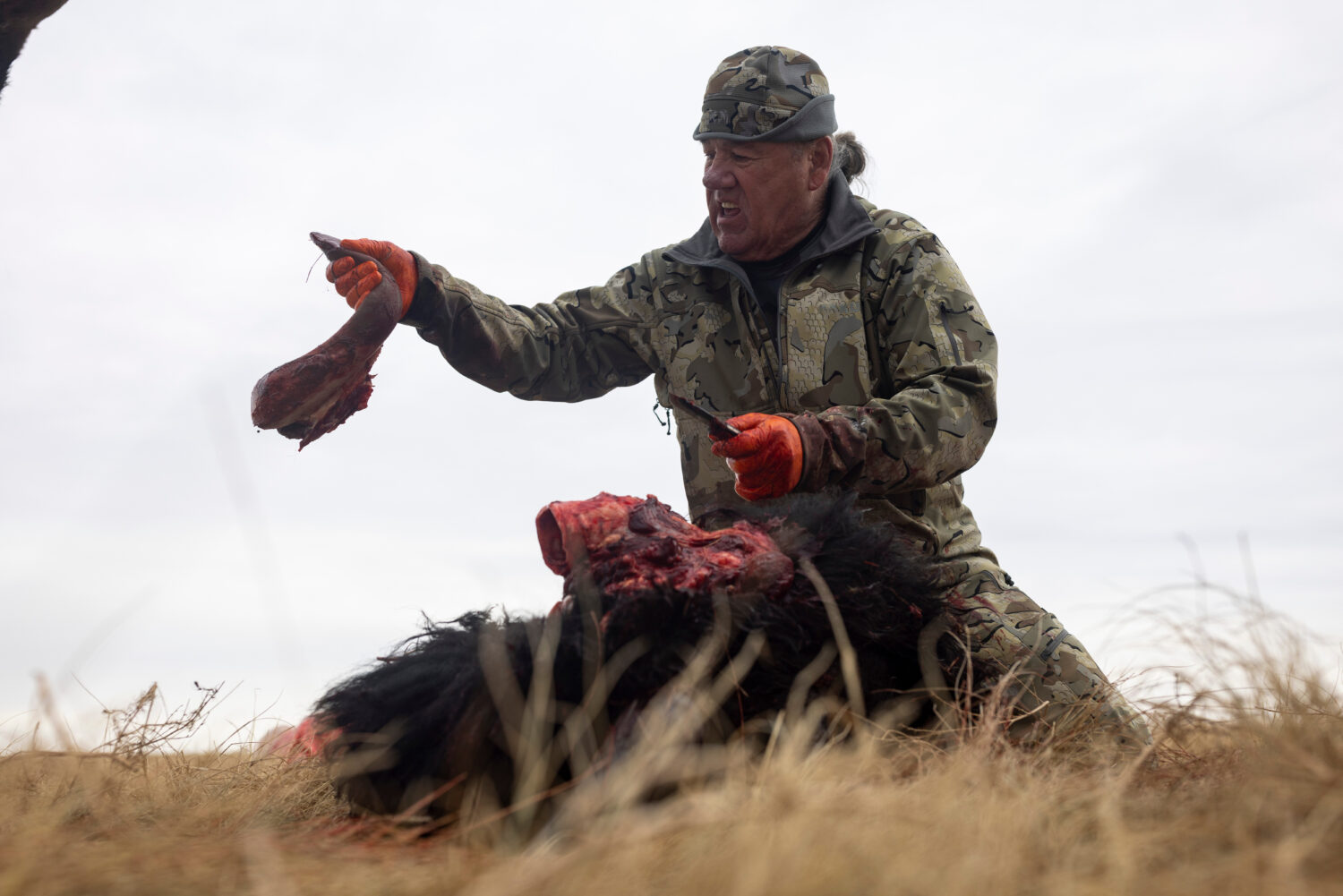
Buffalo manager Robert Magnan cuts out a bison's tongue while field dressing it at the Fort Peck Assiniboine & Sioux Tribes Buffalo Ranch near Wolf Point, Mont., Monday, Nov. 10, 2025. (AP Photo/Mike Clark)
Credit: ASSOCIATED PRESS
(AP Photo/Mike Clark)

WOLF POINT, Mont. (AP) — On the open plains of the Fort Peck Reservation, Robert Magnan leaned out the window of his truck, set a rifle against the door frame and then “pop!” — a bison tumbled dead in its tracks.
Magnan and a co-worker shot two more bison, also known as buffalo, and quickly field dressed the animals before carting them off for processing into ground beef and cuts of meat for distribution to members of the Fort Peck Assiniboine and Sioux Tribes in northern Montana.
As lawmakers in Washington, D.C., plod toward resolving the record government shutdown that interrupted food aid for tens of millions of people, tribal leaders on rural reservations across the Great Plains have been culling their cherished bison herds to help fill the gap.
About one-third of Fort Peck’s tribal members on the reservation depend on monthly benefit checks, Chairman Floyd Azure said. That’s almost triple the rate for the U.S. as a whole. They’ve received only partial payments in November after President Donald Trump’s administration choked off funds to the Supplemental Nutrition Assistance Program during the shutdown.
Fort Peck officials say they anticipated such a moment years ago, when they were bolstering their herd with animals from Yellowstone National Park over objections from cattle ranchers worried about animal disease.
“We were bringing it up with the tribal council: What would happen if the government went bankrupt? How would we feed the people?” said Magnan, the longtime steward of Fort Peck’s bison herds. “It shows we still need buffalo.”
In October, the tribal government authorized killing 30 bison — about 12,000 pounds (5,440 kilograms) of meat. Half had been shot by Tuesday. A pending deal to end the shutdown comes too late for the rest, Magnan said. With Montana among the states that dispersed only partial SNAP payments, Fort Peck will keep handing out buffalo meat for the time being.
Tribes including the Blackfeet, the Lower Brule Sioux, the Cheyenne River Sioux and the Crow have done the same in response to Washington’s dysfunction: feeding thousands of people with bison from herds restored over recent decades after the animals were hunted to near extinction in the 1800s.
Food and nutrition assistance programs are part of the federal government’s trust and treaty responsibilities — its legal and moral obligations to fund tribes’ health and well-being in exchange for land and resources the U.S. took from tribes.
“It’s the obligation they incurred when they took our lands, when they stole our lands, when they cheated us out of our lands,” said Mark Macarro, president of the National Congress of American Indians. “It lacks humanity to do this with SNAP, with food.”
Fort Peck tribal members Miki Astogo and Dillon Jackson-Fisher, who are unemployed, said they borrowed food from Jackson-Fisher’s mother in recent weeks after SNAP payments didn’t come through. On Sunday they got a partial payment — about $196 instead of the usual $298 per month — Agosto said.
It won’t last, they said, so the couple walked 4 miles (6.4 kilometers) into town to pick up a box of food from the tribes that included 2 pounds (0.9 kilograms) of bison.
“Our vehicle’s in the shop, but we have to put food on the table before we pay for the car, you know?” Jackson-Fisher said.
Native American communities elsewhere in the U.S. also are tapping into natural resources to make up for lost federal aid. Members of the Mi’kmaq Nation in Maine stocked a food bank with trout from their hatchery and locally hunted moose meat. In southeastern Oklahoma, the Comanche Nation is accepting deer meat for food banks. And in the southwestern part of the state, the Choctaw Nation set up three meat processing facilities.
Another program that provides food to eligible Native American households, the Food Distribution Program on Indian Reservations, has continued through the shutdown.
Mi’kmaq is among the tribes that don’t have the program, though the tribe is eligible. The Mi’kmaq also get funding for food pantries through the federal Emergency Food Assistance Program, but that money, too, was tied up by the shutdown, tribal Chief Sheila McCormack said.
Roughly 80% of Mi’kmaq tribal members in Aroostook County are SNAP recipients, said Kandi Sock, the tribe’s community services director.
“We have reached out for some extra donations; our farm came through with that, but it will not last long,” Sock said.
Buffalo played a central role for Plains tribes for centuries, providing meat for food and hides for clothing and shelter.
That came to an abrupt end when white “hide hunters” arrived in 1879 in the Upper Missouri River basin around Fort Peck, which had some of the last vestiges of herds that once numbered millions of animals, Assiniboine historian Dennis Smith said. By 1883 the animals were virtually exterminated, according to Smith, a retired University of Nebraska-Omaha history professor.
With no way to feed themselves and the government denying them food, the buffalo’s demise heralded a time of starvation for the Assiniboine, he said. Many other Plains tribes also suffered hardship.
Hundreds of miles to the west of Fort Peck, the Blackfeet Nation killed 18 buffalo from its herd and held a special elk harvest to distribute meat to tribal members. The tribe already gave out buffalo meat periodically to elders, the sick and for ceremonies and social functions. But it’s never killed so many of the 700 animals at once.
“We can’t do that many all the time. We don’t want to deplete the resource,” said Ervin Carlson, who runs the Blackfeet buffalo program.
In South Dakota, the Cheyenne River Sioux Tribe has distributed meat from about 20 of its buffalo. The tribe worked to build its capacity to feed people since experiencing shortages during the COVID-19 pandemic. It now has a meat processing plant that can handle 25 to 30 animals a week, said Jayme Murray with the Cheyenne River Sioux Tribe Buffalo Authority Corp. Tribes from Minnesota to Montana have asked to use the plant, but they’ve had to turn some down, Murray said.
The Lower Brule Sioux Tribe in central South Dakota recently got its first full-fledged grocery store, ending its decades-long status as a “food desert” where people had to drive 100 miles (160 kilometers) round trip for groceries. The interruption to SNAP benefits stoked panic, tribal treasurer and secretary Marty Jandreau said.
Benefits for November were reduced to 65% of the usual amount.
But the Lower Brule have buffalo, cattle and elk in abundance across more than 9 square miles (25 square kilometers). On Sunday, the tribe gave away more than 400 pounds (180 kilograms) of meat to more than 100 tribal members, council members said.
“It makes me feel very proud that we have things we can give back,” tribal council member Marlo Langdeau said.
__
Schafer reported from Lower Brule, South Dakota, and Brewer from Oklahoma City.
___ The Associated Press receives financial support for coverage of Indigenous communities from the Hopper-Dean Family Foundation. AP is solely responsible for all content. Find AP’s standards for working with philanthropies, a list of supporters, and funded coverage areas at ap.org.