US faces new pressure to build weapons without China’s rare earth magnets
Aug 3, 2026, 4:09 AM
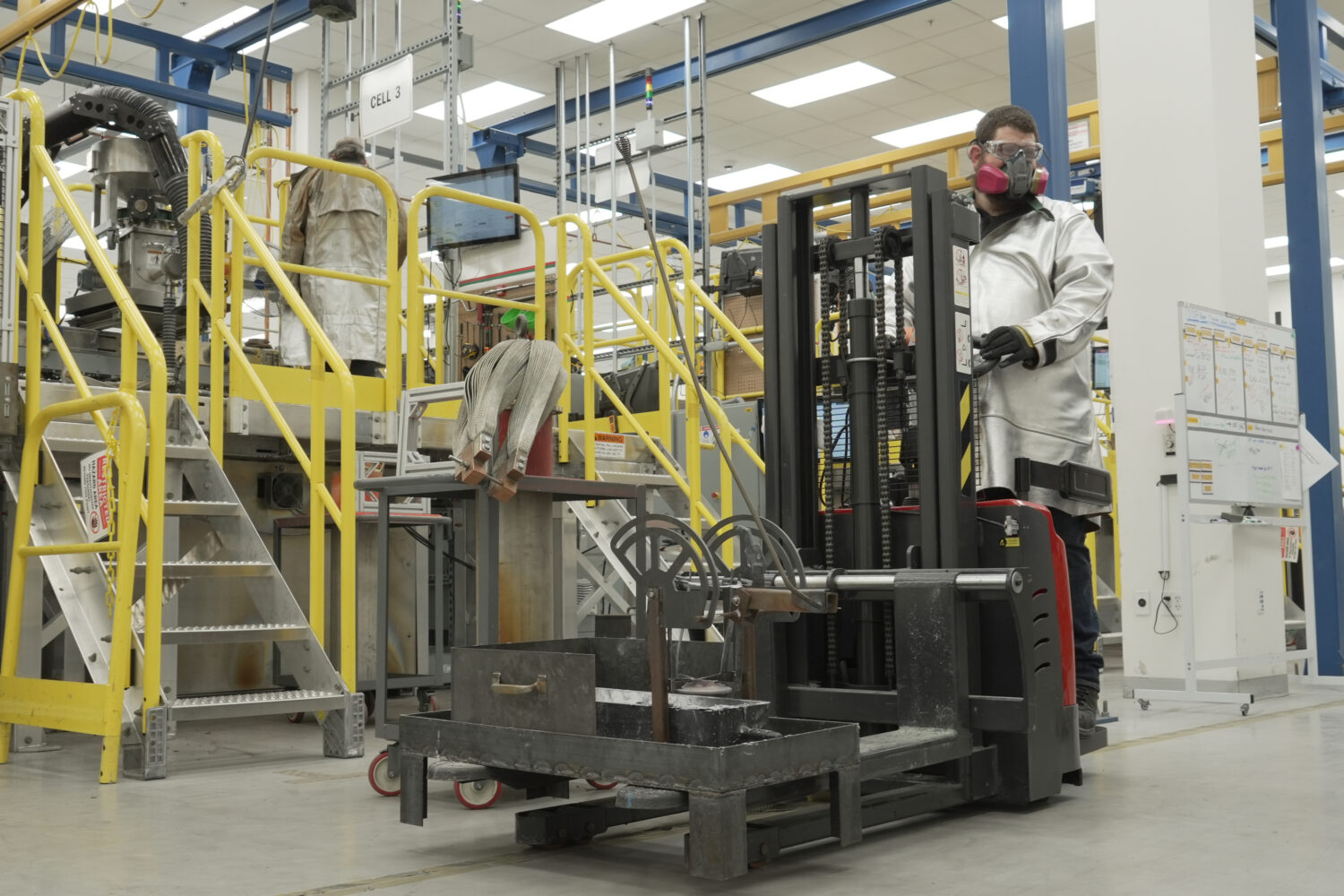
A worker drives a forklift at the Phoenix Tailings refinery Wednesday, July 22, 2026, in Exeter, N.H. (AP Photo/Rodrique Ngowi)
Credit: AP Photo/Rodrique Ngowi
(AP Photo/Rodrique Ngowi)

EXETER, N.H. (AP) — A giant American flag hanging on the wall of a warehouse in New Hampshire hints at the national importance of the elements bound inside the mining waste stored in 1-ton bags. The company uses electrolysis to separate the key critical elements President Donald Trump’s administration desperately wants to produce domestically from the powder left behind at traditional mines.
The small Phoenix Tailings refinery tucked inside an office park in Exeter, New Hampshire, could play a key role in helping America break the chokehold China has on the processing of critical minerals, but it will take 14 to 18 months to build a new factory with a $500 million loan from the Pentagon to drastically expand the company’s separation and metallization capacity, a particularly weak stage in the U.S. mines-to-magnets supply chain.
The task that workers carry out in heat-resistant suits and sealed face masks has become more urgent with the war in the Middle East rapidly drawing down munitions because critical minerals are a key ingredient in widely used U.S. weapons systems such as Tomahawk cruise missiles, THAAD interceptors and F-35 fighter jets. While the White House is demanding military contractors speed up weapons production, it’s also imposing even stricter rules banning them from sourcing critical-mineral components from China.
“It will be a tall order and a challenge to replenish these stocks and scale up in the time frame needed to meet defense demand and regulations,” said Anthony Balladon, the chief commercial officer and a co-founder. He said the company is working hard to greatly increase its capacity.
Although the U.S. is quickening its pace to rebuild the domestic supply chain of critical minerals, free of control from its most formidable rival, most new U.S. mines are years away from reality, so extracting some of these hard-to-pronounce elements from existing mine waste can help satisfy the growing demand in the meantime.
As its name indicates, Phoenix Tailings taps tailings, or waste from traditional mining, as well as recycled magnets and disk drives as the raw materials for separation and metallization, the stage at which China has the strongest hold.
To make inroads, the company, based in Woburn, Massachusetts, plans to build a facility to extract and produce critical metals, such as neodymium, praseodymium, terbium, dysprosium, samarium and yttrium, which are needed in defense, aerospace and automotive industries.
“We call it the Freedom facility because, ultimately, the purpose of this is to ensure that the entire Western Hemisphere, the United States and its allies are free of Chinese influence within the rare-earth space,” Balladon said.
On a recent afternoon, two technicians in heat-resistant hazmat suits were operating an apparatus of cylinders, tubes, funnels and control panels set up on a platform with bright yellow railings. A chemical process involving electricity removes oxygen and turns the oxides feed into a grayish metal: neodymium-praseodymium, which can be used to make extremely strong permanent magnets used in fighter jets, missiles, radar systems and drones.
The metals Phoenix Tailings refines and other critical minerals play “an outsized role” in defense systems, Balladon said. A $150 million weapons system won’t work if it’s missing critical minerals that may be worth only $20,000 to $30,000, he said.
The U.S. defense sector is particularly reliant on samarium and needs 50 to 100 tons each year, but the U.S. capacity is very limited, he said.
Phoenix Tailings is among the few companies capable of producing the final metal, according to Balladon, but its capacity is only about 200 kilograms (440 pounds) a year. He said the company will scale up to about 5 tons in the next three months but it will be next year or 2028 before it reaches its goal of 120-ton capacity.
For years, the U.S. magnet maker Arnold Magnetic Technologies relied on China for samarium to produce the extremely strong, stable-in-high-temperature magnet that goes into precision-guided missiles such as the Tomahawks.
That doesn’t work any more. For Arnold, the solution has come from a relic of Europe’s past rare-earth industry — abandoned mined dirt in the French city of La Rochelle.
Solvay, a Belgium-headquartered chemical company, ceased operations to separate and process rare earths from the mined dirt in the 2000s. That was when China was building up most of the world’s processing capacities with a determination to dominate.
Then came April 2025, when China weaponized its near-monopoly by choking the outflow of processed critical materials and forcing the U.S. government to back off in their trade war. It was then that Solvay restarted separating neodymium and praseodymium at the La Rochelle site, and this year it began to separate heavy rare earths such as samarium, dysprosium and terbium, a Solvay spokesperson said.
“This ramp‑up is driven by several factors: rapidly growing demand for permanent magnets, increased geopolitical focus on supply chain security, and strong customer demand in Europe and the United States for more diversified, resilient and traceable sources of supply,” the company spokesperson said.
In Rochester, New York, where Arnold is headquartered, higher costs by Solvay, as compared with China, have not been a deal-breaker, because the samarium-cobalt magnets that it manufactures account for only a small cost in a weapon system, said Matt Blake, chief executive officer of Arnold Magnetic Technologies. “They are not the absolute cost drivers,” he said.
The surge in demand for such magnets has worked in the company’s favor, said Aaron Williams, the company’s chief commercial officer. “From our end, it’s a good opportunistic growth,” he said.
Brodie Sutherland, chief executive officer of Patriot Critical Minerals Corp., which seeks to explore and mine tungsten in the U.S., is concerned that the U.S. will not be able to get by without China-sourced tungsten after Jan. 1, 2027, a deadline imposed by the Pentagon.
The U.S. is fully dependent on imports, with China controlling roughly 80% of the global mine supply and an even larger share of downstream processing, Sutherland said.
Efforts to ramp up U.S. production will take years, he said, and in the meantime the Pentagon and its defense contractors will need to rely on existing inventories, expanded recycling and limited non-China sources.
The need to increase production has become more urgent as the war with Iran digs into the U.S. military’s already diminished stockpiles of advanced missile interceptors. This could force the U.S. and its Middle Eastern allies to take more risks to conserve those air defenses, potentially putting American troops at risk, according to an analysis from the Center for Strategic and International Studies, a Washington think tank.
It also has raised concerns that the U.S. military would have diminished firepower in any potential future conflict with China. CSIS warned in May that it could take at least three years to replenish stockpiles of the Tomahawks, Patriots and THAADs, or Terminal High Altitude Area Defense interceptors.
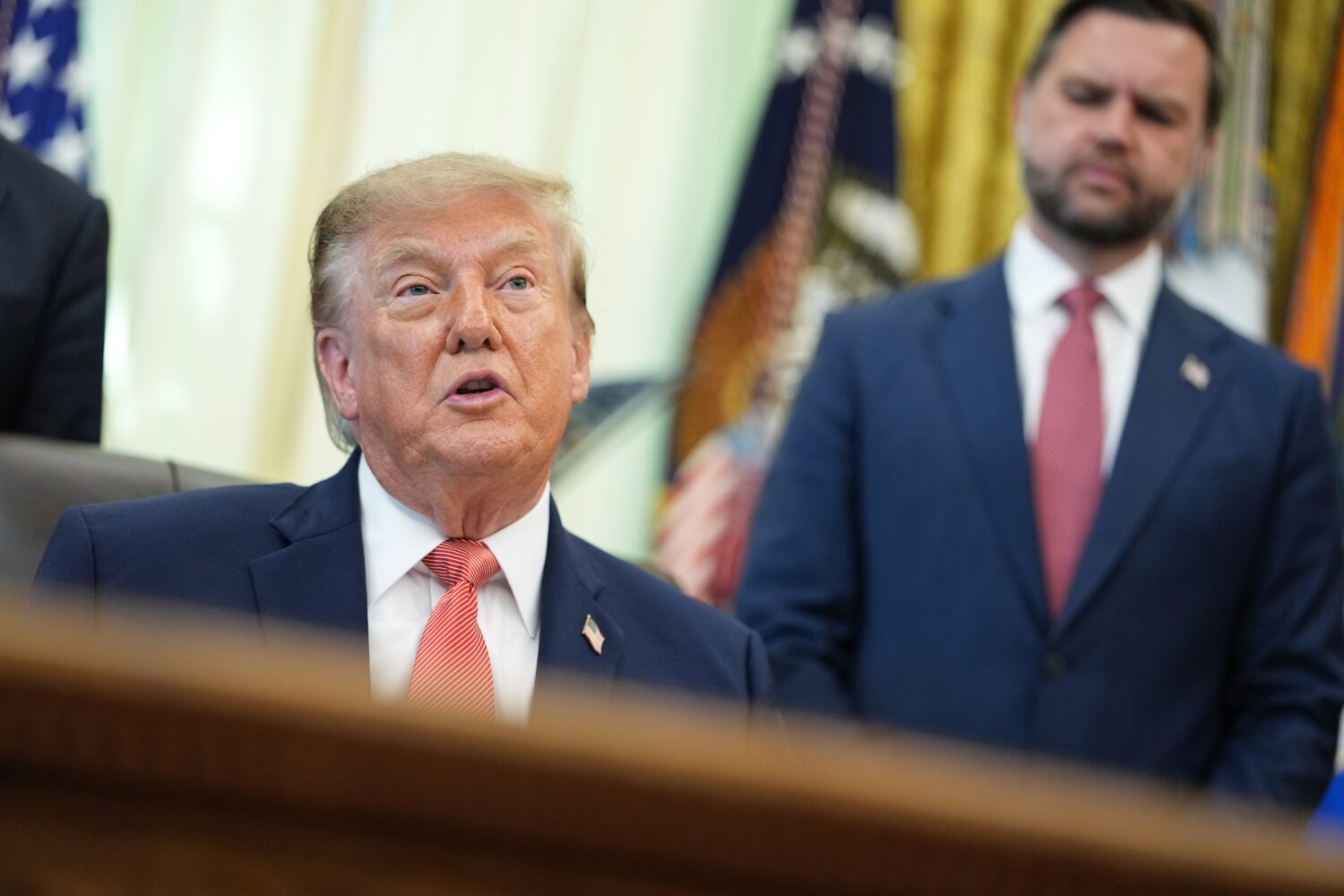
But just last month, Trump, a Republican, complicated the mission by announcing stricter controls on defense contractors sourcing critical materials from China. His executive order also curtails the Pentagon’s waiver authority should a contractor cite “non-availability” of a domestic source. It criticizes defense contractors for failing to prioritize domestic production.
“It is the policy of the United States that not only the finished equipment deployed by our military, but also the critical materials and components necessary to manufacture, maintain, sustain, and repair that equipment, are sourced domestically or from allied nations,” the July 20 order declared.
In a statement, Lockheed Martin said “we continuously assess the global rare earth supply chain to ensure access to critical materials that support our customers’ missions.” Several other major U.S. defense contractors, including Raytheon Technologies and Northrop Grumman, didn’t respond to The Associated Press’ requests for comment.
Balladon is confident that U.S. companies and partners can rise to the task. “Ultimately, with the right support and partners across the industry,” he said, “we think we can make it happen.”
___
Funk reported from Omaha, Nebraska.