Wildfire smoke kills tens of thousands of people a year. Here’s how it attacks the body
Jul 17, 2026, 6:02 AM | Updated: 7:26 am
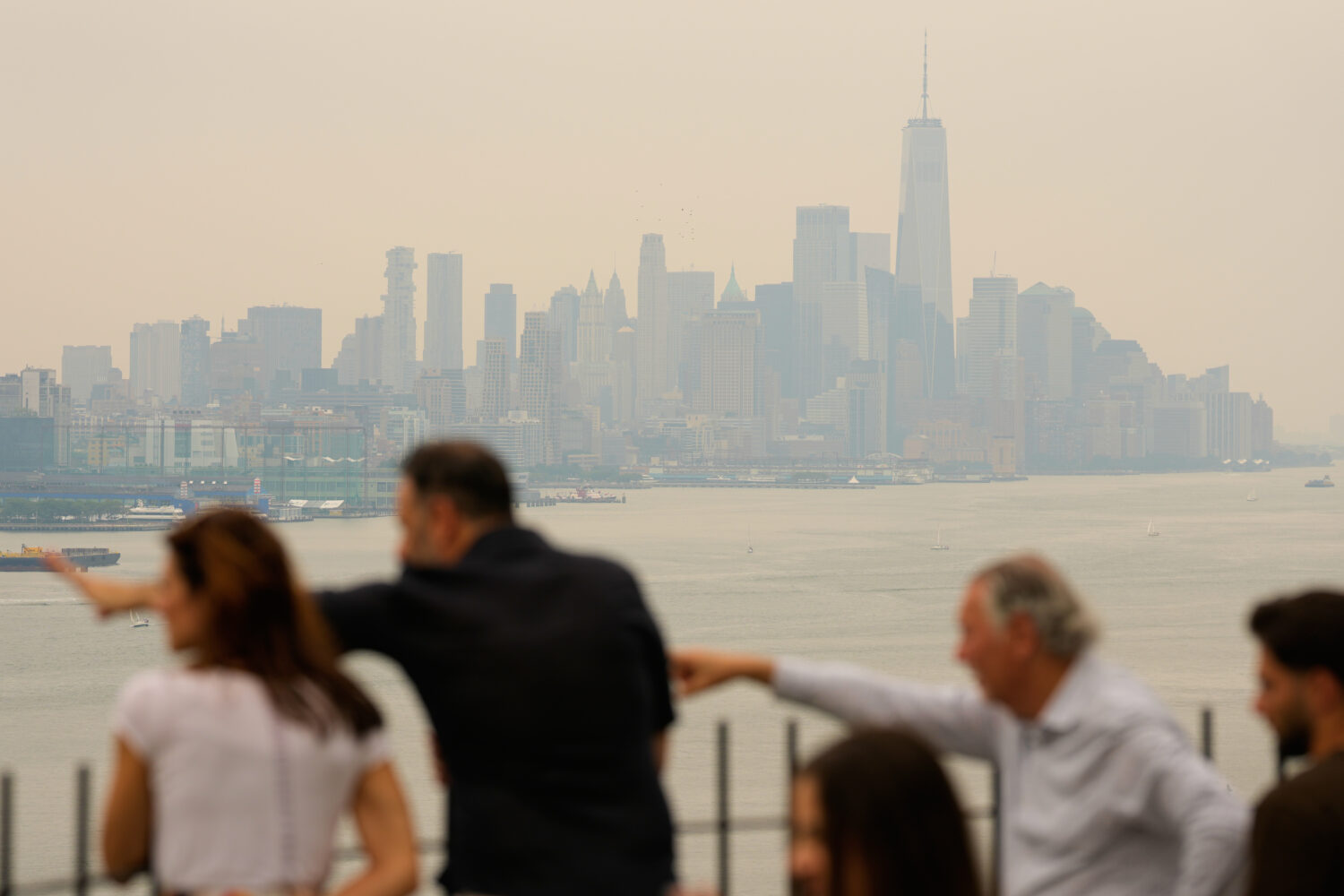
People look over the New York City skyline shrouded in smoke in Weehawken, N.J., Thursday, July 16, 2026. (AP Photo/Seth Wenig)
Credit: AP Photo/Seth Wenig
(AP Photo/Seth Wenig)

Smoke from wildfires — which are burning more of the Northern Hemisphere as Earth warms — attacks nearly every system in the human body, killing tens of thousands of people a year, numerous medical studies show.
It attacks the body immediately, spiking asthma cases with increased ambulance runs within hours, swamps emergency rooms in a day or so with people suffering from heart attacks and other cardiovascular and lung issues, as well as mental health issues, doctors and scientists told The Associated Press.
Smoke also harms pregnant women, increasing the risk of premature births and low-weight babies who could have breathing problems the rest of their lives, doctors and studies say. And then there are long-term risks connecting prolonged smoke and other air pollution exposure to some cancers and dementia.
After huge global fires in 2018 and 2019, the medical and science communities started looking at the health effects from the smoke with “more and more studies coming out finding that there’s all types of impacts that may not have been so obvious before,” said Dr. Mary Johnson, a Harvard School of Public Health environmental health scientist.
Smoke causes inflammation by triggering the body’s immune system to go into overtime to fight the irritant. Scientists have found it can harm the brain, the skin and men’s sperm, with almost no system of the body spared, Johnson said. People over 60 become more prone to stroke in wildfire smoke, she said.
“Wildfire smoke is the toxic product of combustion of whatever burned,” which could include houses and cars, said Dr. Courtney Howard, an emergency room physician, chair of the Global Climate and Health Alliance and president-elect of the Canadian Medical Association.
“So really it’s a big giant toxic soup of particles and gases.”
Scientists have counted at least 1,000 toxins in wildfire smoke, according to Colorado State University environmental toxicologist Luke Montrose.
“If I gave you a list, you would recognize some of these as being very bad, oftentimes associated with the burning of diesel fuel or cigarette smoke, things like formaldehyde or volatile organic compounds,” Montrose said. “So just the smoke itself can be bad.”
So far this year, more than 5,740 square miles (more than 14,860 square kilometers) of the United States has burned from wildfires, which is 31% more than the average of the previous 10 years on this date, according to the National Interagency Fire Center. The amount of U.S. land burned each year in the 2020s — averaged out over a decade — is now more than twice what it was 30 years ago.
Europe saw a record high amount of land burned in 2025, Canada has had several record or near-record fire years in the 2020s and the Arctic recently has had unprecedented levels of burning.
“Wildfires are becoming more frequent and intense because of climate change, and when a fire happens, you have smoke,” said Colleen Reid, a University of Colorado geographic health professor.
Most of the biggest particles in wildfire smoke fall close to where a blaze is burning, while the smallest particles — the ones that scientists say do the most damage — travel the farthest. In a typical wildfire, the nasty particles that harm human health are about the size of one micron, Reid said.
First those particles have to get by your body’s protection, mainly nose hairs and mucus, then they get into your lungs and from there the bloodstream.
Montrose said the particles can be coated in lots of chemicals and have large surface areas. That triggers the body’s defense system to “send signals to other cells that say, ‘We have a problem. We need to mount an immune response to this.’ And that’s where you get your acute effect or your effect within minutes, hours or even that day.” It’s mostly happening in the hearts and lungs, he said.
And many people die.
On average 24,100 people died each year in the Lower 48 states between 2006 and 2020 due to long-term exposure to tiny particles from wildfire smoke, according to a study this year in the journal Science Advances. A Stanford study projects that U.S. wildfire smoke deaths will increase with climate change and by midcentury hit an annual cost of $244 billion in terms of the economic value the government puts on each life.
On a global scale, wildfire smoke particles cause 677,745 deaths annually, with almost 39% of them children under age 5, according to a 2021 study that combined observations, studies on how the body responds to the particles and computer models to calculate the toll.
The biggest nonlethal effects have to do with the way people breathe, especially those with asthma.
“We did a study here in 2014 after we had about two-and-a-half months of smoke off and on, because we’re in the subarctic so we’re warming at triple the global rate, so in a way we’re kind of canaries in the coal mine of the health impacts of climate change,” Howard said on a clear day from Yellowknife, Canada. “We found a full doubling of emergency department visits for asthma and about 50% increase in pneumonia.”
“Even in individuals that don’t have asthma, the air can be so irritating that you could have difficulty with your respiratory system regardless,” Johnson said, “whether it’s coughing, whether it’s chest tightness, whether it’s sore throat, headache.”
Studies have linked smoke to people having more trouble with decision making and other cognitive issues. People come to the emergency room depressed, Howard said. That’s why it’s important to find a place with clean air — including designated shelters or libraries — to get a break from the smoke and possibly exercise, she said.
Experts suggest people wear high-quality masks when outdoors, even though they don’t provide perfect protection. Inside, check windows and doors for seals, invest in a good ventilation system and check air filters, they say.
“Staying away from the smoke is No. 1 if you can,” Johnson said.
___
The Associated Press’ climate and environmental coverage receives financial support from multiple private foundations. AP is solely responsible for all content. Find AP’s standards for working with philanthropies, a list of supporters and funded coverage areas at AP.org.