You survived ‘The Big Dark’: 5 pm sunsets are right around the corner
Jan 22, 2026, 12:00 PM | Updated: 3:05 pm

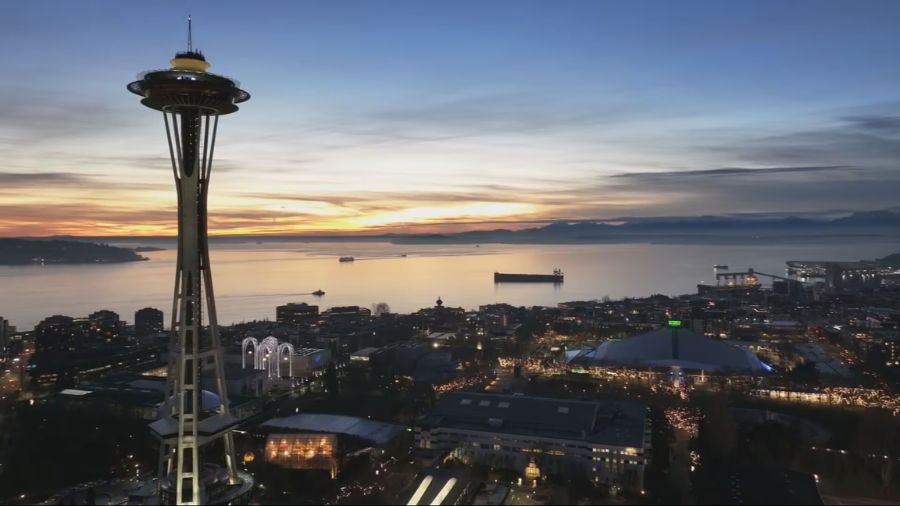
A view of the Space Needle and Olympic Mountains at sunset in February. (Photo: Michael Guio via Flickr Creative Commons)
(Photo: Michael Guio via Flickr Creative Commons)
Congratulations. If you’re in Washington and you’re reading this, you’ve survived “The Big Dark.”
What’s that, you say? It’s the 10 weeks between mid-November and late January.
RELATED STORIES


The science behind ‘The Big Dark’
In November, the light is fading fast. By the time daylight saving time ends and clocks jump back an hour, dark times will have arrived. Before we know it, the sun is setting by 4:30 p.m.
Winter is darker and colder because the northern hemisphere is tilted away from the sun.
“The Earth rotates around the sun in an elliptical orbit. And in doing so, the Earth has a 23.5-degree tilt. During our winter season, we are actually a little closer to the sun than we are during the summer,” KIRO Newsradio Meteorologist Ted Buehner explained. “But it also means our daylight hours are shorter. In fact, right around the winter solstice, we’re down to about eight hours and 20 minutes of daylight. In contrast, when we have our summer solstice, we’re right around 16 hours of daylight. So, about double what we get this time of year.”
November is also usually the rainiest month of the year, followed closely by December and January, setting northwest residents up for gloomy darkness even during the day as clouds bear down on the region and wipe out nearly any trace of the sun.
That’s The Big Dark.
But there’s hope.
Sunday, Jan. 25, will mark the first 5 p.m. sunset of the year. And it will get later every day.
“In the winter season, right around the winter solstice, we’re only gaining a few seconds. Now, here we are in the latter part of January, we’re gaining about a minute a day at this point. And that is going to accelerate to about three-and-a-half minutes when we get to March. So we’re making that momentum, gaining daylight on both the sunrise and the sunset,” Buehner said.
The first 7:30 a.m. sunrise will arrive on Feb. 5.
“So as a result, we’re starting to get more daylight on both ends of the day until summer solstice in the third week of June,” Buehner said.
Because of the springtime change, sunrises will shift back to 7:30 a.m. in March, but we’ll also get later sunsets. And by then, the days will be gaining more and more daylight.
Week-by-week look at sunrises and sunsets in Seattle
Here’s a week-by-week look at sunrise and sunset in Seattle, through the spring equinox, according to Time and Date.
Jan. 26
Sunrise: 7:42 a.m.
Sunset: 5:01 p.m.
Feb. 2
Sunrise: 7:34 a.m.
Sunset: 5:12 p.m.
Feb. 9
Sunrise: 7:24 a.m.
Sunset: 5:23 p.m.
Feb. 16
Sunrise: 7:12 a.m.
Sunset: 5:34 p.m.
Feb. 23
Sunrise: 7:00 a.m.
Sunset: 5:45 p.m.
March 2
Sunrise: 6:47 a.m.
Sunset: 5:56 p.m.
March 9 (after time change)
Sunrise: 7:33 a.m.
Sunset: 7:06 p.m.
March 16
Sunrise: 7:19 a.m.
Sunset: 7:16 p.m.
March 20 (spring equinox)
Sunrise: 7:11 a.m.
Sunset: 7:22 p.m.
Read more of Jillian Raftery’s stories here.