Gain sleep, lose sunlight: Clocks will fall back Sunday as 4 p.m. sunsets begin
Oct 31, 2025, 1:27 PM | Updated: 1:27 pm

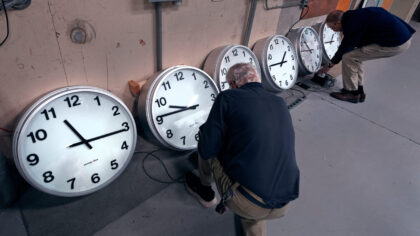
Clockmakers Rich Finn, left, and Tom Erb adjust the time zone controllers on a series of clocks that'll be installed at Paine Field in Everett, Wash., at the Electric Time Company. (File photo: Charles Krupa, AP)
(File photo: Charles Krupa, AP)

While many are looking forward to extra sleep on Sunday, others are dreading 4 p.m. sunsets.
Daylight Saving Time (DST) ends Sunday, November 2, and clocks will fall back one hour. Subsequently, 4 p.m. sunsets begin next week.
Say goodbye to 5 p.m. sunsets
The sun will set at 5:53 p.m. on Saturday and then at 4:51 p.m. on Sunday, according to Sunrise Sunset’s website.
Daylight will continue to slowly crawl back each day, with the sun setting at 4:22 p.m. on November 30.
Sunsets won’t return to 5 p.m. until January 24.
Daylight Saving Time ends
When clocks fall back on Sunday, The Associated Press recommends people get out into the morning sun to help their body’s clock reset.
Standard time resets at 2 a.m., so people will either want to set their clocks an hour back before bed or as soon as they wake up.
Clocks will then “spring forward” on March 8 and DST will return.
The American Medical Association and American Academy of Sleep Medicine, among other health organizations, have pushed for standard time year-round, according to The AP.
Research from Stanford University found switching back and forth is bad for health, as organs, the immune system, and metabolism can be disrupted.
“The best way to think about it is as if the central clock were like a conductor of an orchestra and each of the organs were a different instrument,” Jamie Zeitzer, co-director of Stanford’s Center for Sleep and Circadian Sciences, said, The AP reported.
It’s better to have more light in the morning and less at night to keep the natural rhythm, Zeitzer added.
RELATED STORIES


History of Daylight Saving Time
So why have Daylight Saving Time in the first place?
Contrary to popular belief, Benjamin Franklin didn’t invent it. The idea actually came from George Hudson, a New Zealand entomologist, in 1895. Hudson proposed the time change to give himself more daylight hours to study insects, KIRO host John Curley explained.
“He studied bugs, and he wanted more time to look at bugs during the daylight. That’s why he came up with it,” Curley said on “The John Curley Show” on KIRO Newsradio.
While DST was originally adopted to conserve energy, studies have shown it doesn’t significantly reduce energy consumption.
“It doesn’t actually do anything to save energy because people use more AC in the summer,” Curley said.
Farmers have historically opposed DST because it disrupts their schedules, particularly when it comes to feeding livestock.
“Farmers didn’t like it either, because it messed up their cows when it came to feeding time,” Curley explained.
The first widespread use of DST was during World War I by Germany, aiming to conserve fuel. The United States followed suit in 1918 under President Woodrow Wilson, but the practice was repealed after the war. It was reintroduced during World War II by President Franklin D. Roosevelt and later standardized by the Uniform Time Act of 1966 under President Lyndon B. Johnson.
“President Wilson — one of the worst — in 1918, he made it a law. Then it was repealed,” Curley said. “Then FDR relaunched it in 1942, and then LBJ made it officially the law in 196,6 and that’s why we’re stuck with daylight saving time.”
Contributing: MyNorthwest staff; The Associated Press