What is the Puget Sound Convergence Zone? Why spring weather turns wild in western WA
Apr 16, 2026, 11:39 AM

A map tracking Puget Sound Convergence Zone radar from December 26, 2025. (Photo courtesy of Emerald City Weather Blog)
(Photo courtesy of Emerald City Weather Blog)
Spring offers a unique weather feature in the Puget Sound region — the Puget Sound Convergence Zone. The Convergence Zone can occur at any time of the year, but it occurs most often in the spring.
Monday brings the Convergence Zone, with the bulk of the showers in Snohomish and northern King Counties. The weather changes Tuesday as a Pacific frontal system tracks onshore with rain spreading inland through Tuesday night. Wednesday is expected to produce another Puget Sound Convergence Zone with more showers concentrated mainly in the North Sound.
Puget Sound Convergence Zone recipe
What is the Puget Sound Convergence Zone? Imagine water in a stream flowing around a large rock. The water wraps around the rock and meets on the other side. On a grand scale, that’s what happens with westerly air flow off the Pacific Ocean, wrapping around and colliding just east of the Olympics.
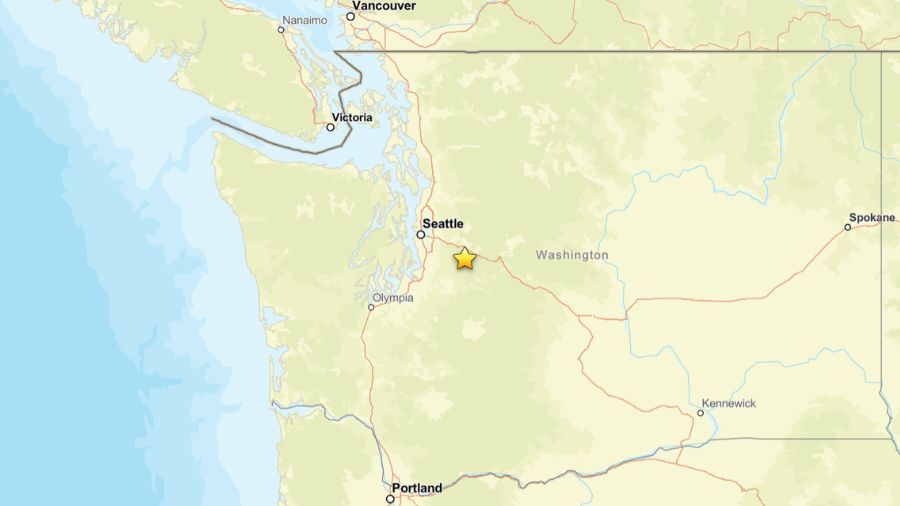
South Snohomish County is ground zero for the Convergence Zone. The westerly air flows through the Strait of Juan de Fuca and along the south side of the Olympics, wrapping around the mountains, collides, rises, and produces clouds and then rain. If it is cold enough, it can snow. Even thunderstorms can develop. With more frequent, stronger flows through the Strait of Juan de Fuca, the Convergence Zone often drifts south into King County.
RELATED STORIES

Unseasonably cool through mid-week
After Wednesday’s spring showers, the clouds are expected to part, permitting temperatures to feel more winter-like. Highs Wednesday into Friday will warm only into the 50s, about 5 degrees below average for mid-April. Lows in the usual colder areas, such as the South Sound, have the potential to dip back into the freezing range, with frost likely.
In addition, winter mountain weather is anticipated to make a brief comeback. Snow levels on Tuesday are expected to drop to near 3,000 feet, then to near 1,500 feet on Wednesday. Mountain highway crews plan to keep the roadways clear and address any snow accumulation.
Later in the week, higher pressure aloft is forecast to build over the region, warming temperatures back up to near 60 by Saturday.
Spring also tops for thunderstorms and even tornadoes
Spring is also the peak time of year for thunderstorms, particularly involving the Puget Sound Convergence Zone. One key by-product of thunderstorms is tornadoes, and spring is prime time for tornadoes in Western Washington.
Tornadoes are born from thunderstorms. The December 2018 Port Orchard F2 tornado with winds up to 110 mph was generated from a thunderstorm. A tornado is a rapidly rotating column of air touching the ground. A funnel cloud does not touch the ground. A waterspout is a tornado over water, like Puget Sound.
Washington State averages around two tornadoes per year. Some years have none. In 1997, though, a record 14 tornadoes occurred. Tornadoes can occur any time of the year, but the seasonal transition of spring and fall is when most tornadoes occur, with April and May having the greatest number of tornadoes in the state.
Most Washington tornadoes are weak and last less than two minutes. Most are F0 or F1 events with wind speeds under 110 mph.
However, Washington has suffered three F3 tornadoes since 1950, two of which occurred on the same day – April 5, 1972. Vancouver was hit by one, striking a school, a grocery store, and a bowling house, killing six and injuring more than 200. Washington led the nation in tornado deaths that year. Later that same day, another F3 tornado touched down outside of Davenport, west of Spokane.
The other F3 tornado occurred in early December 1969, starting as a waterspout off Des Moines and tracking into the Green River valley. Fortunately, there were no injuries.
Like thunderstorms with lightning, head indoors if a thunderstorm approaches. The phrase to remember is: When thunder roars, go indoors. And for tornado safety, get into an interior room without windows or, if available, a basement.
Western Washington spring weather usually offers a wide variety of conditions, from recent warm sunshine to showers, hail, thunderstorms, and even tornadoes. Remember, when you are weather-aware, you are weather-prepared.
Ted Buehner is the KIRO Newsradio meteorologist. Follow him on X and Bluesky. Read more of his stories here.