Spring brings sunshine, showers, and spectacular rainbows to the Puget Sound
Apr 9, 2025, 12:04 PM

A rainbow is seen in Seattle. (Photo: Bruce Bennett via Getty Images)
(Photo: Bruce Bennett via Getty Images)
Spring is here, bringing days filled with a mix of sunshine and showers. It’s also the peak season for the Puget Sound Convergence Zone. You’ve likely heard the term, but what does it actually mean?
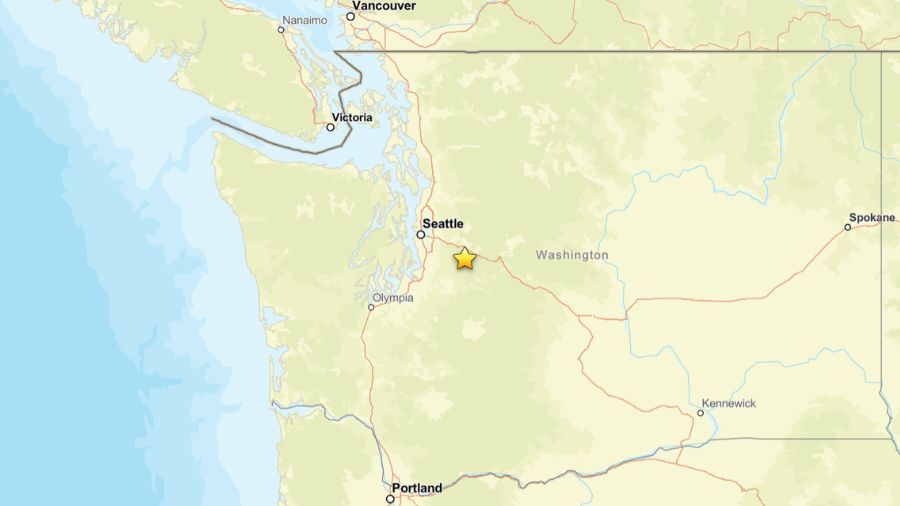
Imagine water in a stream flowing around a large rock. The water wraps around the rock and meets on the other side. On a larger scale, this is similar to what happens with westerly air flowing off the Pacific. The air flows around the Olympic Mountains and converges just east of them.
South Snohomish County is ground zero for the Puget Sound Convergence Zone. The air flows around the Olympics through the Strait of Juan de Fuca on the north side and the Chehalis Gap on the south side. As the air converges, it rises, producing clouds and often rain.
If it’s cold enough, snow can even fall—as it did on April 18, 2008, when parts of southern Snohomish County saw up to 10 inches of snow. Thunderstorms can also develop. When there’s frequent, stronger flow through the Strait of Juan de Fuca, the convergence zone can shift southward into King County.
The Puget Sound Convergence Zone can occur at any time of the year, but it happens most frequently in the spring. Ironically, areas to the north and south of the convergence zone often experience breaks in the cloud cover and periods of sunshine. For example, the San Juan Islands and Skagit County to the north and Renton to Tacoma to the south often have clear skies.
Spring marks peak rainbow season in Puget Sound
RELATED STORIES

Spring also marks the peak of the North Sound’s rainbow season. While rainbows can occur year-round, the combination of spring showers and a higher sun angle results in more frequent rainbows during this season.
Rainbows are formed when sunlight interacts with rain or water droplets suspended in the air. Sunlight enters a droplet, slowing and bending the light as it passes from air to denser water. The light reflects off the inside of each droplet, breaking into its different colors. As the light exits the droplet, it forms a rainbow.
Sunlight consists of a spectrum of colors, each with a different wavelength. Violet has the shortest wavelength and bends the most, while red has the longest wavelength and bends the least. When you see a rainbow, the light reflecting back to you, with the sun at your back, will show all the colors between violet and red, with violet on the bottom and red on top.
If you spot a rainbow, take a picture, and share it with us on MyNorthwest’s photo page.