Tease of spring weather brings pollen season, flurry of allergies
Mar 21, 2024, 6:00 AM | Updated: 6:12 am

A bee collects pollen from a lavender bush. (Photo: Leon Neal/Getty Images)
(Photo: Leon Neal/Getty Images)

Spring briefly bloomed earlier this week, meaning pollen season has made its way to cause sniffling and sinus misery across the Puget Sound region.
While pollen from grass and weeds remains absent in Washington at this point of the season, tree pollen has reached 344 pollen grains per cubic meter (P/M3) — a “high” rating from the Northwest Asthma and Allergy Center.
The number is still on the low side of the “high” rating, as pollen grains would need to surpass 600 in order to reach the center’s highest rating, “very high.” Yesterday reached 257 P/M3.
More on Seattle’s weather: Tuesday is Seattle’s last 60+ degree day in March
“Most people are experiencing an increase in their allergy symptoms, particularly those that are sensitive to spring allergens,” Preeti Sharma, M.D., a pediatric pulmonologist at the Children’s Health Medical Center in Dallas, told CBS. “It’s warm, the wind has been blowing and that just puts more allergens in the air for all of us to breathe in.”
Climate change causing more severe allergies?
Allergists with the University of Washington (UW) Medical Center in Montlake remain unsure if increasingly warmer temperatures and climate change correlate with a bad allergy season. However, they’ve stated allergy season has only gotten worse in the past couple of years.
“Overall, what we’ve seen for the past couple of years is that pollen counts have indeed been higher, and because of that some people are coming in, feeling that symptoms are worse,” Jenny Sun, M.D., a clinical assistant professor of allergy and immunology with UW Medicine’s Division of Allergy and Infectious Diseases, told KING 5.
The Washington State Department of Health (WADOH) has attributed some of the increase in pollen intensity to climate change, finding pollen season is beginning to start 20 days earlier and last for almost a month longer, compared to 30 years ago.
More on climate change affecting pollen: UW Medicine believes climate change causing longer allergy seasons
“Scientists have found that allergy seasons are getting longer and more severe,” WADOH stated. “Human-caused climate change is the ‘dominant driver’ of these longer pollen seasons and is a major reason for increasing concentrations of pollen.”
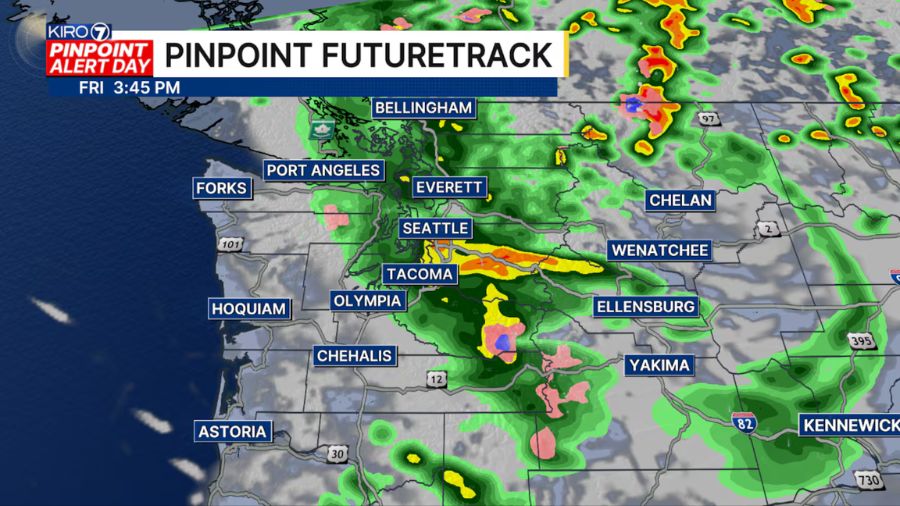
Pollen counts are expected to drop starting Friday, coinciding with at least a 50% chance of rain for five of the next seven days in Seattle. Rain reduces pollen count, according to the Northwest Asthma and Allergy Center.
To minimize allergies, The Weather Channel recommends showering after being outdoors, minimizing indoor pollen by keeping windows shut and using AC or a HEPA purifier instead and being up-to-date on all allergy relief options.
Frank Sumrall is a content editor at MyNorthwest. You can read his stories here and you can email him here.