Washington drought set to worsen as heat wave, El Niño loom over Pacific Northwest
Jul 8, 2026, 5:24 PM

A firefighter monitors flames caused by the Hughes Fire along Castaic Lake in Castaic, Calif., Jan. 22, 2025. (Photo: Jae C. Hong, The Associated Press)
(Photo: Jae C. Hong, The Associated Press)
Federal forecasters are warning the Columbia River Basin in Washington and Oregon is the most likely spot in the West to see drought intensify over the next three months.
“The deficits in places like Washington and Idaho and Oregon are still very significant,” Jason Gerlich, a Regional Drought Information Coordinator with the National Integrated Drought Information System (NIDIS), said on Wednesday. “It’s not gonna take just one prolonged rain event to move some of these states out of their drought conditions.”
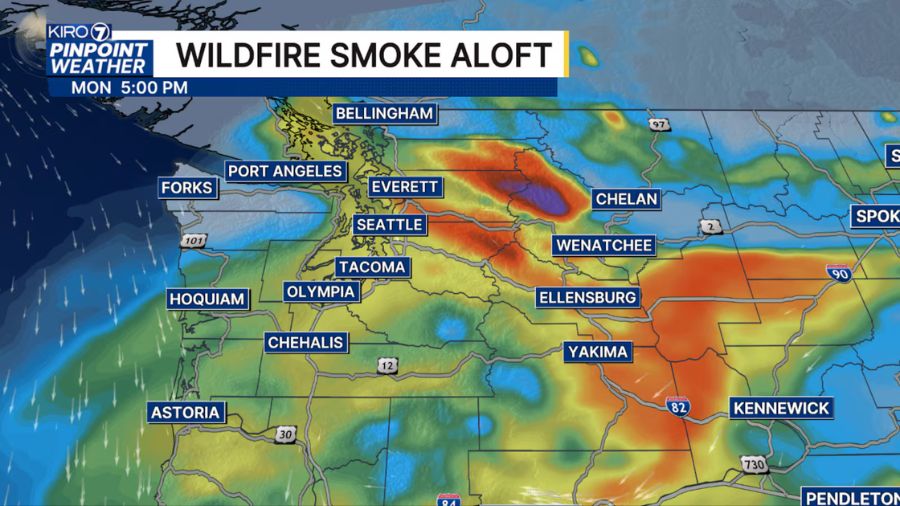
At the same time, a heat wave building over the northern Plains could push into the Pacific Northwest by late July — raising wildfire risk heading into peak fire season, federal forecasters warned Wednesday.
Fuel moisture in eastern Washington and the Oregon Cascades is tracking below normal and at times hitting record lows. Fire officials say they wouldn’t be surprised if new records are set by late July, heading into peak fire season.
Adding to the concern, the National Oceanic and Atmospheric Administration (NOAA) is forecasting an El Niño winter this year, meaning warmer and drier conditions than normal.
NOAA meteorologist Andy Hoell said that given Washington’s current drought, that outlook is bad news. The state has been in a drought for four straight years, and forecasters say it will take multiple wet winters to dig out.
“Recovery from this drought would probably take several years,” Hoell said Wednesday. “It would be great if we could start immediately for that. Unfortunately, El Niño tends not to lead to that widespread recovery.”
Dry conditions and rising wildfire threat
The latest summer seasonal weather outlook continues to reflect good odds of warmer-than-average temperatures and below-average precipitation during the usually driest time of the year.
This combination of warmer summer weather and ongoing dry conditions means the region is ripe for wildfires. The warmer temperatures are going to simply amplify the wildfire potential this summer.
Much of the interior of western Washington already has outdoor burn bans in place into September. For the latest on outdoor burning in your area, visit your local fire district website.
Eastern Washington has already had over two dozen wildfires.
Soon, much of the rest of western Washington will likely experience more fires. Smaller fuels like unirrigated grasses and shrubs are dry and ready to ignite if prompted.
NOAA confirmed El Niño last month
Last month, the U.S. National Oceanic and Atmospheric Administration officially confirmed the existence of El Niño, which is a warming of the Pacific near the equator that affects weather patterns across the globe. NOAA’s announcement said there’s a 63% chance that the El Niño will get so intense this late fall and early winter that it “would rank among the largest El Niño events in the historical record going back to 1950.”
The warm, deep waters of an El Niño affect weather patterns by bringing “a lot of extra heat to the surface, fueling a lot of extreme events for a lot of places around the world,” Clark University climate scientist Abby Frazier said.
She said, especially in the Pacific, “it can get dire very quickly.”
United Nations Secretary-General António Guterres described El Niño as an “urgent climate warning,” according to The Associated Press.
“El Niño conditions will pour fuel on the fire of a warming world,” Guterres said in a video message.
RELATED STORIES
El Niño’s impacts spawn winners and losers
The weather pattern’s effects vary by region. El Niño often dampens, but doesn’t eliminate, Atlantic hurricane season activity, but increases it in the Pacific. So, while the U.S. East and Gulf coasts may get a break, Hawaii and other islands are more in danger, Frazier said.
The drought-stricken Middle East could benefit, climate scientists said. Other places are looking at more danger. Parts of western South America — where the first El Niños were noticed decades ago — often get heavy rain and floods, along with an extra warm summer. India faces more intense heat waves, while drought, wildfires, and heat threaten Australia.
Northeastern Africa is likely going to get weather whiplash from intense drought to dangerously heavy rains, said Columbia University climate scientist and El Niño expert Muhammad Azhar Ehsan.
In the U.S., El Niños can cause more intense storms with heavier rainfall in the south, but they also tend to generally benefit the U.S. agriculture industry, said Jon Gottschalck, operational branch chief at NOAA’s Climate Prediction Center.
Michael Ferrari, meteorologist and head of research at the investment research firm Moby, said conditions for grains and seed, especially soybeans, look favorable in 18 major growing states, but are more mixed when it comes to dairy and cattle.
The northern Rockies and Southwest, where there’s an “off-the-charts” snow drought, could get some strong summer rains, Gottschalck said. The biggest effect in the U.S. is often in the winter, when the south can get wetter and the Pacific Northwest warmer and drier.
But overall, temperatures raised by the weather pattern can dampen American economic growth, Stanford climate economist Marshall Burke said. Several climate scientists forecast that 2027 will be the hottest year on record because of the lagging effects of this El Niño, which is expected to peak in the fall or winter.
“We have pretty clear evidence that the U.S. economy grows more slowly when temps are above normal,” Burke said.
Contributing: The Associated Press; Frank Lenzi and Ted Buehner, KIRO Newsradio