Will a ‘Heat Dome’ be part of the upcoming Seattle summer?
Apr 23, 2024, 11:45 AM | Updated: Apr 24, 2024, 7:17 am

Patrons enjoy Lake Ballinger Park in Mountlake Terrace close to sunset on Sunday, April 14, 2024. (Photo: Steve Coogan, MyNorthwest)
(Photo: Steve Coogan, MyNorthwest)
The latest seasonal weather outlook from the National Weather Service’s Climate Prediction Center was recently released. What does the rest of this spring and summer look like? Could there be another “heat dome” episode?
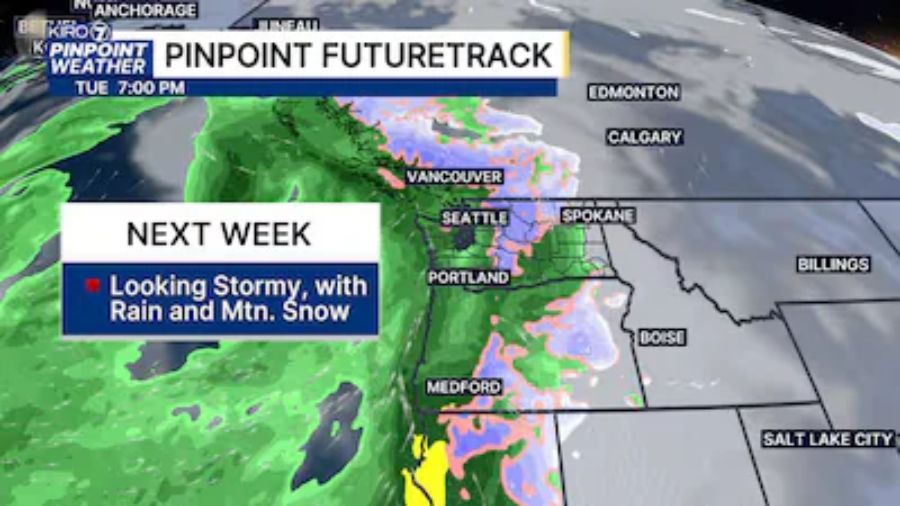
The weather outlook continues to be stacked in favor of warmer-than-average temperatures and tipped toward drier than normal through September. That does not mean there will not be any cooler or wet periods such as is anticipated for the rest of this month into early May, but in the long run, the probabilities support overall warmer and drier conditions.
The chance of having a heat dome like the one in late June 2021 with 100-degree days is quite slim. Yet, recent years have had a number of 90 degree or warmer days and this summer may do the same.
More Ted Buehner: Puget Sound Convergence Zone brings sunshine, showers, rainbows
The El Niño climate pattern from this past winter has moderated. To refresh, El Niño is when the sea surface temperatures in the tropical Eastern Pacific Ocean – the waters west of Peru – are warmer than average. La Nina is when those same waters are cooler than average. In between, when those sea surface temperatures are close to average, that is called neutral conditions, and where those tropical waters are at this moment.
Longer range guidance on where those Eastern Pacific tropical waters are trending is back to another La Niña for this coming winter season. During La Niña winters, the North Pacific storm track spends more time at our latitude, resulting in a cooler and wetter winter season that also translates to a healthy mountain snowpack. El Niño winters usually result in a warmer than average winter and a less than average mountain snowpack – exactly what unfolded this past winter.
These climate patterns usually have the greatest impact on the world’s weather patterns, primarily during the winter or cold seasons, and little impact during the summer seasons. Yet as the planet continues to warm both in the air and in the oceans, these climate patterns may be having a greater impact during the warm seasons.
Our warming planet has been witnessing more amplitude in weather patterns in recent decades. An analogy would be a roller-coaster simulating the Jetstream that drives the storm track. If the roller-coaster is steeper going up and then over the hump, the Jetstream has had more of these kinds of higher amplitude events during recent summers globally, resulting in more heat waves. On occasion, this weather pattern ‘cuts off’, resulting in a ‘heat dome’.
10 years later: Ted Buehner recalls Oso landslide sweeping everything in its path
The “heat dome” in late June 2021 was such a ‘cut off’ weather pattern, producing building excessive heat before it broke down. Temperatures in the region have reached never-before-been highs, well above 100 degrees for several days. That event occurred following the first of three back-to-back years of La Niña winters.
Again, ‘heat domes’ like that one in 2021 are quite rare and unlikely to occur again in this region. Yet, it can no longer be ruled out.
Thanks to this past winter’s El Niño, the region has fallen below average on rainfall so far this year, and the mountain snowpack finished the winter season well below normal. With the current weather outlook of warmer and drier conditions into September, the State Department of Ecology declared a drought emergency for much of the state last week. Water supply for agriculture, power generation, fish, domestic consumption, and other uses will be a concern through the summer.
The anticipated warmer and drier conditions also point to a likely extended wildfire season, starting earlier than usual and ending later. Wildfires also point to the potential of wildfire smoke and air quality concerns. Just this past weekend, a pair of wildfires occurred in Western Washington, demonstrating how dry conditions have become.
Will there be another “heat dome” like the one in late June 2021? Most likely, no – yet, the odds on periods of excessive heat with temperatures at least in the 90s look favorable, and with the heat, a greater likelihood of wildfires and related smoke.
Now is the time to prepare for whatever unfolds heading into this summer.
Ted Buehner is the KIRO Newsradio meteorologist. You can read more of Ted’s stories here and follow him on X, formerly known as Twitter.