Blink and you’ll miss it: Sunday’s winter solstice marks shortest day of the year
Dec 19, 2025, 5:00 AM | Updated: 3:43 pm

A hoar frost clings to trees as the sunsets over fields. (Photo: Christopher Furlong, Getty Images)
(Photo: Christopher Furlong, Getty Images)
The winter solstice is this weekend, on Sunday, December 21, at 7:03 a.m. Pacific Time, initiating the start of astronomical winter.
Sunrise will be at 7:55 a.m. and sunset at 4:18 p.m., for a total of 8 hours and 23 minutes, marking the shortest day of the year.
When the sun is out, the day also features the longest shadows of the year since the peak sun angle above the horizon is at its lowest point, only about 19.7 degrees above the horizon. The winter solstice also marks the longest night of the year.
What is the winter solstice?
The winter solstice is the moment when the sun is centered over the Tropic of Capricorn in the Southern Hemisphere at 23.5 degrees south, thanks to the tilt of the Earth as it rotates around the sun throughout the year.
In contrast, in the Southern Hemisphere, the day is their longest time period of daylight, just like our summer solstice in mid-June. Also of interest, those above the Arctic Circle will have no daylight at all on the winter solstice, as well as several days on either side of the solstice.
From a weather perspective, the seasons lag the winter and summer solstices since it takes time for the sun to warm the Earth’s surface, ground, and water. So, western Washington’s historical coldest month of the year is January, even as daylight hours start to increase. The same goes for July as our warmest month of the year, even as hours of daylight begin to shrink following the summer solstice in mid-June, with 16 hours and 2 minutes of daylight.
Looking at world history
The winter solstice has quite a history over the centuries. Early humans tracked the days by observing the sun as it cast shadows at different times of the year. Historians believe Stonehenge in England during the Stone Age was built to keep track of the sun’s annual progress across the sky.
Many countries around the world have celebrated the solstice over time, including Scandinavia, Albania, India, England and Ireland, Europe, Iran, Japan, the Romans, and other parts of Eastern Asia, while in the Southern Hemisphere, many celebrate their summer solstice.
Winter weather outlook
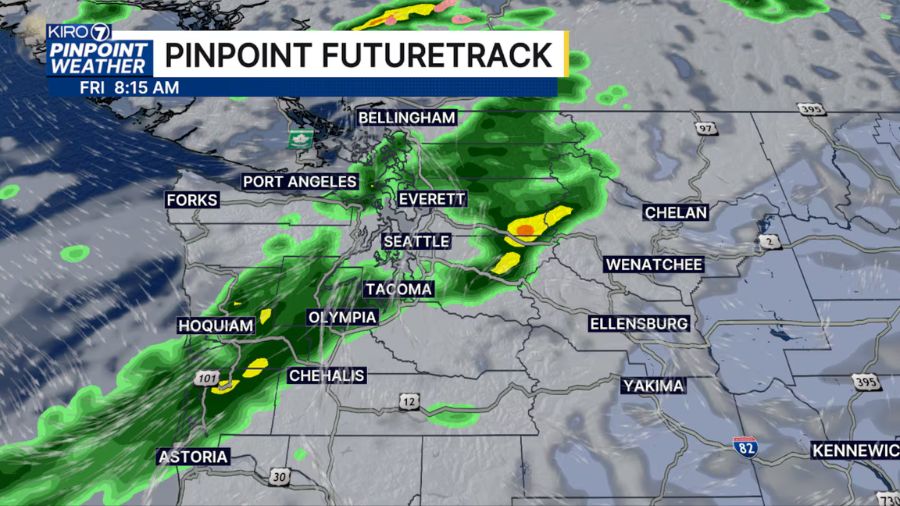
This period of warm, wet weather with periods of heavy rainfall, high snow levels, flooding, landslides, and strong winds will come to an end by this weekend. After the first day of winter, the region’s weather will feel more winterlike.
The weather outlook heading into the new year reflects cooler and wetter than average conditions, a typical La Niña-type weather pattern. This outlook means rainfall in the lowlands and snow in the mountains.
Starting Friday, December 19, mountain snow levels will drop below the passes, permitting snow to pile up. Moving into early next week, at least several feet of new snow is forecast to fall. It is quite possible that by Christmas Day, several ski areas will have enough snow to open up.
Snow on Christmas?
Many would like to see some snow in their backyards for Christmas. Historically, there is only about a 5% chance of snow on the ground on Christmas Day in the Seattle area.
If current longer-range forecast guidance is on track, cooler air from the interior of western Canada is forecast to slide south into western Washington. This weather pattern would cool the existing air mass enough to bring snow levels lower, including the foothills. Areas closer to the Canadian border, like Bellingham, would also have a better chance.
RELATED STORIES

Longer days coming
After the winter solstice on December 21, daylight hours will begin to grow longer, at first slowly as a matter of seconds, and then by the spring equinox in March, peaking at around three and a half minutes per day. The increase of daylight will then gradually slow, ending on the summer solstice in mid-June with just over 16 hours of daylight.
As I often joked just after the winter solstice when working at the National Weather Service, summer is coming!
Ted Buehner is the KIRO Newsradio meteorologist. Follow him on X and Bluesky. Read more of his stories here.