From bombs to glass: Hanford site can now transform nuclear waste
Oct 2, 2025, 11:29 AM
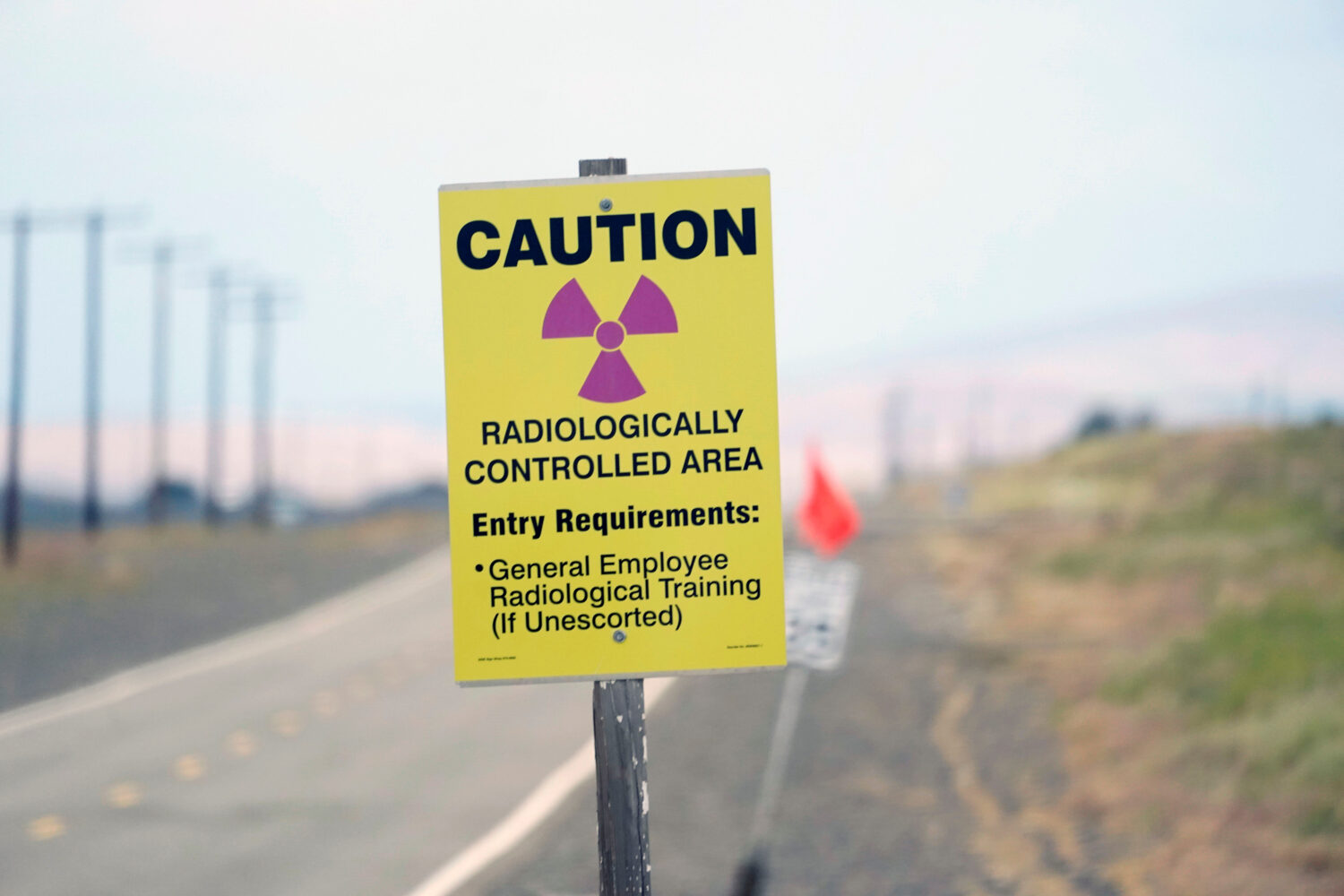
FILE - A caution sign is shown on a road on the Hanford Nuclear Reservation on June 2, 2022, in Richland, Wash. (AP Photo/Ted S. Warren, File)
Credit: ASSOCIATED PRESS
(AP Photo/Ted S. Warren, File)

SEATTLE (AP) — For much of the 20th century, a sprawling complex in the desert of southeastern Washington state turned out most of the plutonium used in the nation’s nuclear arsenal, from the first atomic bomb to the arms race that fueled the Cold War.
Now, after decades of planning and billions of dollars of investment, the site is turning liquid nuclear and chemical waste at the Hanford Nuclear Reservation into a much safer substance: glass.
State regulators on Wednesday issued the final permit Hanford needed for workers to remove more waste from often-leaky underground tanks, mix it in a crucible with additives, and heat it above 2,000 degrees Fahrenheit (1,000 Celsius). The mixture then cools in stainless steel vats and solidifies into glass — still radioactive, but far more stable to keep in storage, and less likely to seep into the soil or the nearby Columbia River.
The long-awaited development is a key step in cleaning up the nation’s most polluted nuclear waste site. Construction on the Hanford Waste Treatment and Immobilization Plant began in 2002.
“We are at the precipice of a really significant moment in Hanford’s history,” said Casey Sixkiller, director of the Washington State Department of Ecology, in a video interview.
The roughly 600-square-mile (1500-square-km) reservation is near the confluence of two of the Pacific Northwest’s most significant rivers, the Snake and the Columbia, in an area important to Native American tribes for millennia.
Wartime planners selected the area because it was isolated and had access to cold water and hydroelectric power. In early 1943, the U.S. government seized the land for a secret project, displacing roughly 2,000 residents, including farmers.
Tens of thousands of workers then responded to newspaper ads around the country promising good jobs to support the Allied effort to defeat Nazi Germany and Japan in World War II, and a new company town arose in the desert.
Most of the workers had no idea they were involved in building the world’s first full-scale plutonium production reactor until the U.S. dropped nuclear bombs on Hiroshima and Nagasaki in August 1945, and President Harry S. Truman announced the existence of the Manhattan Project to the world.
Hanford would grow to include nine nuclear reactors churning out plutonium for the nation’s nuclear arsenal. The last of these was shut down in 1987. Two years later, Washington state, the U.S. Department of Energy and the U.S. Environmental Protection Agency reached an agreement to clean up the site.
Seven of the nine reactors have been “cocooned” to prevent contamination from escaping until radiation levels drop enough to allow for dismantling, near the end of the century.
There are also 177 giant underground tanks that hold some 56 million gallons (212 million liters) of highly radioactive and chemically hazardous waste. Those tanks are well past their projected lifespan of 25 years. More than one-third have leaked in the past, and three are currently leaking.
During its years producing plutonium for nuclear weapons, Hanford dumped effluent directly into the Columbia River and into ineffective containment ponds, polluting the surrounding groundwater and contaminating the food chain of wildlife that depends on it, according to a 2013 government assessment.
Now Hanford is focused on cleanup, with an annual budget of around $3 billion.
Encasing radioactive waste in glass — called “vitrification” — has been recognized since at least the 1980s as an effective method for neutralizing it. There are plans for two facilities at Hanford: the one now approved to process low-level nuclear waste after repeated delays, and an adjacent facility for the high-level waste that remains under construction.
More than $30 billion has been spent on the plants so far. The U.S. Department of Energy, which oversees Hanford, has faced an Oct. 15 deadline to have turned some of its stored waste into glass, per a cleanup schedule and consent decree involving the EPA and Washington state.
The first waste to be mixed with glass will include pretreated radioactive cesium and strontium, according to a statement from the Department of Energy.
The Energy Department fired Roger Jarrell, its main overseer of the Hanford cleanup, earlier this month, prompting concerns about the Trump administration’s commitment. Democratic Sen. Patty Murray said Energy Secretary Chris Wright told her by phone that he was looking to stall the vitrification operations.
That prompted outrage from Washington state officials. Gov. Bob Ferguson, joined at a news conference by tribal leaders and labor representatives, threatened legal action.
But Wright insisted the department had changed nothing, and on Sept. 17, a deputy signed paperwork allowing vitrification to proceed following approvals by state regulators.
“Although there are challenges, we are committed to beginning operations by October 15, 2025,” Wright said in a statement last month. “As always, we are prioritizing the health and safety of both the workforce and the community as we work to meet our nation’s need to safely and efficiently dispose of nuclear waste.”
On Wednesday, with state approval issued, Ferguson urged the Energy Department to follow through.
“Our state has done our part to start up the Waste Treatment Plant,” said Ferguson, in a statement. “Now the federal government needs to live up to its responsibilities and clean up what they left behind.”
In a statement ahead of the government shutdown, Department of Energy said it would be able to continue all of its operations for one to five days. After that, the department’s work will cease unless operations are “related to the safety of human life and the protection of property.”